











 Continue with Google

 Share on media
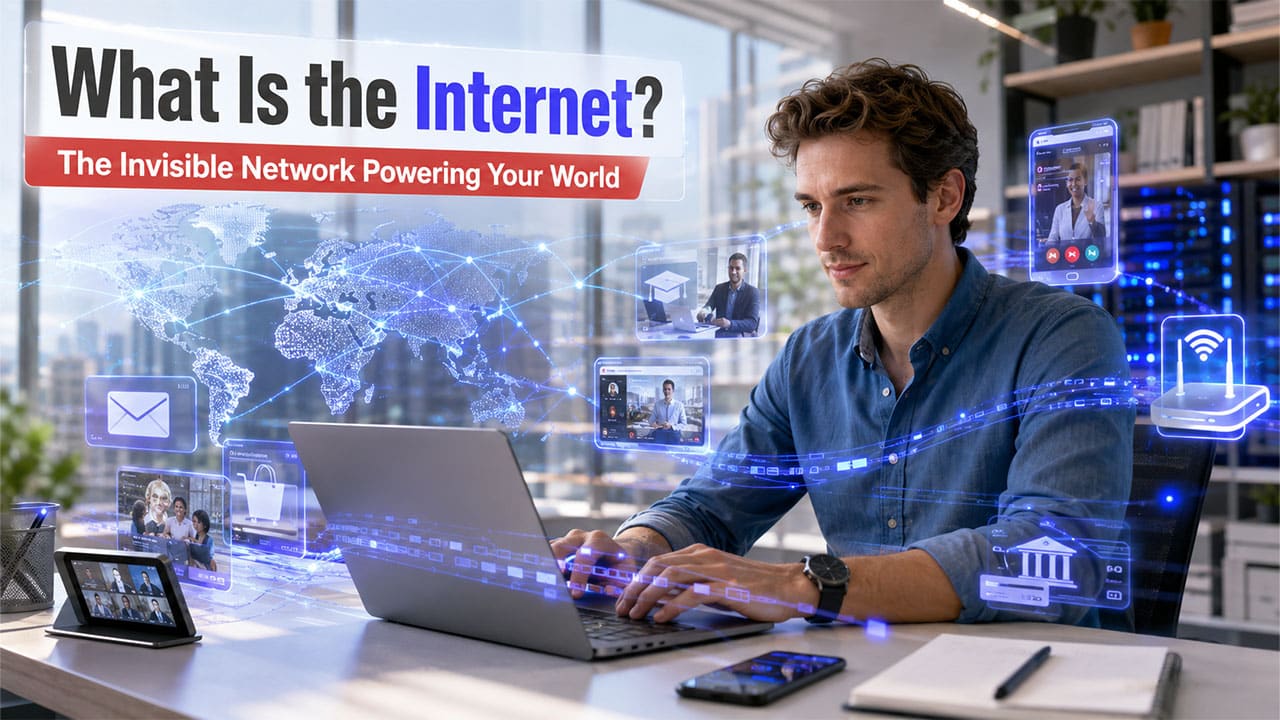
Think about your day today. You must have started off your day with checking your smartphone, messaging a friend, searching for something on the Internet, without even noticing the fact. This is how the internet seamlessly integrates itself into everything we do.
Now comes the question – what exactly is the internet? In layman’s terms, the internet can be defined as the global system of interconnected computer networks through which data can be exchanged instantly, regardless of distance.
In the blog post, we will discuss in brief the internet definition, internet history, how the internet works, and the various uses of the internet, using simple language that anyone can understand.
What is the Internet?
To understand what the Internet is, let’s start with a simple term- a network. A network is just a group of connected computers that send data to each other, kind of like a friend circle that’s always in touch and sharing updates.
The internet is basically a massive collection of these networks, all linked together – which is actually where the name comes from: Interconnected networks.
Because networks connect to other networks, a computer on one side of the world can talk to one side of the world can talk to one on the other side in seconds. This is what makes instant communication across the globe possible.
All this happens through wires, cables, and radio waves that carry data as tiny pulses of light or electricity called “bits.” The more bits that can travel at once, the faster the internet feels.
How Does the Internet Work?

Two core ideas explain how does the internet work – packets and protocols.
Packets
A Packet is a small piece of larger message, carrying both data and a “header” that tells the receiving device what to do with furniture you assemble at home.
When you send something online, it’s broken into smaller packets, converted into bits, and routed through devices like routers and switches. Once they reach their destination, they’re reassembled in order.
It’s a bit like how the Statue of Liberty was built in France, shipped to the US in pieces, and reassembled on-site, except packets do this in milliseconds, letting a photo travel across the world and load almost instantly.
This works through packet switching, where routers handle packets independently so no single connection hogs the network. Without it, only a couple of people could use the internet at once instead of millions today.
Protocols
Getting different computers and software to understand each other needed a shared language; that’s where protocols come in. A protocol is a standardized way of formatting data so that any device can understand it.
Common examples include Ethernet (within a network), IP (across networks), TCP (ensuring packets arrive correctly), and HTTP (formatting data for websites). There are also protocols for routing, testing, and encryption, with alternatives like UDP used for things like video streaming.
Because every device follows these shared protocols, the internet works the same way no matter who or what connects to it.
History of the Internet
The internet has an earlier history than what most people know; it was initially a research project that later evolved into the device we use every day. The brief history of the development of the internet is presented below:
1960s: The beginning of the process was marked by ARPANET, a project funded by the U.S. Department of Defense that aimed at linking computers from different locations for research.
1970s: Development of key protocols that enabled interconnection between different networks – TCP/IP. It became an essential stage for the further development of the internet as we know it.
1980s: Adoption of TCP/IP by many other networks and use of the term “Internet”.
1990s: The invention of the World Wide Web provided access to the internet for common users via browsers and websites.
2000s: Replacing dial-up connections with broadband, development of internet speeds, emergence of social media networks.
2010 and after: Emergence of mobile internet and the smartphone era.
The history demonstrates how fast technological innovations can transform our lives.
What Physical Infrastructures Does the Internet Depend Upon?
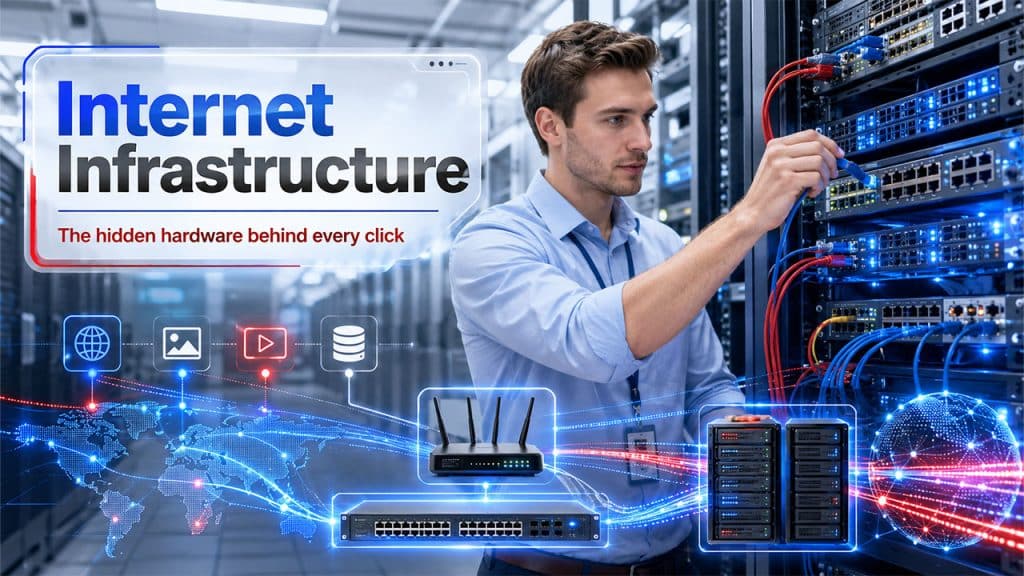
Every time you click on something online, it is the physical infrastructure working in the background that makes things possible. The following list presents some important components of this structure:
Routers are the equipment responsible for directing packets to particular networks depending on their destination.
Switches connect devices belonging to the same network through the use of packet switching by routing every packet to the appropriate destination and forwarding information to its next destination.
Web servers are the powerful machines where all the web content, such as websites, pictures, and videos are stored. Also, these servers run applications, databases, and manage tasks such as DNS queries. Web servers can mostly be found in large data centers worldwide.
Types of Internet Connections
Internet connections vary widely, and each kind has its advantages and disadvantages. Here are the most widely used types of connections:
Dial-up
One of the first forms of internet access technology that required a phone line to go online. This connection type is incredibly slow and blocks phone communication when connected to the internet, which is why it is practically obsolete.
DSL
Also uses telephone lines; however, it does not interface with voice communications. Faster than dial-up, this type of internet connection was very common in households for many years before being outmoded by even faster connection types.
Fiber optic
Currently, fiber optic is considered to be the fastest connection type. It sends information in the form of light pulses through special glass pipes and offers high speed and low latency, which makes it perfect for watching videos, gaming, and transferring big files.
Cable broadband
This form relies on the same infrastructure used by cable TV, making use of coaxial wires running along your street. It delivers good performance speeds and is generally easy to access in most cities and towns, although speed may become slightly reduced during times of peak network utilization since everyone in the neighborhood utilizes the same connection.
Mobile Internet
This is the internet you get on your phone through cellular networks like 4G and 5G. The advantage of mobile internet lies in its availability wherever there is cellular network coverage.
Satellite Internet
Satellite internet is delivered via satellites orbiting the Earth, thus making it particularly suitable in rural and remote areas. Although it is slower than fiber and cable internet, it is crucial for delivering internet in places without any other options.
Common Uses of the Internet

The internet is entrenched in nearly every aspect of our lives, but its uses go far beyond just web surfing or communicating with others. The following list provides an overview of the most popular uses of the internet:
Communication
Thanks to numerous services, it has never been easier to stay in touch with anyone from around the world using only an internet connection.
Education
Learning about virtually any topic has become possible thanks to various online courses and lessons that do not require attending physical classes.
Entertainment
Entertainment can be done through watching movies and series, listening to music, playing video games or using social media – all of these uses depend on the internet.
Banking
From checking one’s balance to making money transfers, banking has greatly benefited from the internet, making it convenient and accessible.
Business and Remote Work
Business and collaboration have become reliant on the internet, allowing employees from all over the world to work remotely.
Email Communication
Another example of the evolution of online communication methods is email, which still represents one of the oldest means to communicate on the internet. With email, people can exchange messages and documents right away, regardless of the distance that separates them.
For a better understanding of how email works, visit What is Email.
Content Creation and AI Tools
In addition, the internet helped to transform the way of creating content, allowing users to leverage the help of AI tools that facilitate the writing process and increase its productivity. These tools can be helpful in brainstorming and editing the written pieces, among other stages. Read more about it in our guide on AI Writing Assistant.
Software and Technical Documentation
Finally, the internet has changed the process of creating business technical content, such as user manuals and product guides, in companies. Certain software solutions make the process easier and help to organize all the information.
Discover the features of the best technical documentation software in our guide.
Benefits of the Internet
- Instant availability of information: Get answers, updates, and information about anything instantly.
- Easy communications: Keep in touch with your loved ones and workmates no matter where they are via messages, calls, and video calls.
- Educational benefits: Online learning is available for acquiring skills on your own terms.
- Advantage in career and business: Have the opportunity to work remotely, target a wider audience, and conduct business online.
- Availability of entertainment: Watch movies and TV shows anytime you like without adhering to any timetable.
Disadvantages of using the Internet
- Privacy and security threats: Privacy of personal information may be compromised due to hacking, fraud, and poor security.
- Information overload: Given the amount of information available, distinguishing between right and wrong becomes very tough.
- Overuse and addiction: Increased exposure to screens can harm the concentration levels and sleep quality of individuals.
- Internet dependency: Several tasks require an active Internet connection and hence create dependence on the same.
- Misinformation: Fake news spreads like wildfire at times, even quicker than real facts.
Conclusion
The internet definition probably feels a lot clearer now than it did at the start. What began as a way to connect a few computers has grown into something that touches almost every part of our daily lives.
We’ve covered what the internet is and looked briefly at the history of the internet, and broken down how does the internet work through packets, protocols, and the infrastructure behind it. We’ve also walked through its common uses, along with the benefits and downsides that come with staying this connected.
At the end, the internet is just a tool – a powerful one. Used mindfully, it brings information, opportunity, and connection right to our fingertips.
Frequently Asked Questions
What is the internet definition in simple words?
The internet is a massive network that connects computers and devices across the world, allowing them to share information and communicate instantly, regardless of distance.
How does the internet work?
The internet works by breaking data into small packets, sending them through routers and switches using standardized protocols, and reassembling them at the destination — all within milliseconds.
Who invented the Internet?
The internet wasn’t invented by a single person. It evolved from ARPANET, a U.S. government-funded research project in the 1960s, with many scientists and engineers contributing to its development over time.
What is the difference between the Internet and the World Wide Web?
The internet is the underlying network that connects devices, while the World Wide Web is just one service that runs on it — specifically, the websites and pages you access through a browser.
What are the main benefits of using the internet?
The internet offers instant access to information, easier communication, online learning opportunities, convenient shopping and banking, and the ability to work or run a business remotely.