











 Continue with Google

 Share on media

You did not get the job offer, project, or meeting you wanted. It is disappointing, no doubt. However, what you do next could impact the future. Instead of closing the door, what if you could leave it cracked open for future opportunity?
This is where a well-thought-out “Thank you for your consideration” comes in. Responding graciously to rejection is not just about being polite; it is a powerful way to demonstrate professionalism, resilience, and interest in the future. However, many people do not know what to say in each circumstance. In a world that often moves on too quickly, showing gratitude can help you meaningfully stand out and gives you an opportunity to convert a “no” today into a “yes” tomorrow. Take the time to send a thank-you email, and you could bring a smile to somebody’s face.
This guide will explore the ways of writing a perfect “Thank you for your consideration” email and how to show appreciation to make people feel valued.
Understanding What “Thank You for Your Consideration” Really Means
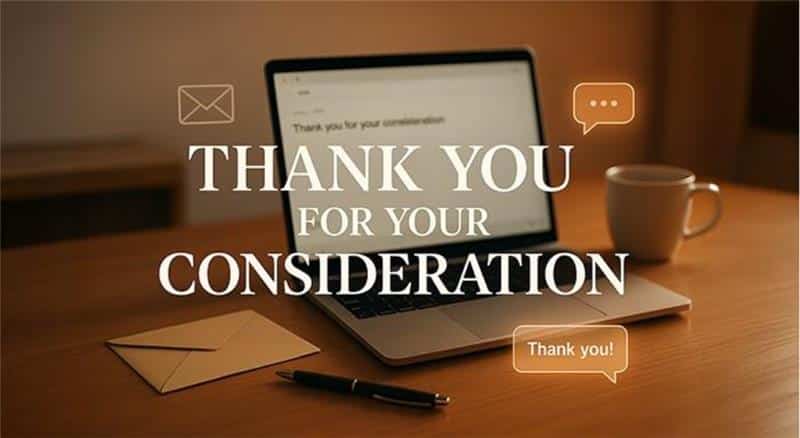
“Thank you for your consideration” email is a beautiful thought. There can be many scenarios where you might want to send a “thank you” email. In each case, the purpose of the thank-you email is the same; you are expressing gratitude to others. In today’s digital age, using an AI Email Writer can also help you quickly craft professional and well-structured thank-you messages without losing a personal touch.
These emails are a key part of your business communication, enhancing relationships and expanding opportunities. Just imagine getting a simple “thank you for your time and consideration” email back from your provider or a teammate; it’s enough to immediately make your day. And it will definitely motivate you to continue to consider using their services or to reconnect with them to catch up on the teamwork.
Nonetheless, the words you select as well as the writing tone can also affect how your audience receives the message. There are hundreds of ways to express appreciation, but what words should you use? Let’s explore that in detail.
The words you select as well as the writing tone can also affect how your audience receives your message. This is especially important in digital communication, where abbreviations and informal expressions can sometimes have different meanings depending on the context. For example, understanding wyf meaning can help you recognize how the same abbreviation may be interpreted differently in casual conversations. There are hundreds of ways to express appreciation, but what words should you use? Let’s explore that in detail.
7 Situations to Send a “Thank You for Your Consideration” Email
We all know how important it is to say “thank you” in professional contexts; however, did you know there are less obvious situations where a “thank you for your consideration” email can really make a difference? These gems can help you stand out from the crowd, deepen relationships, and become a declaration of your professionalism in ways you may not expect.
1. When You Didn’t Get the Job (Rejection Follow-Up)
Send a thank you for not selecting me? I know it sounds strange, but doing a follow-up email after the interview in this way really sticks with people and creates a positive lasting impression.
When to use it: After receiving confirmation you weren’t selected for a job, project, or opportunity you interviewed or applied for.
Why It’s Effective:
- It conveys a sense of grace and professionalism in the face of disappointing news.
- It provides an opportunity to keep the door open for other future possibilities.
- It demonstrates an ability to handle bad news and/or disappointment in a positive manner.
Template to use:
{{Your Name}}
2. When You’ve Caused a Delay (Thank You for Your Patience)
It can be useful in situations where things don’t go as expected. Whenever you have caused an inconvenience and delay for someone else, starting with a statement of thanks can go a long way to maintaining a relationship with that person.
When does this situation apply? After you have resolved a situation that caused someone else delays or inconveniences.
Why this email is effective:
- Recognizes the other person’s time and willingness to be understanding.
- Shows accountability, professionalism, and recognition of how their time is valued.
- Helps repair a positive relationship when you or another service has caused the delay.
Template you can use:
{{Your Name}}
3. After Submitting Your CV or Application
Following the submission of your CV, sending a thank-you email can help to establish a good impression and demonstrate that you are proactive.
When to use it: After submitting your CV for a job application.
Why it works:
- Highlight appreciation and professionalism.
- Strengthens interest in the role and the organization.
- Solidify your presence for the hiring manager.
Template you may use:
{{Your Name}}
4. When You Receive Constructive Criticism
Accepting criticism can be difficult, but it’s generally a great opportunity for growth. Saying “thank you for the update” when someone offers feedback shows maturity and respect. Being able to express appreciation for constructive criticism may set you apart and show others that you are committed to improvement.
When to use it: After receiving constructive criticism and/or detailed feedback on your work, performance, presentation, proposal, or something similar.
Why it works:
- It shows maturity and a determined mindset.
- It encourages the person who is giving feedback to provide more detailed constructive feedback in the future.
- It shows others that you are committed to your professional development.
Template you can use:
{{Your Name}}
5. After a Professional Introduction
Networking is an important part of the career, and showing gratitude for an introduction can help establish valuable connections and provide increased networking possibilities.
When to use it: After someone has introduced you to a beneficial contact or set up an opportunity for you.
Why it works:
- It recognizes the work put in on your behalf.
- It plants the seed for future introductions and networking.
- It keeps you top of mind with the introducer for future opportunities.
Template you can use:
{{Your Name}}
6. When Thanking a Mentor for Their Guidance
Mentoring is a vital aspect of career development regardless of the setting, formal or informal. While academic settings often have well-defined mentoring situations, it is important to show gratitude for ongoing mentoring, as it deepens these important relationships.
When to use it: Once in a while throughout the mentoring relationship or at a significant moment.
Why it works:
- Shows that you realize the value of their time and effort.
- Encourages the mentor to continue to support or advise you.
- You articulate how mentoring has contributed to your professional development.
Template you can use:
{{Your Name}}
7. After a Job Interview
Following up with a thank-you email after interviewing for a job is an important part of the job application process. It expresses your gratitude for consideration, as well as your enthusiasm for the position.
When to send it: After you have completed an interview for a job or internship.
Why it works:
- It expresses gratitude and professionalism.
- Reiterates your interest in the position.
- Keeps you at the forefront of the interviewer’s mind.
Template you can use:
{{Your Name}}
Tips to Write a Memorable “Thank You for Your Consideration” Email
Here are several email strategies to improve your “thank you for consideration emails,” which will guide you to draft your message in a more professional way and can help create a lasting impression:
- When applicable, personalize your message by addressing each recipient directly, mentioning details about the specific company or role, and highlighting individual key takeaways regarding the meeting.
- When expressing your reasons for thanking them, be specific and sincere. Subsequently, express your appreciation with a positive tone, conveying your enthusiasm and interest in the role.
- When drafting your message, be clear and direct, avoiding unnecessary details; use formal/professional language, and have a logical structure for your email.
- Before you send your message, check for any grammatical and spelling errors, and proofread your message to verify all details.
Common Mistakes to Avoid When Writing a “Thank You for Your Consideration” Email
Even a well-intentioned thank-you email can lose its impact if it contains common mistakes. Avoiding these errors helps ensure your message leaves a positive and professional impression.
Avoid Being Too Generic
A simple “Thanks for everything” may sound polite, but it lacks sincerity. Mention specific details, such as the role, meeting, feedback, or opportunity, to make your gratitude more meaningful and memorable.
Don’t Send It Too Late
Timing matters. For interviews, applications, or professional introductions, try to send your thank-you email within 24 to 48 hours. Prompt communication shows enthusiasm, professionalism, and respect for the recipient’s time.
Keep the Message Concise
Long emails may reduce the effectiveness of your appreciation. Focus on expressing gratitude, mentioning key points, and closing on a positive note without adding unnecessary information.
Avoid Informal Language
Even if you have a friendly relationship with the recipient, maintain a professional tone. Proper greetings, complete sentences, and respectful wording reinforce your credibility.
Proofread Before Sending
Spelling mistakes, incorrect names, or grammatical errors can undermine an otherwise thoughtful message. Always review your email carefully before hitting send.
Mastering professional email communication also means understanding common email phrases. For example, many professionals often wonder about the meaning of phrases like reply above this line email meaning, especially when dealing with automated support systems and business correspondence.
Final Thoughts: Gratitude Never Goes Unnoticed
In summary, a “thank you for your consideration” email should be more than merely a gracious follow-up note. It is a way to achieve a positive, actionable outcome. Whether a post-interview “thank you,” a request for feedback, or a simple “thank you” for the help you receive, emails of gratitude will display your professionalism, humility, and emotional intelligence. Adding a few minutes to your preparation time in crafting your note will provide you with new and better opportunities for the future along with a continued relationship with someone you wish to be involved with. In a fast-paced digital world, sincerity still stands out, and a simple “thank you for your consideration” can go a long way in shaping how people remember you.
Frequently Asked Questions (FAQs)
Is it professional to say “thank you for your consideration”?
Yes, it is completely professional and widely accepted in business communication. The phrase shows respect, gratitude, and appreciation for the recipient’s time, effort, and decision-making process.
When should I send a thank-you-for-your-consideration email?
The best time depends on the situation. For interviews or applications, send it within 24 hours. For mentorship, networking, or constructive feedback, sending it within a few days is generally appropriate.
Can I send a thank-you email even after being rejected?
Absolutely. Sending a polite thank-you email after a rejection demonstrates maturity and professionalism. It also helps maintain positive relationships and may open doors for future opportunities.
What can I say instead of “thank you for your consideration”?
Some professional alternatives include:
- Thank you for your time and attention.
- I appreciate your thoughtful review.
- Thank you for considering my application.
- I sincerely value your feedback and support.
- Thank you for the opportunity to connect.
Using different expressions can make your communication feel more natural and personalized.
How long should a professional thank-you email be?
A professional thank-you email should generally be brief and focused, usually between 100 and 200 words. The goal is to express gratitude clearly while respecting the recipient’s time. Ending with appropriate or even creative signatures can also leave a positive impression. Many professionals today experiment with Funny Email Sign-Offs in informal workplace settings, though traditional sign-offs remain the safest choice for formal communication.