











 Continue with Google

 Share on media

If you’ve ever spotted a phone number starting with 833 and wondered what it actually is, you‘re not alone. Area code 833 is becoming one of the more common toll-free prefixes businesses use today, right alongside the more familiar 800 and 888 numbers.
What is 833 area code, then? In simple terms, it’s a toll-free number that allows customers to connect with a business without having to pay anything extra, as the business pays for the call instead. Since it became available in 2017, this toll-free number has gradually gained popularity among businesses.
In this blog, we’ll break down what is 833 area code, clear up common questions like 833 area code location, and walk through how businesses of all sizes are using it to build trust, improve customer communication, and support their growth.
What Is the 833 Area Code?
The 833 area code is a toll-free prefix that companies use to make it possible and entirely free to make calls to them. Similar to other well-known prefixes, including 800, 866, 877, and 888, the 833 area code is used for one major purpose: to reduce the cost of making calls.
833 area code was introduced in 2017 mainly as a solution to the growing number of toll-free numbers that were issued, as the older area codes began running out of numbers.
Following is a list of features of the 833 area code:
- Free for callers: Business is responsible for paying for the call, eliminating one barrier to calling.
- One of the many toll-free prefix numbers: Works together with 800, 866, 877, and 888, operating the same way.
- Introduced in 2017: Introduced in order to meet the increased demand of newer area codes.
- Used in a range of industries: Used by both small businesses, large corporations, and nonprofits.
- Increases accessibility and builds trust: Encourages more frequent customer contacts.
It’s a small detail on the surface, but one that quietly plays a big role in how approachable and trustworthy a business feels to the people trying to reach it.
How Does Area Code 833 Work?
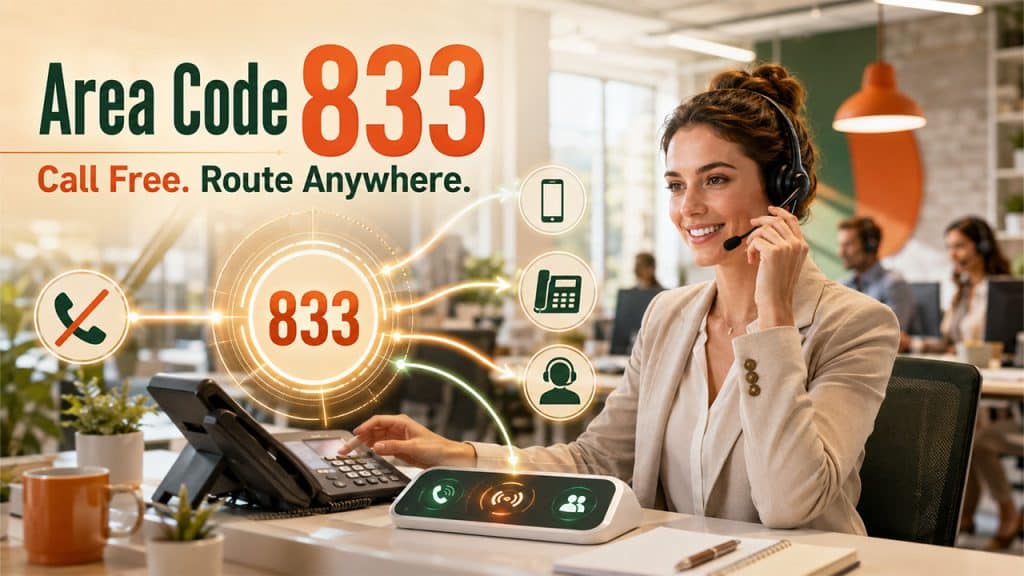
Essentially, the difference between regular telephone numbers and 833 numbers is simply the reversed cost of the call. The caller does not have to pay for the call made, but rather the company owning the toll-free number will be charged instead. Thus, one is free from any doubt concerning possible expenses incurred while using the phone number.
The other major difference about 833 numbers is the fact that they do not belong to a particular physical phone line. Rather, these numbers may be configured in such a way that the phone calls made to this number are forwarded to a wide variety of devices, including cell phones, a landline, or a VoIP. As call data starts flowing in from multiple channels, many businesses also rely on ETL Process Optimization to move and structure that information effectively across the systems they already use
Here’s a simple breakdown of how it functions:
- Caller dials the 833 number: Exactly as any ordinary telephone number.
- Call gets routed: The 833 number forwards the call to any chosen line or device.
- Company pays the cost: No cost at all to the caller, regardless of location.
- Flexible call forwarding: Calls can be forwarded to phones or call centers.
- Scalable configuration: Easily increase the number of phone lines as needed.
This flexibility is part of why so many businesses, from small startups to national companies, find toll-free numbers like 833 such a practical long-term communication tool.
Benefits of Using an 833 Number for Businesses
Utilization of an area code 833 brings along several tangible benefits for companies that prioritize customer satisfaction and sustainable development.
- Higher customer availability: Takes away the issues of price, motivating more calls and interest.
- Enhancement of professional appearance: Toll-free numbers contribute to a more professional image of a company.
- Call analysis and statistics: Companies have the ability to track call patterns and use them to develop further.
- Scalability: Numbers may be easily scaled and reconfigured while the company expands.
- Probability: Companies are able to retain their 833 number regardless of service provider changes.
- Customer relationship improvement: Higher frequency of calls helps to establish more loyal customers.
In essence, 833 number is much more than an opportunity to be available; it’s a small investment that pays off through better customer relationships and more consistent engagement over time, especially when paired with Lead Generation Services that turn those inquiries into real business opportunities.
Who Can Use Area Code 833?
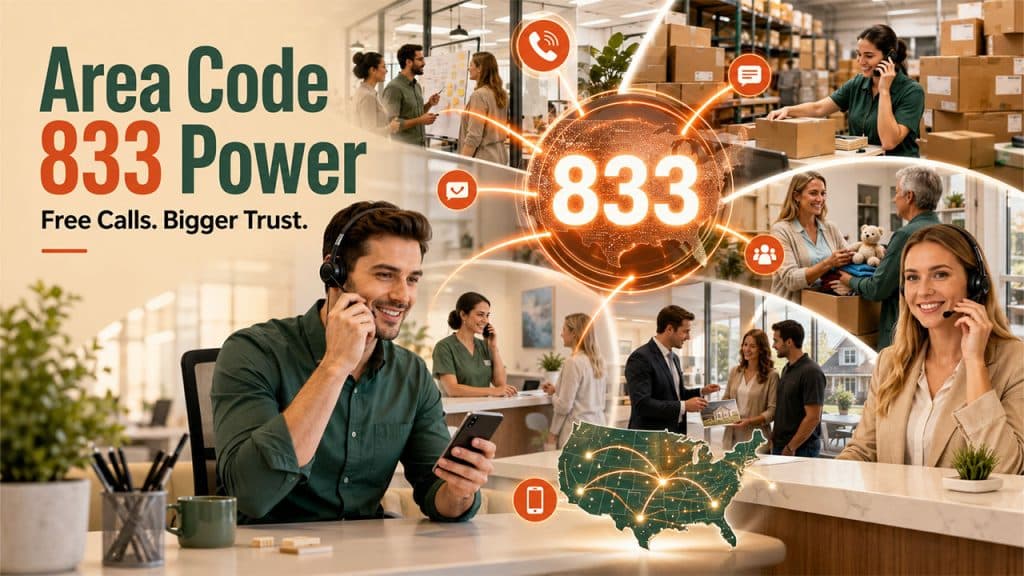
An 833 area code number can be obtained by virtually any type of company, irrespective of its size and specialization, which explains the wide popularity of this kind of number among various types of organizations. In particular, start-ups use an 833 number to establish themselves as credible companies in the absence of their own call centers, while online stores employ it to provide free support for clients both pre- and post-purchase.
Another group of organizations greatly benefiting from the use of a toll-free number includes non-profits that have to keep in touch with their donors and volunteers on a relatively tight budget. In turn, service industries, such as health care, real estate, and insurance companies, prefer this kind of number because of the greater importance of trust and accessibility in the corresponding field of activity.
Finally, national or remote-first companies have an opportunity to provide all customers in the United States with the same number, no matter whether they are located there or not. In this way, even a small local company will be able to use the number for its needs, while a larger company will manage millions of calls with the help of the same number.
Tips for Choosing the Right Area Code 833 Number
The selection of an appropriate area code 833 number might play a more significant role than most people think, particularly in terms of brand awareness and credibility.
- It should be memorable: Pick a number that is easy to remember, preferably with a simple pattern or repetition.
- Vanity number: opt for numbers that represent a specific word associated with your company.
- Features provided by the provider: Select a provider who offers features such as call tracking and routing.
- Scalability: Select a solution that will easily scale with your company in the future.
- Comparing pricing plans: Not all toll-free services cost the same; hence, it might be wise to compare some providers.
A little additional effort spent on this step might prove to be a great saving of time and money in the future.
Tracking and Optimizing Area Code 833 Number Performance
After an area code 833 number goes live, it starts providing valuable insights about its usage, which can be analyzed and utilized to further optimize the customer interaction experience over time. Usually, companies begin tracking their call activity in order to analyze such basic indicators as the time when calls usually occur, the average length of the calls, and their total quantity to understand their current situation better.
With the growth of the number of calls, such an analysis becomes increasingly difficult. This is when the importance of using a special tool like the Phone Number Extractor appears, since it is capable of automatically collecting the necessary information about the calling parties, while filtering the data manually would require considerable effort from the business owner’s side.
The final stage of working with such data is its analysis, based on which businesses can improve their customer interaction practices. For instance, response and conversion rate statistics will help to adjust the customer interaction process and make improvements whenever needed. In such a way, an ordinary phone number gradually becomes something much more important for the business than just an instrument for receiving calls.
Conclusion
At this point, area code 833 probably feels a lot less mysterious than it did at the start. What’s essentially a toll-free number turns out to play a real role in how approachable, professional, and trustworthy a business feels to the people trying to reach it.
We’ve covered what is 833 area code, cleared up confusion around 833 area code location, and walked through how these numbers actually work behind the scenes. We also looked at who benefits from using one, how to choose a good number, and how tracking call performance over time can turn a simple toll-free line into a genuine source of customer insight.
At the end of the day, an area code 833 number is a small addition with a fairly big payoff, making it easier for customers to reach out, and easier for businesses to build the kind of trust that keeps people coming back.
Frequently Asked Questions
What is 833 area code?
The 833 area code is a toll-free number prefix that businesses use so customers can call them for free, with the business covering the cost of the call instead.
Is area code 833 tied to a specific location?
No, the 833 area code isn’t linked to any particular city or region. It works nationally, so a business using this number could be based anywhere.
How does area code 833 work for businesses?
Calls to an 833 number are routed to the business’s chosen device, like a landline, mobile phone, or VoIP system, with the business paying for the call instead of the customer.
Who should consider using an area code 833 number?
Businesses of almost any size or industry can benefit, including small startups, e-commerce platforms, non-profits, and national or remote-first companies.
Can businesses track performance with an area code 833 number?
Yes, businesses can monitor call volume, response times, and customer patterns, often using tools to organize call data and turn it into useful insights for growth.