

 Continue with Google

 Share on media

No matter how good your email campaigns are, they wouldn’t do you any good if your audience does not open them. Sending an email is one thing, but making sure that they open it is another thing. Now, the question arises, how will you know whether your audience is opening your email or not? One of the important metrics that can help you in this aspect is email open rate. Email open rate is based on a specific subscriber list and is one of the main indicators of success. If your email open rate is low, then very few people are opening your emails, and there might be something off about your email strategy.
Let us explore the fundamentals of email performance, what a good email open rate is, and what are the factors impact your email open rate. Let us see how you can resolve your low open rate and how you can make your email campaigns perfect-
Fundamentals of Email Performance
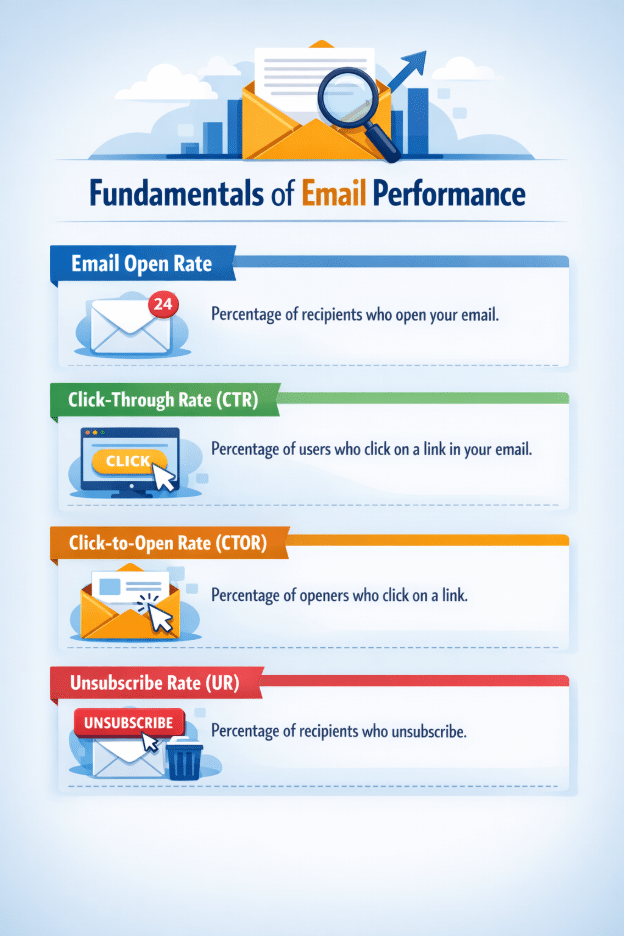
Let us start with something very basic: how can you understand the email performance strategy in general? You already know something about email open rate, but let us see a few other important factors:
- Email Open Rate: The rate at which your audience opens your email.
- Click-through Rate (CTR): The rate at which your users select and follow at least one link in your email.
- Click-to-Open Rate (CTOR): The overall percentage of users who open your email and follow through.
- Unsubscribe Rate (UR): The rate at which your recipients unsubscribe.
The email benchmarks for such rates change by email type and industry.
Why Are Email Open Rates Significant?
Email open rates are a critical metric in email marketing because they tell you about the exact performance of your email campaign. For example, email open rates will let you know:
- If your email has reached the inbox of your recipient.
- Whether you have identified the right segment.
- Whether the subject line of your email was compelling.
- Is your preheader text engaging enough?
Now that we have a clear idea regarding why email open rates are significant, let us understand what a good email open rate is.
What Is a Good Email Open Rate?
Open rates greatly depend on the kind of email you are sending. For example, the majority of email open rates have an 80-85% average open rate. On the other hand, the majority of marketing emails fall between 80-85%.
The open rate of transaction emails tends to be higher because it is the kind of information that people want to repeatedly visit or view immediately. These can be receipts for purchases or password resets. So, it is not uncommon to see open rates in higher ranges.
Email marketing is more difficult, and as experts suggest, it is important to keep marketing and transactional emails separate. In this way, senders can prevent lower rates of engagement from hampering their triggered messages. An email rate of 20-25% is not a bad number either. But let us look at some of the qualities that we can expect to see in a good email open rate:
Your open rate is constantly improving and is steady. Check your open rates over a period of time, such as for a quarter or a year. Assess your open rate to assess whether your email strategy is healthy.
The open rate equals the average for distinct devices. The open rates can change depending on whether the subscriber can open the email on their laptop or mobile devices. Take a deeper look at the indicators to see whether they meet the benchmarks.
Your open rate is equal to or greater than the industry average. Though every industry is different, having an open rate above, equal to, or very close to the industry average showcases that you are in pace with your competitors.
Email Open Rate Benchmarks by Industry
One of the most common questions marketers ask is whether their email open rate is performing well compared to others in their industry. Since subscriber behavior varies across sectors, comparing your performance against industry benchmarks can provide valuable insights.
Here are some average email open rate benchmarks across different industries:
| Industry | Average Open Rate |
|---|---|
| Education | 25% – 35% |
| Healthcare | 20% – 30% |
| E-commerce | 15% – 25% |
| Real Estate | 20% – 28% |
| Technology | 18% – 26% |
| Financial Services | 22% – 30% |
| Nonprofits | 25% – 35% |
Instead of focusing solely on industry averages, monitor your own performance trends over time. A consistent increase in open rates usually indicates that your audience finds your content valuable and relevant.
What Are the Factors That Impact Your Open Rate?
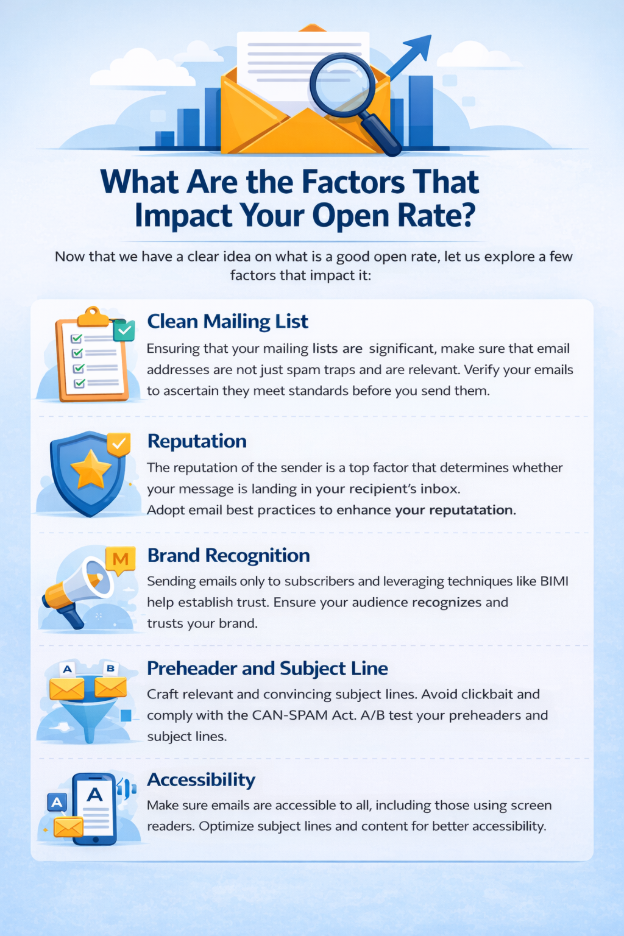
Now that we have a clear idea of what a good open rate is, let us explore a few factors that impact it:
- Clean Mailing List: Ensuring that your mailing lists are significant, make sure that email addresses are not just spam traps and are relevant. It is important to verify your emails and ascertain that they meet the standards before you send them.
- Reputation: The reputation of the sender is a top factor that determines whether your message lands in the inbox of your email recipient or not. After all, if your message is not being delivered, the subscriber is unlikely to open it. Assess your bounce rate to find out whether your emails are being delivered or not. Having said that, you can adopt email best practices that can improve your reputation as a sender.
- Brand Recognition: Does your audience have a clear idea of who you are and what your brand stands for? Have they received enough emails from you recently to understand who you are? Only sending emails to those who have subscribed and leveraging techniques like BIMI will allow you to drive maximum open rates.
- Preheader and Subject Line: Readers will not open your message if your subject line is not relevant, well-crafted, or convincing. Furthermore, you must also avoid clickbait subject lines, so you do not appear like a spammer and comply with CAN-SPAM Act guidelines. Perform A/B testing of your preheaders and subject lines to find out what is right for your subscribers.
- Accessibility: It is important to ensure that the subscribers not only receive an email but also receive it. When you are designing your subject lines and content marketing, focus on screen readers to enhance open rates and accessibility.
How Can You Fix a Low Open Rate?
Most of the time, a low open rate arises if you are not following email best practices. If you are consistently getting a low open rate, it is advisable to conduct a detailed audit on email deliverability. In this audit, you will find out what is working and what is not, and it will enable you to recognize potential threats and issues.
Low open rates also happen when your email lists are of low quality. If you have not updated your email list in a while or if you have built it through shady means, you will likely find that your subscribers are just not interested in opening your email.
Furthermore, you can also delete subscribers who have not engaged with your emails in a while. As a thumb rule, look for the subscribers who have not opened your monthly newsletter in the last three months. You can expect the subscribers to unsubscribe themselves, but people can forget about unsubscribing or stop using that email address completely.
Also, consider the content you are putting in your email. Is it relevant? Are you using customization tokens in your email body and subject?
Little changes like these can make a significant difference in improving your email open rate. Even as small a customization as “Hi Jason, I think our new product catalogue might interest you” will go a long way than a generic “Hi, you will be surprised to see the products we have launched.”
Best Practices to Improve Email Open Rates
Improving your email open rate requires continuous testing and optimization. Here are some proven strategies that can help:
- Optimize Send Times: Test different days and times to determine when your subscribers are most active.
- Segment Your Audience: Send personalized content based on user interests, demographics, or purchase behavior.
- Keep Subject Lines Concise: Subject lines between 30-50 characters often perform better on mobile devices.
- Use Personalization: Including the recipient’s name can increase engagement and open rates.
- Avoid Spam Trigger Words: Terms such as “Free Money,” “Guaranteed,” or excessive capitalization can negatively impact deliverability.
- Maintain Consistent Communication: Sending emails regularly helps build familiarity and trust with subscribers.
- Improve Your Outreach Email Strategy: A well-crafted Outreach Email with a personalized subject line and relevant content can significantly improve open rates and engagement.
By implementing these practices consistently, marketers can gradually improve both deliverability and subscriber engagement.
How Do You Calculate Email OR, CTR, and CTOR?
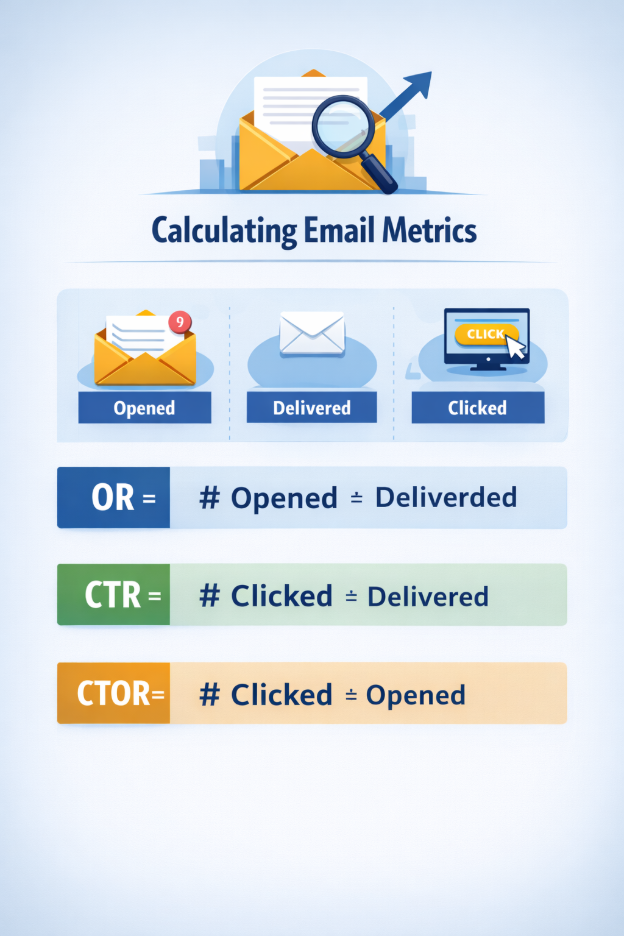
To understand email campaign performance, marketers typically track three key metrics: Open Rate (OR), Click-Through Rate (CTR), and Click-to-Open Rate (CTOR). These metrics are based on the number of emails delivered, opened, and clicked.
1. Open Rate (OR)
Open Rate measures the percentage of delivered emails that were opened by recipients.
Formula:
OR = (Opened Emails ÷ Delivered Emails) × 100
2. Click-to-Open Rate (CTOR)
CTOR measures the percentage of recipients who clicked a link after opening the email. It helps evaluate how engaging your email content is.
Formula:
CTOR = (Clicked Emails ÷ Opened Emails) × 100
3. Click-Through Rate (CTR)
CTR measures the percentage of delivered emails that generated at least one click.
Formula:
CTR = (Clicked Emails ÷ Delivered Emails) × 100
For example, if you send 1,000 emails, 250 recipients open them, and 50 click a link, your metrics would be:
- Open Rate = (250 ÷ 1,000) × 100 = 25%
- CTOR = (50 ÷ 250) × 100 = 20%
- CTR = (50 ÷ 1,000) × 100 = 5%
These metrics work together to provide a clearer picture of your email campaign performance and help identify areas for improvement.
Conclusion
It can be frustrating to see your email open rate in the low ranges, but it is important not to feel demotivated. As the above blog suggests, it is a fixable problem. You can start by conducting a thorough audit of your email deliverability. Check whether you are creating the right content for the right audience. Furthermore, consistently update your email lists and remove the ones that have not interacted with your email in the last 3 months. You can also implement email best practices and make sure that you align with CAN-SPAM Act guidelines to improve your overall reputation. Just as an Eporer focuses on building meaningful digital connections through relevant and engaging content, email marketers must prioritize audience needs and personalization to improve engagement. Pinpointing the exact problems and implementing the right solutions will help you see consistent improvements to your email open rate metrics.
Frequently Asked Questions (FAQs)
What is considered a good email open rate in 2026?
A good email open rate generally ranges between 20% and 30% for marketing campaigns. However, the ideal rate depends on your industry, audience quality, and email type.
Why are my email open rates suddenly dropping?
A sudden drop may occur due to poor deliverability, increased spam filtering, outdated email lists, irrelevant content, or ineffective subject lines.
Does email personalization improve open rates?
Yes. Personalized subject lines and email content can increase engagement and encourage recipients to open your emails.
How often should I clean my email list?
It is recommended to clean your email list every 3 to 6 months by removing invalid, inactive, and unengaged subscribers.
How does Direct Mail Marketing compare with email marketing?
While direct mail marketing uses physical promotional materials delivered through postal services, email marketing offers faster delivery, lower costs, and easier performance tracking. Many businesses use both channels together to maximize customer engagement.