


 Continue with Google

 Share on media
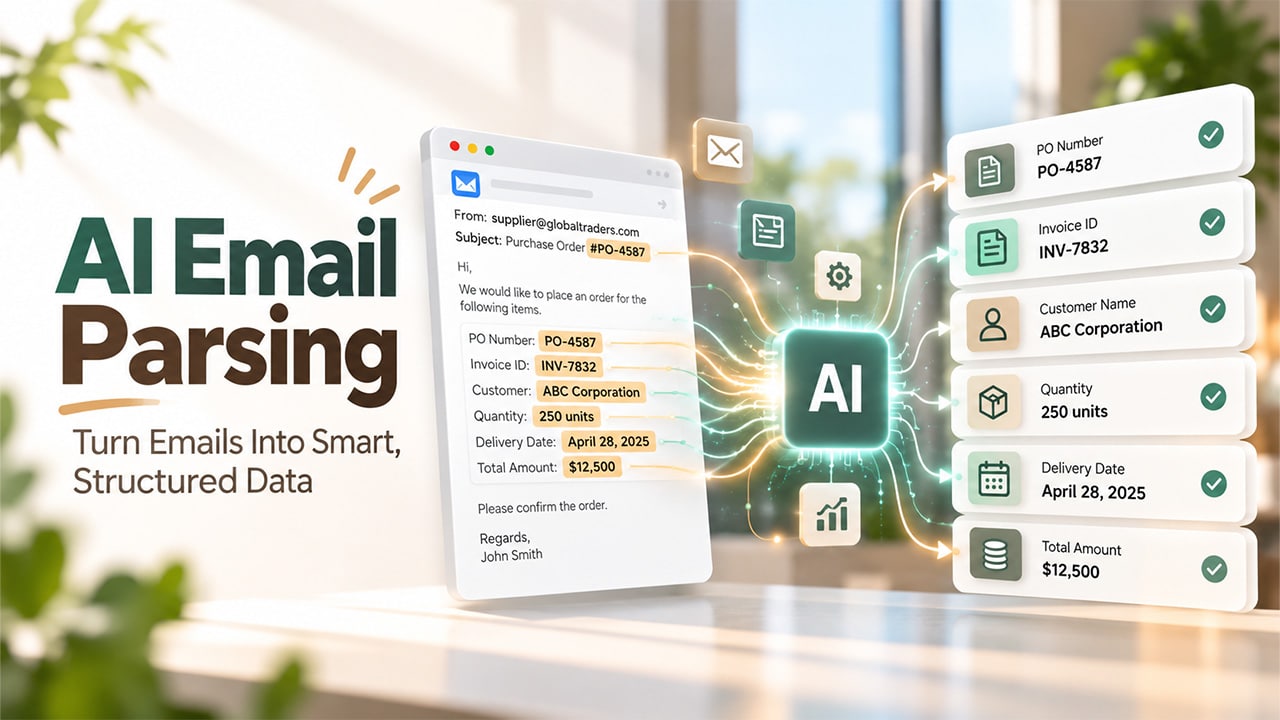
The guide explains what AI email parsing is, how AI identifies entities in an email, how AI understands email intent, and common challenges in AI email parsing.
In business communication, emails are more than just simple messages. They contain business-critical information such as purchase order numbers, invoice IDs, delivery dates, customer names, payment terms, and order quantities. However, extracting all this information manually from a large volume of emails can be time-consuming, error-prone, and difficult to scale.
This is where AI email parsing offers its capabilities. AI email parsing helps businesses efficiently transform unstructured email content into structured and usable data. An AI-powered system can identify important entities, understand the intent of the sender, and organize the extracted information into meaningful fields or keys, instead of simply reading an email as a block of text.
What is AI Email Parsing?
AI email parsing is the process of utilizing artificial intelligence to read emails, understand their meaning, extract crucial information, and convert the information into structured data that software can process easily.
Traditional email processing generally depends on fixed templates or predefined rules. AI email parsing helps solve this challenge by using key capabilities, such as natural language processing (NLP), machine learning, and large language models (LLMs), to understand the context of an email and identify the information that matters.
To understand the fundamentals of extracting information from emails, explore our guide on how email parsing works.
Why Is AI Email Parsing Important?
AI email parsing helps businesses:
- Automate Data Entry: Extract information without manually reading every email.
- Reduce Errors: Apply consistent extraction and validation rules.
- Understand Different Writing Styles: Recognize the same information even when senders use different phrases.
- Improve Workflow Automation: Send extracted data to ERP, CRM, accounting, or order management systems.
- Save Time: Process large volumes of business emails more efficiently.
How AI Identifies Entities in an Email
Artificial intelligence identifies entities in an email by analyzing the words, phrases, and context to recognize essential pieces of information, which may include purchase order numbers, invoice IDs, customer names, product names, quantities, and delivery dates.
In AI email parsing, all these pieces of information are called entities, and each entity represents a specific type of information that a business might need to extract and use.
1. Recognizing Important Words and Phrases
The first step is identifying meaningful expressions in the email. A technique called Named Entity Recognition (NER) helps identify categories such as people, organizations, locations, dates, and monetary values.
2. Understanding Context
Recognizing a number or phrase is not enough. AI must understand what it represents in the sentence. AI uses contextual clues to determine the role of the value rather than treating every number as the same type of information.
3. Matching Entities with Patterns
Businesses often use recognizable formats for their identifiers. Artificial intelligence can easily combine these patterns with contextual information to classify the values.
4. Mapping Entities to Smart Keys
Once AI identifies an entity, the system maps it to a standardized key so other applications can use the extracted information. Standardized keys ensure that variations such as “PO number,” “purchase order reference,” and “PO ID” can map to a consistent field.
5. Validating the Extracted Entities
After identifying entities, a reliable AI email parsing system can validate the results. If the email contains insufficient information, the system should mark the field as missing or uncertain rather than inventing a value.
How Smart Keys Are Created in AI Email Parsing
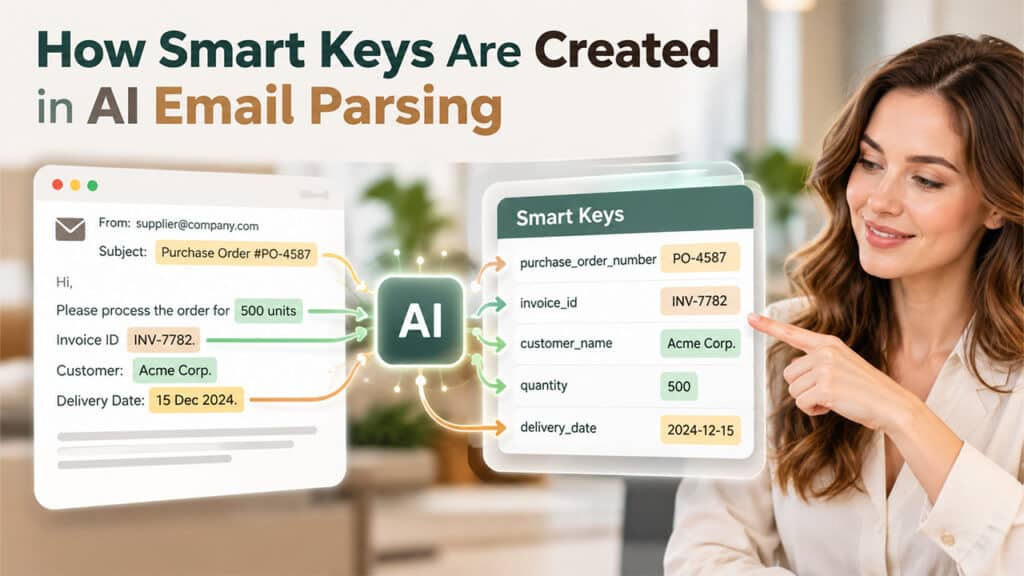
Smart keys are standardized field names that AI email parsing systems use to organize information extracted from emails. These keys help transform unstructured email text into structured data that software applications can understand and process.
The complete process through which smart keys are created in AI email parsing is as follows:
- Step 1: Identify the Information in the Email
The first step is to identify meaningful information in the email, such as purchase order numbers, invoice IDs, customer names, quantities, and dates.
- Step 2: Understand the Meaning of Each Entity
AI uses surrounding words, sentence structure, recognizable patterns, and business context to classify the extracted information.
- Step 3: Map Entity Types to Smart Keys
Once the entity types have been identified, the system maps them to standardized field names.
The field names are usually defined through one of three approaches:
- Predefined Schema: Developers define the keys before the system processes emails.
- AI-generated Keys: A language model proposes field names based on the extracted information and instructions.
- Hybrid Mapping: AI identifies the entity, and application logic maps it to an approved, standardized key.
- Step 4: Normalize Different Phrases into One Key
Different senders can describe the same information in different ways. Although the wording varies, the underlying entity may be the same.
- Step 5: Generate Structured Output
After mapping the entities to standardized keys, the AI email parsing system organizes the values into a structured format, such as JSON.
How AI Parses Email Attachments
AI email parser extracts information from files that are attached to an email, interprets the content, and converts relevant details into structured data that business applications can utilize.
AI email parsing can analyze both the email message and its attachments to collect this information, identify entities, understand the sender’s intent, and map extracted values to standardized keys.
The process of an AI email parser in analyzing email attachments is as follows:
- Identifying and Reading Email Attachments
The first step is identifying which files are attached to an email and determining how to extract their contents. The extraction methods mainly depend on the file format and whether the document contains searchable text or images.
- Extracting Important Information from Attachments
Once the attachment content is accessible, AI identifies the business information that matters to the business. An AI-powered parser can identify the values and classify them according to their meaning.
- Using OCR and AI Together
Some attachments of an email might contain text that cannot be selected or copied because the document is essentially an image. This is where ORC becomes important. ORC converts text appearing in an image into machine-readable text. AI can easily analyze the extracted content to understand the meaning of the recognized words and values.
- Mapping Attachment Data to Smart Keys
After identifying entities, the AI email parsing system maps them to standardized field names. This standardization is important because different suppliers may use different labels for the same information.
- Combining Email Body and Attachment Data
A particularly useful capability is combining information extracted from the email body with information found in its attachments. The email body provides the requested action and delivery instructions, while the attachment contains the order details.
- Handling Conflicting or Missing Information
Email attachments do not always agree with the email body. A reliable system should not silently choose one date without considering the business rules.
- Validating and Using the Extracted Data
The final step is to check whether the extracted information is usable.
Validation may include checking whether:
- The purchase order number matches the expected format.
- The customer exists in the business database.
- Quantities and monetary amounts are valid.
- The invoice total matches its line items, where applicable.
- Required fields are present.
- Extracted values are consistent across the email and attachment.
For a closer look at extracting information from PDFs, scanned documents, and email attachments, read our guide on how document parsing works.
Common Challenges in AI Email Parsing
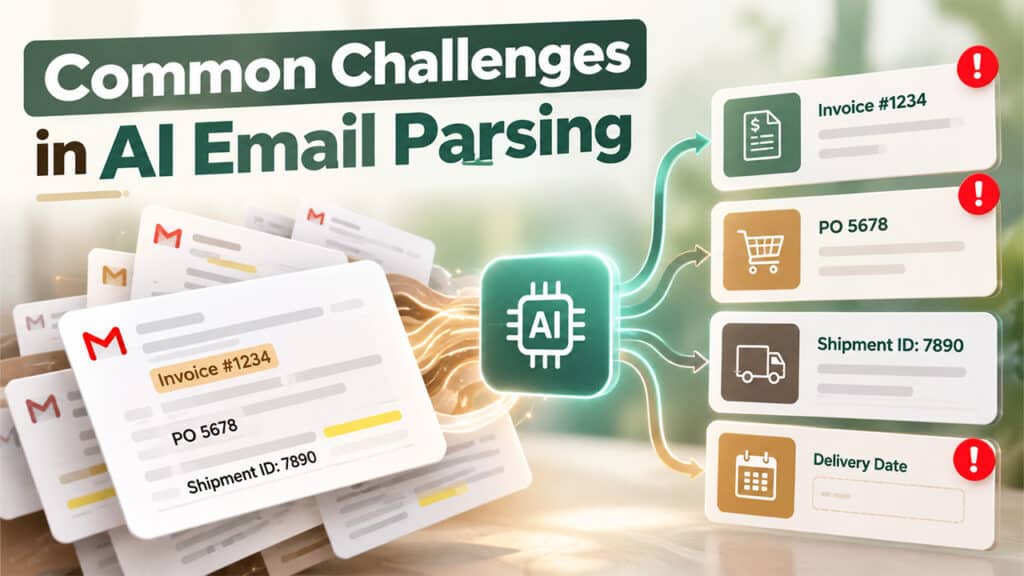
Although AI offers key capabilities in interpreting varied email formats, reliable extraction requires careful implementation. Some of the key challenges with AI email parsing are as follows:
- Ambiguous References: A number present in an email may represent various sections, such as an invoice, purchase order, customer account, or shipment identifier. The system should use context and validation rules to differentiate between them.
- Missing Information: An email can also mention a purchase order without specifying a delivery date. The parser needs to return a missing value, such as null, rather than inventing data.
- Multiple Entities in a Single Email: A message may discuss several purchase orders, invoices, or delivery dates. A simple single-value field might not be sufficient.
Best Practices for Building a Smart Email Parsing System
To design a dependable AI email parsing workflow, businesses should consider the following practices:
- Define Entities First: Businesses should identify the information that they require, such as order numbers, invoice IDs, dates, and quantities.
- Create Canonical Schema: Focus on establishing exact field names that the application expects before processing emails at scale.
- Use Context-Aware Extraction: Businesses should use context-aware extraction by combining surrounding text, email subjects, known patterns, and relevant business rules.
- Separate Extraction from Intent: Keep entity values and business actions in distinct fields so they can be evaluated independently.
- Validate Extracted Values: Check formats, required fields, and relationships between entities.
Conclusion
AI email parsing helps businesses transform unstructured emails and attachments into structured, actionable data. By identifying entities, understanding email intent, and mapping information to standardized keys, artificial intelligence makes email processing more efficient and consistent. With proper validation and a well-defined schema, businesses can reduce manual effort, improve data accuracy, and streamline workflows across their systems.