












 Continue with Google

 Share on media
Being an Email marketer, whose subscribers are from the USA, it becomes necessary for you to know and practice compliance with the CAN-SPAM Act of the United States of America, 2003.
Email is still one of the most powerful resources of digital marketing, and no company holds back from using it to grab the attention of their target audience. In the middle of all of this, they often forget the burden the recipient goes through with all those spammy emails they receive.
To solve this, the USA passed its first recipient-protective law – the CAN-SPAM Act.
What is the CAN-SPAM Act?
The CAN-SPAM Act (Controlling the Assault of Non-Solicited Pornography and Marketing) was passed by the United States Congress in 2003.
It regulates commercial email from businesses and provides the freedom for the addressee to easily opt out of future emails.
The law is applied in all the states of America and protects all its citizens. It promises to safeguard the recipients from spammy or misleading senders and imposes heavy punishments if a company doesn’t comply.
So, it is not just a law that passed the gates of the US judiciary, but a necessity for anyone sending commercial emails. All individuals and businesses need to be cautious not to violate the rules laid down.
What is the Penalty?
This is what most of us wonder in a “what if” situation, and honestly, it’s smart to learn.
If someone breaches the law, they can be penalized up to $53,088 for each email violation, and multiple individuals can be convicted for the same. In some cases where illegal email harvesting was done, the perpetrator has even been sentenced to jail time by the judiciary.
Who comes under the CAN-SPAM Act?
Any mail whose primary motive is commercial advertisement or promotion of goods or services needs to obey the CAN-SPAM Act rules. However, the transactional or relationship ones are not a part of this law.
For instance, Jamie signed in to a pet product site, and they will receive an email for OTP or a confirmation, “your order for dog food is complete”. This is transactional and will not fall under this law, but “Buy our dog food at 10% off” is a promotion and will have to comply with the CAN-SPAM Act rules.
CAN-SPAM Act vs GDPR and Other Email Laws
Many businesses send emails globally, which means CAN-SPAM is not the only regulation they need to understand. While the CAN-SPAM Act applies mainly to commercial emails sent to users in the United States, other regions have stricter laws.
For example, the European Union follows GDPR (General Data Protection Regulation), which requires clear consent before sending marketing emails. Similarly, Canada follows CASL (Canada’s Anti-Spam Legislation), which is also stricter than CAN-SPAM in terms of permission-based marketing.
The biggest difference is that CAN-SPAM allows businesses to send promotional emails without prior consent, as long as recipients can easily opt out. GDPR and CASL, however, often require explicit permission before any promotional communication.
For businesses running international campaigns, understanding multiple regulations becomes essential. Following proper email security policies and global compliance standards can help companies avoid legal risks and build stronger customer trust.
Requirements under the CAN-SPAM Act
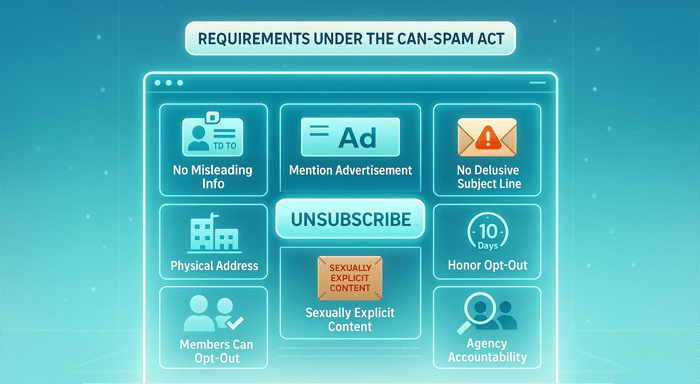
There are some requirements that a sender needs to follow before dispatching their email to US residents. We have listed them in the following points:
- No Misleading information: It’s important that your “From” and “To” fields clearly mention the sender’s details and should be accurate.
- Mention advertisement: If it’s promotional, the mail should clearly specify that it’s an advertisement.
- Specify physical address: Your company’s valid physical address must be included in every commercial message.
- Easy Unsubscribe Option: A visible and simple unsubscribe button must be provided.
- No Delusive Subject Line: CAN-SPAM warns against a delusive subject line that persuades urgency in the reader to open the email, but inside it’s just a promotional ad.
- Honor opt-out requests: If a user unsubscribes from your email, then it must be processed within 10 days. The sooner a company does that, the more trustworthy it appears.
- Members and subscribers: Even paying members must be allowed to opt out easily, without long forms or logins.
- Messages with indecent content: In case there is indecent content in your email, it’s necessary, according to CAN-SPAM, that the subject line should clearly mention “Sexually Explicit” and it also requires that the first screen of the email (before scrolling) should be a “brown paper wrapper”.
- Keep an eye on the agency: Even if a company hires an email agency, it will be the company itself that will be liable under the CAN-SPAM Act, and it’s the company’s responsibility to keep an eye on the agency’s work.
Best Practices to Stay CAN-SPAM Compliant
Following the CAN-SPAM Act becomes much easier when businesses build good email marketing habits from the beginning. These practices not only help avoid penalties but also improve engagement and sender reputation.
Some recommended best practices include:
- Use verified and permission-based email lists
- Avoid clickbait or misleading subject lines
- Clearly mention your business identity
- Add an unsubscribe link in every email
- Remove unsubscribed users immediately
- Regularly clean inactive or invalid email addresses
- Segment your audience to send relevant content
- Monitor third-party email agencies carefully
Companies that maintain ethical email practices often experience better deliverability rates, improved CTRs, and fewer spam complaints over time.
Common CAN-SPAM Mistakes Businesses Should Avoid
Even experienced marketers sometimes unknowingly violate CAN-SPAM rules. These mistakes may look small, but they can seriously damage a company’s reputation and lead to penalties.
Some of the most common mistakes include:
- Sending emails without a valid physical address
- Hiding or disguising sender information
- Making the unsubscribe process complicated
- Ignoring unsubscribe requests
- Using deceptive subject lines to increase open rates
- Purchasing low-quality email lists
- Sending excessive promotional emails in a short period
Many businesses also fail to understand how compliance laws overlap with other online regulations. For example, laws related to online identity and privacy, such as VPN Age Verification Law Utah, show how governments are increasingly focusing on protecting users’ digital rights and online transparency.
Advantages of CAN-SPAM:
Though its primary goal is to protect the recipient, it also benefits both sides – the person receiving the mail and the company sending the mail. Let’s discuss the advantages for both:
For Recipients:
- Easy opt-out option: CAN-SPAM ensures the recipients have the right to easily opt out of any kind of mail services.
- Less cluttered inboxes: With only 15 GB of space, no one wants it to be filled with unusual emails and to be bugged by notifications every second. Furthermore, important mail gets lost in spam mail.
- Transparency: A Clear ‘From’ section allows the addressee to know who the mail is from, and it also saves them from fraud.
- Protection against deception: Strict subject line rules prevent misleading tactics.
- Safety: Proper labelling, such as “advertisement” and “sexually explicit,” allows the recipient to decide whether to open the message.
For Sender/Company:
- Better CTR (Click-Through Rate): Targeting genuinely interested users leads to higher engagement.
- Trustworthiness: Companies that comply with the law have better trust and reputation. It shows that they value customers’ rights.
- Niche audience: Through emails, it conveys firms that who are the people that are interested in their services and would be more likely to pay for them. It allows them to directly communicate with their niche audience rather than being unread spam mail.
- Reduced Spam Complaints: Through an easy opt-out option, people are less likely to complain about the mail as spammy.
Conclusion
CAN-SPAM provides a legal foundation for better and safer email marketing. It does not just ensure safety to the recipients by giving them full control over their inbox and easy opt-out from unnecessary emails but also provides advantages to the companies by increasing their trustworthiness in front of their recipients. Companies that follow the rules show that they value customer rights, and in return, they enjoy higher engagement, better CTRs, and a stronger reputation.
By treating compliance not as a burden but as a duty, businesses can avoid penalties as well as win their audience’s trust and reliance on them.
FAQs
Does the CAN-SPAM Act apply only to businesses in the USA?
No. The CAN-SPAM Act applies to any individual or business sending commercial emails to recipients located in the United States, even if the sender operates from another country.
Is prior permission required before sending marketing emails under CAN-SPAM?
Unlike GDPR, the CAN-SPAM Act does not strictly require prior consent before sending promotional emails. However, businesses must provide a clear opt-out option and follow all compliance rules.
How quickly must unsubscribe requests be processed?
According to the CAN-SPAM Act, unsubscribe requests must be honored within 10 business days. Companies cannot charge fees or require extra steps for opting out.
What types of emails are exempt from the CAN-SPAM Act?
Transactional or relationship emails such as order confirmations, password resets, invoices, and shipping notifications are generally exempt because their primary purpose is not promotional.
Can companies be penalized for actions taken by third-party email agencies?
Yes. Even if a business hires an external email marketing agency, the company itself can still be held legally responsible for violations committed on its behalf.