












 Continue with Google

 Share on media
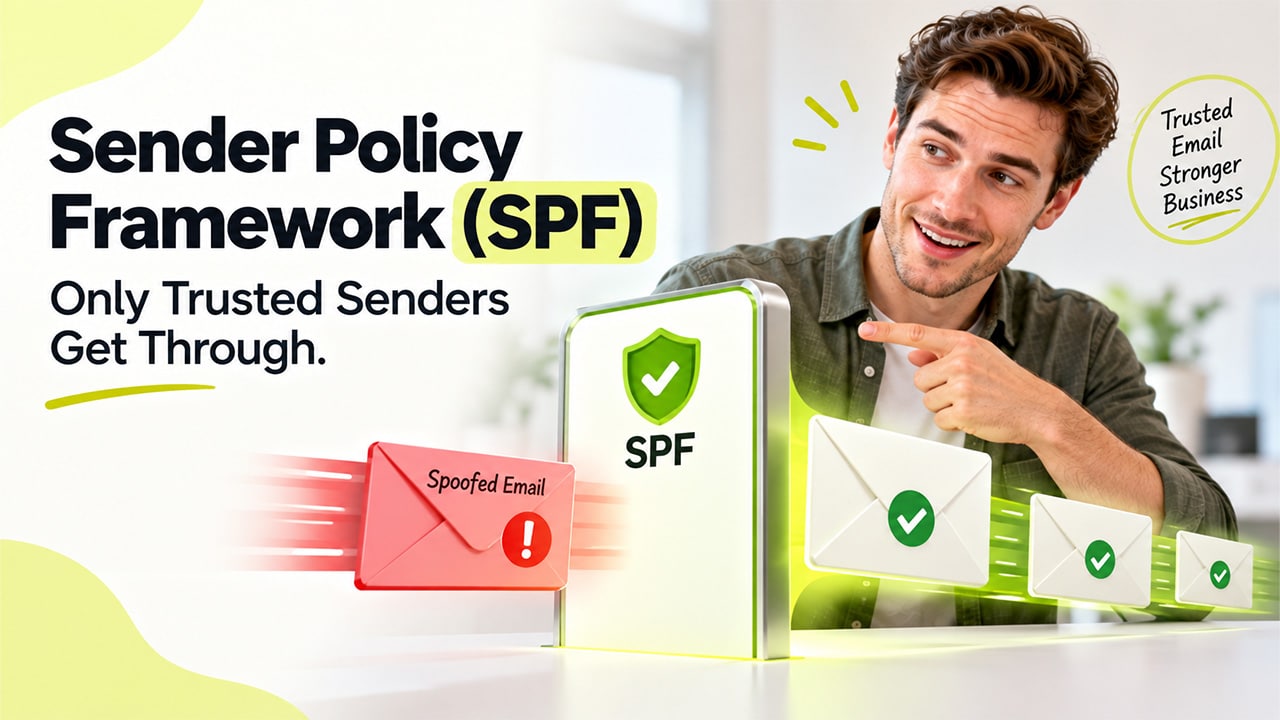
Email spoofing emerges as one of the simplest ways for attackers to impersonate a reliable brand, and it works since most of the domains do not bother to ensure proper front-end security. Sender Policy Framework (SPF): How It Works and Why It Matters is a key question that every business sending transaction or marketing email has to answer eventually, since SPF emerges is the first checkpoint a receiving mail server uses to decide whether the message is forged or genuine.
Essentially, SPF email authentication allows a domain owner to publish, in DNS, precisely which mail servers are allowed to send email on their behalf. When a message comes, the receiver servers validate the sending IP against that published list. If the IP address is not on it, the email can be quarantined, flagged, or rejected outright, as per the policy of the domain.
This is important more than ever for teams operating drip campaigns, outreach, or automated workflows that pull, organize, and send email data. A poorly set up Sender Policy Framework Record implies that your legitimate messages arrive in your spam along with the phishing attempts that you are looking to avoid.
What Is Sender Policy Framework (SPF)?
Sender Policy Framework (SPF) is defined as an email authentication protocol created to stop domain spoofing before it comes to your inbox. The authentication is done by providing domain owners with a way to declare, in advance, which servers are allowed to send email using their domain name.
SPF is one of three key protocols that form the pillar of modern Email Security Policies, working along with DMARC and DKIM to validate distinct aspects of the legitimacy of the email:
- SPF verifies whether the sending server is authorized by the owner of the domain.
- DKIM validates that the massage content was not changed in transit.
- DMARC links DKIM and SPF together and tells receiving servers what needs to be done when a check sees failure.
None of the above protocols operate well. A domain that publishes only an SPF record without DMARC and DKIM creates gaps that attackers exploit, specifically around the visible “From” address that recipient ultimately sees.
How the SPF Protocol Works?
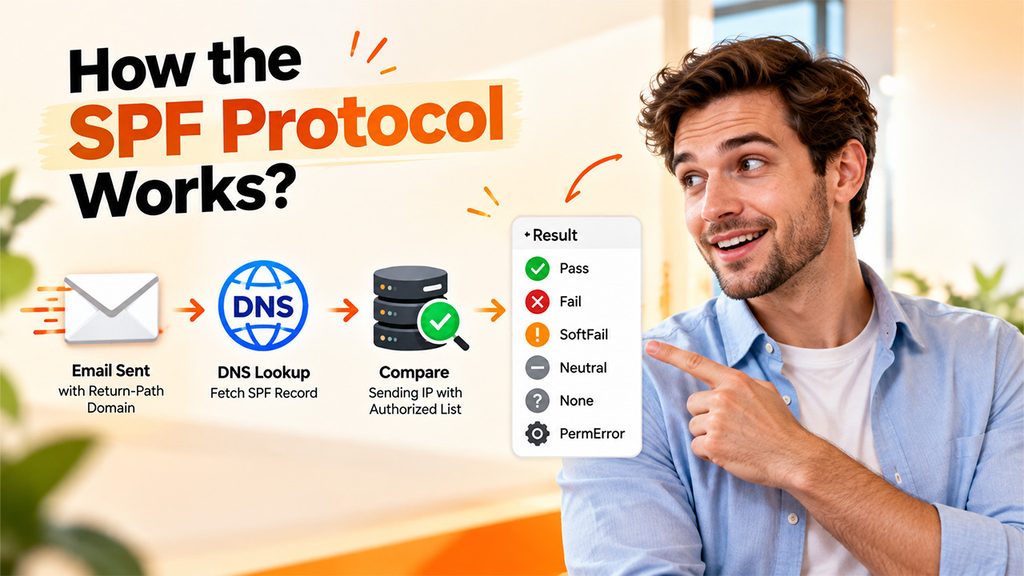
SPF verification completely happens in the background through DNS lookups, with no visible interruption to the recipient or sender. The process operates in a fixed sequence each time an email gets sent:
- The sending server sends the email, which carries the domain in its Return-Path address.
- The receiving mail server then pulls this domain from the Return-Path.
- It carries out a DNS lookup to get the published SPF record of the domain.
- It compares the IP address of the sender against the authorized list in the record.
- Depending on the match (or lack of one), the email fails, passes, or gets a soft fail/neutral result.
You must be familiar with a few key terms that come as a result. These results impact the deliverability directly.
- Pass – The authorized sending IP.
- Fail – The unauthorized sending IP and the domain rejects.
- SoftFail – The IP is not authorized, but the domain is not going for a hard block.
- Neutral – There is no explicit claim from the domain regarding the IP.
- None – No SPF record is there for the domain.
- PermError – There is a syntax error in the record, or it goes beyond the DNS lookup limit.
One key limitation you need to know is as follows: SPF just checks the IP address of the server. It has no way to validate the actual identity of the sender or whether the message body was modified. This is where DKIM steps in to reduce this gap.
What Does an SPF Record Appear Like?
An SPF record refers to a DNS TXT record that gets published at the domain level. It follows a determined syntax made up of qualifiers and mechanisms, and it must start with the version tag v=spf1.
A major record appears like this:
v=spf1 ip4:192.0.2.0/24 include:mailprovider.com -all
Every component plays a particular role:
- v=spf1 – compulsory version tag, must show up first.
- ip4: / ip6: – verifies a particular IP address or range.
- include: – verifies the SPF record of the third-party (which is common for email marketing tools)
- a: / mx: – authorizes the mail exchange servers or domain’s own AI record.
- -all – hard fail, i.e., rejects anything which is not matching.
- ~all – soft fail, i.e., flag it but still deliver.
- ?all – neutral; no policy is enforced.
Some rules are non-negotiable when you are drafting a record:
- Only a single SPF record is allowed per domain. Multiple records lead to PermError.
- SPF allows a maximum of 10 DNS lookup per check; each involves a redirect mechanism, or mx counts toward the limit.
- Domains that do not send emails must publish v=spf1 -all to avoid spoofing an unutilized domain.
Why Is SPF Important for Security and Deliverability?

Publishing a right Sender Policy Framework Record is not just a security checkbox. It impacts directly whether your emails are coming to your inbox or not.
On the side of security, SPF aids by:
- Blocking unverified servers from sending an email that looks to come from your domain.
- Minimize the success rate of phishing campaigns that spoof your brand.
- Providing a clear signal to receiving mail servers about which sources you rely on.
On the side of deliverability, an authentic SPF setup:
- Minimizes the possibilities of legit campaigns being categorized as spam.
- Ensures domain reputation over time with different mailbox providers.
- Sends a signal to ISPs that your domain seriously takes security.
Misconfiguration works opposite but just as quickly. An outdated record that misses a new sending platform, that record that goes beyond the 10-lookup limit, or duplicate SPF records on the same domain can all legit email to silently fail authentication, typically without any obvious warning until deliverability drops quietly.
For any business that runs numerous sending sources (an email marketing tool, a CRM, an outreach platform, or a transactional email, for instance), auditing each sender and ensuring that the record stays updated after each change in infrastructure is vital. This is a natural extension of wider Email Security Policies, since SPF is only as dependable as the maintenance that drives it.
SPF Alone Is Not Sufficient
SPF is basic, but it was never created to solve email authentication on its own. Its limits are well-documented and real:
- It cannot secure the “From” address that a recipient actually sees because it verifies the Return-Path instead.
- It segments the forwarded email since the IP of the forwarding server is not on the original record.
- It cannot confirm whether message content was changed in transit.
- It cannot prevent a lookalike domain from registering its own verified SPF record.
This is precisely why comparing DKIM vs SPF vs DMARC is important when developing an authentication strategy. DKIM includes a cryptographic signature that verifies the integrity of the message, while DMARC enforces alignment between DKIM, SPF, and then visible “From” address. This closes the precise gap that SPF leaves open. A domain that runs all three together gets substantially stronger security than any single protocol can provide alone.
Conclusion
Sender Policy Framework (SPF): How It Works and Why It Matters boils down to a one single idea: let the world know which servers are allowed to speak for your domain and enable receiving mail servers to do the rest of the work. An SPF record which gets correctly published secures domain reputation, blocks unauthorized senders, and enhances deliverability. However, it works as part of a multifaceted approach along with DMARC and DKIM, not an individual fix.
For any team handling outbound email at scale, considering SPF as a real-time configuration, updated with each new sending source and audited regularly is what really keeps both deliverability and security intact over time.