












 Continue with Google

 Share on media
The blog explores the difference between DKIM vs SPF vs DMARC and why it is essential for improving email security, protecting domain reputation, and increasing the chances that legitimate emails reach the inbox.
Email is among the most essential communication channels for businesses. Organizations use it for multiple applications, from customer support and marketing to invoices, password resets, and internal communications. However, email is also one of the most commonly exploited channels for phishing, spoofing, and other forms of fraud. To protect email communications from all these malpractices, organizations rely on three essential authentication methods, i.e., SPF, DKIM, and DMARC.
Although these technologies are often mentioned together, they generally solve very different problems. SPF verifies which servers are authorized to send email to a domain, DKIM adds a cryptographic signature to outgoing messages, and DMARC is built on SPF and DKIM to determine how receiving mail servers should handle messages that fail to authenticate. Understanding DKIM vs SPF vs DMARC can help businesses choose the right email authentication approach and strengthen their domain’s email security.
What is SPF?
SPF stands for Sender Policy Framework. It is a DNS-based email authentication mechanism that allows a domain owner to specify which mail servers are permitted to send email using the domain.
When a receiving mail server gets a message, it can check the SPF record of the domain and compare the sending server’s IP address against the published list. If the sending server is authorized, the SPF check can pass, and if it isn’t, the message may fail SPF authentication.
However, SPF has a key limitation, which is that it authenticates the envelope sender and not necessarily the visible ‘From’ address that users see in their email clients.
What is DKIM?
DKIM stands for DomainKeys Identified Mail. Unlike SPF, DKIM uses cryptographic signatures to validate the email itself, unlike SPF, which just validates the sending server. When an organization sends a DKIM-signed email, its mail system adds a digital signature to the message, and the corresponding public key is published in the domain’s DNS.
If the verification succeeds, the receiver has evidence that the message was signed by an authorized system and that the signed portions of the message have not been modified after signing.
DKIM is particularly valuable for organizations that use multiple email platforms, marketing systems, customer support tools, and other third-party services.
What is DMARC?
DMARC stands for Domain-based Message Authentication, Reporting, and Conformance. It doesn’t replace SPF or DKIM, instead, it builds on them.
The primary aim of DMARC is to help domain owners determine whether an email claiming to come from their domain has authenticated properly and whether the authentication aligns with the visible ‘From’ address. DMARC also offers domain owners a way to publish instructions for messages that fail the required authentication checks.
DKIM vs SPF vs DMARC: Key Differences
A quick comparison between DKIM vs SPF vs DMARC are as follows:
| Features | SPF | DKIM | DMARC |
| Primary Purpose | Authorizes sending servers. | Authenticates messages with signatures. | Defines authentication and handling policy. |
| Uses DNS | Yes | Yes | Yes |
| Uses Cryptography | No | Yes | No |
| Authenticate sending infrastructure | Yes | Indirectly | Uses SPF/DKIM results |
| Provides reporting | No | No | Yes |
| Detect message modification | No | Yes, for signed content | Indirectly through DKIM |
DKIM vs SPF vs DMARC: How Each Works
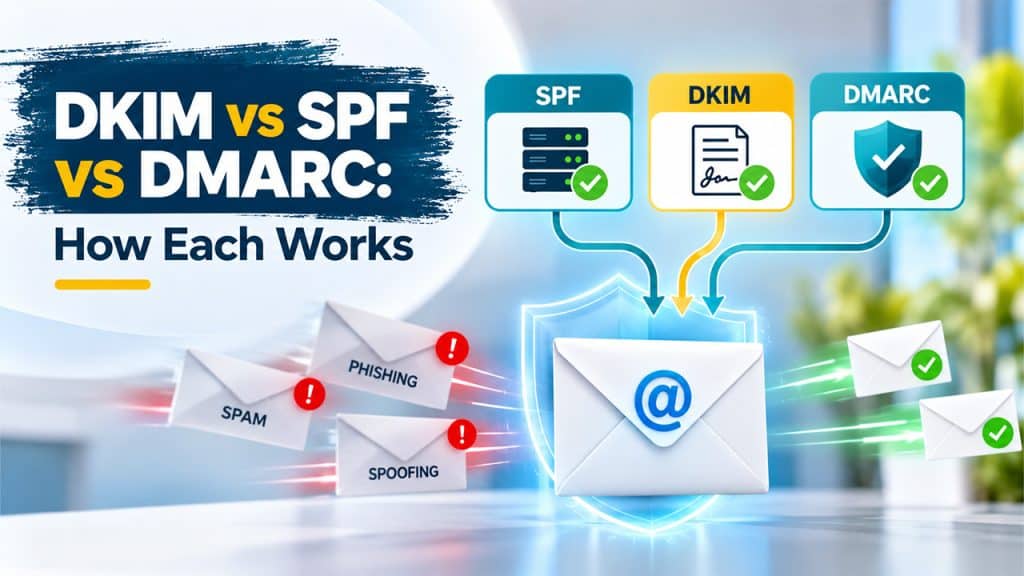
Although SPF, DKIM, and DMARC all help protect email from spoofing and phishing, each works in a different way.
How SPF Works
The workings of SPF are relatively straightforward and include:
- Step 1: A sender sends an email claiming to be from a particular domain.
- Step 2: The receiving mail server identifies the server that delivered the message.
- Step 3: It looks up the sender domain’s SPF record in DNS.
- Step 4: It checks whether the sending server is authorized.
- Step 5: The receiving server records an SPF result such as pass, fail, softfail, neutral, or another result.
How DKIM Works
A simplified DKIM process includes:
- Step 1: The sending mail server creates a cryptographic signature using a private key.
- Step 2: The signature is added to the email as a DKIM header.
- Step 3: The domain publishes the corresponding public key in DNS.
- Step 4: The receiving server retrieves the public key.
- Step 5: It uses the key to verify the message signature.
- Step 6: The receiving server records whether DKIM verification passed or failed.
How DMARC Works
The working of DMARC is as follows:
- Step 1: DMARC uses the authentication results from SPF and DKIM.
- Step 2: It checks whether the authenticated domain matches the domain shown in the email’s ‘From’ address.
- Step 3: The domain owner specifies what should happen to emails that fail DMARC—none, quarantine, or reject.
- Step 4: DMARC can send reports to domain owners about authentication results and potential spoofing attempts.
- Step 5: By enforcing authentication and alignment, DMARC makes it harder for attackers to impersonate a legitimate domain.
How They Work Together
The three standards can be viewed as different layers but are part of the same email security system.
- SPF: Is the sending server authorized?
- DKIM: Does the message have a valid cryptographic signature?
- DMARC: Does the authentication align with the visible ‘From’ domain, and what should happen if it doesn’t?
DKIM vs SPF vs DMARC: How These Improve Deliverability
SPF, DKIM, and DMARC help improve email deliverability by helping mailbox providers verify that the emails are coming from legitimate and authorized sources.
- SPF Builds Sender Trust: SPF identifies the servers authorized to send email to the receiver’s domain. It helps receiving email servers distinguish legitimate senders from unauthorized ones.
- DKIM Verifies Message Authenticity: DKIM adds a digital signature to outgoing emails. Receiving servers can verify the signature and confirm that the message was authorized and that the signed content hasn’t been altered.
- DMARC Strengthens Domain Reputation: DMARC checks SPF and DKIM authentication and ensures that they align with the visible ‘From’ domain. This provides stronger evidence that an email genuinely represents the claimed sender.
- Reduces Spoofing and Phishing: Proper authentication makes it more difficult for attackers to impersonate the domain, helping protect the reputation of the domain.
- Improves Mailbox-Provider Trust: Consistent authentication offers receiving providers stronger signals when deciding whether a legitimate message should reach the inbox.
DKIM vs SPF vs DMARC: Common Mistakes to Avoid
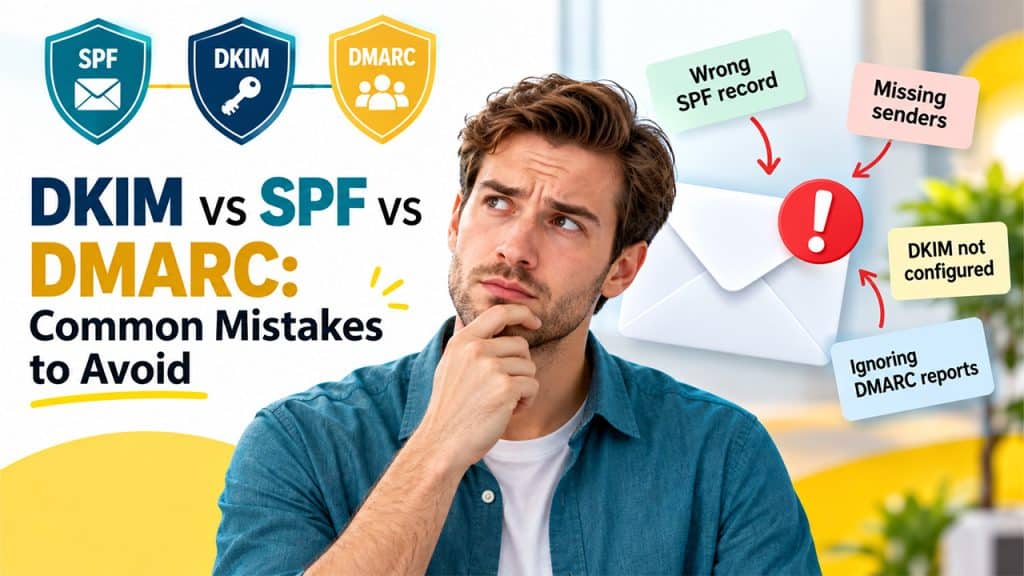
An organization that has implemented email authentication can also run into various configuration problems. Organizations should consider avoiding the following factors to efficiently implement email authentication:
- Creating an Overly Complicated SPF Record
SPF has DNS lookup limitations, so the organization that combines many third-party email services can accidentally create records that exceed those limits. It is essential to keep the SPF configurations organized and avoid any unnecessary mechanisms.
- Forgetting Third-Party Sender
A company may configure SPF for its primary email provider but forget about its marketing platform or transactional email service. This often results in authentication failures for legitimate messages.
- Not Configuring DKIM for Every Sending Service
Each email platform may require its own DKIM configuration. Just enabling DKIM for corporate emails cannot automatically authenticate mail sent through other platforms.
- Ignoring DMARC Reports
Publishing a DMARC record is only a part of the process. Reports can offer valuable visibility into which systems are sending email using the organization’s domain. Regularly reviewing those reports can reveal forgotten services, configuration issues, and potentially unauthorized sending activity.
Conclusion
The key difference between DKIM vs SPF vs DMARC becomes more clearer when the user views them as three complementary layers of email authentication. SPF verifies whether a sending server is authorized, whereas DKIM uses cryptographic signatures to authenticate messages and detect changes to signed content. DMARC builds on SPF and DKIM by checking alignment, providing reporting, and allowing domain owners to define how authentication failures should be handled. For businesses that rely heavily on email, implementing all three is an important part of a modern email security strategy.