












 Continue with Google

 Share on media
If you are a business owner, a marketer, or someone just getting started with outreach, this detailed post breaks down what email marketing really is, how it works, and how to run it in a way that brings consistent, measurable results.
A Channel That Has Stayed Relevant for Over Five Decades
Surprisingly, the first commercial email was sent in 1978 by Gary Thuerk, a marketing manager at Digital Equipment Corp. His list had just 400 addresses, but that single campaign reportedly generated about $13 million in sales. That send proved what was possible long before the internet became what it is today.
Fast forward to now, and over 333 billion emails are sent every single day globally. The channel has grown enormously, but the core idea has stayed the same. You reach people directly, in a space they check regularly, with a message that actually matters to them.
How It Works, and Why So Many People Get It Wrong
The concept is pretty simple. A business can send an email to a group of subscribers to promote something, share news, or build a relationship. But the execution is where most people run into trouble or fail to utilize this amazing channel. A poorly built list, a weak subject line, or a message that lands in spam can make even the best-written campaign completely invisible.
The reason is that most businesses focus too much on the content and not enough on the infrastructure underneath it. Also, they wonder why open rates stay low even after hours of writing and designing. But the fact is, how you build your list and how you protect your sender reputation matter just as much as what you eventually write.
Types of Campaigns That Drive Real Results
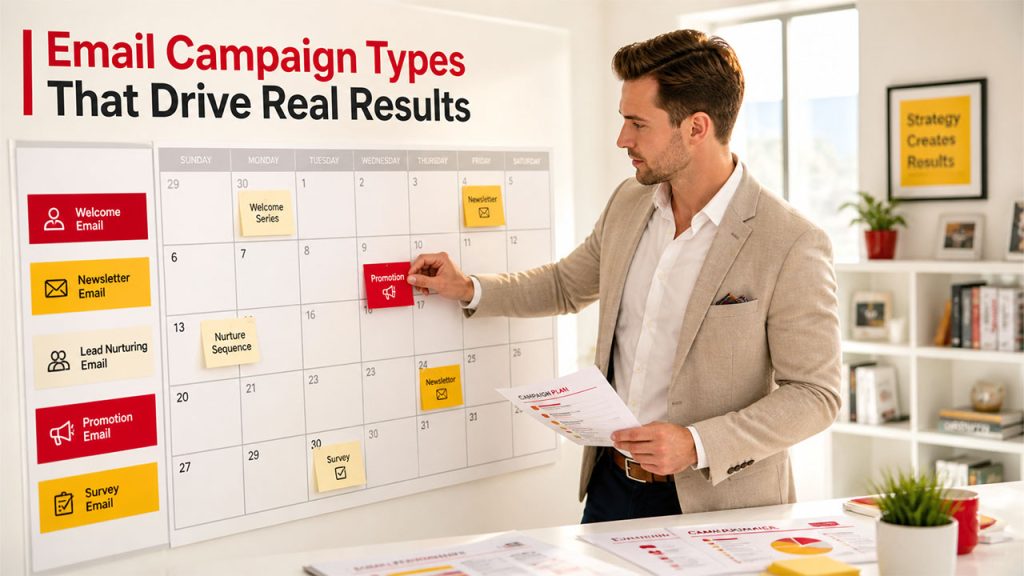
Not all campaigns serve the same purpose, and knowing the difference helps you plan more effectively. For example, welcome emails introduce a new subscriber to your brand and consistently outperform other message types in engagement. However, the newsletter email keeps your target audience informed about the products, blogs, and anything else happening at your company.
The lead nurturing email helps move your leads closer to making a purchase, but not too quickly. Whereas, the promotional email is aimed at a larger target audience, and the survey email gathers information. In many cases, businesses also combine email strategies with direct mail marketing to create a more personalized and multi-channel customer experience.
Each format fits a different moment in the customer relationship. Choosing the right type at the right time is a core part of what makes email marketing campaigns actually effective and worth running.
Why Your Contact List Is the Foundation of Everything
No campaign works without a solid contact list. Not just any list, but a list of people who actually want to hear from you and whose email addresses are active and accurate. This is the part that most businesses underestimate the most.
A contact list with bad, outdated, or inaccurate data is worse than a small list. High bounce rates send signals to internet service providers that something is wrong, and your future emails start landing in spam, even for subscribers who genuinely signed up.
This is why using an Email Extractor to pull verified professional contacts from real domains gives you a far stronger starting point than any purchased list. In addition, tools like Reverse Email Lookup let you verify who is behind an address before it enters your CRM, saving you from deliverability problems down the line.
The Tools That Make Every Great Campaign Happen
Effective email marketing tools go beyond sending out emails. They also offer functionality such as list management, automating follow-ups, tracking performance, and staying compliant with regulations like CAN-SPAM and GDPR.
Most software will offer you insights into open rates, clicks, conversions, and other metrics that show what’s working. You can use automations to send out trigger-based emails without having to manually set up each new one. Lastly, segmentation features allow you to segment your audience based on interests, buying history, and engagement levels.
Selecting the appropriate email marketing services depends on your list size, campaign complexity, and necessary automations.
Building a Clean List the Right Way
The biggest mistake marketers make is buying contact lists. It looks like an instant solution, but such purchased lists are almost always outdated, inaccurate, and full of contacts who never agreed to hear from you.
This eventually leads directly to high bounce rates, spam complaints, and real damage to your sender reputation that takes months to fix. Instead, you should grow your list organically through lead magnets, sign-up forms, and targeted extraction. And once you have a list, you need to actively protect it.
Running your contacts through an Email Spam Checker tool catches bad addresses early and keeps your sender score in good standing, before any campaign is launch. For a full breakdown on staying out of spam folders, this guide on avoiding spam filters in email marketing covers every practical step in detail.
What Separates a Good Strategy from a Poor One
A solid email marketing strategy starts with a clear picture of who you are reaching and what you want them to do after reading your email.
Every message should carry one goal, not several competing ideas. Next, your subject line needs to earn the open, because no one reads an email they did not click on. After that, the body needs to deliver exactly what the subject line promised. Most struggling campaigns break down at one of those three points.
Tracking the Email Marketing ROI across campaigns shows you which messages are generating real returns, and which ones are just consuming your send quota without moving the needle.
Mistakes That Quietly Kill Campaign Performance

Even experienced teams fall into habits that slowly hurt their results over time. A few of the most common ones are worth knowing upfront:
- Sending to the full list every time without segmenting. This drops engagement and conditions subscribers to ignore future messages.
- Ignoring inactive contacts. Dead weight drags down open rates and hurts overall deliverability across every campaign you run.
- Skipping the mobile preview before sending. A large share of emails open on phones, and a broken layout on mobile gets deleted almost immediately.
- Using vague subject lines. Specific, direct subject lines consistently outperform generic ones in every industry and audience type.
- Never running A/B tests. Sending the same format repeatedly without testing means performance improvements stay permanently out of reach.
Make Every Send Count, Your Subscribers Are Paying Attention
Email is not just a marketing channel. For many businesses, it is one of the most preferred sources of returning customers and consistent revenue growth over time. When your list is clean, your content is relevant, and your campaigns are well-timed, the results compound in ways that paid ads simply cannot replicate.
A good email marketing strategy connects your brand to its potential customers in a manner that no algorithm can interfere. Platforms such as ExtractMails make the task easier for you by providing tools that assist in extracting contacts, validating emails, and maintaining quality data since day one.
Lead Generation Service and a clean data infrastructure are not extras for businesses that take outreach seriously. They are the starting point. Therefore, if your business relies on reaching the right people with the right message, getting your email foundation right is one of the most impactful decisions you can make right now
Frequently Asked Questions
What is the easiest way to define email marketing?
It is a type of marketing in which the product is advertised, relationships are built, and updates are shared via email with a subscription base. Email marketing is considered one of the most efficient marketing channels, both in terms of cost-effectiveness and results.
How do email marketing campaigns differ from ordinary emails?
Ordinary emails represent communication between two parties. Campaigns have a defined structure, target, and expected outcome. While regular emails require no measurement or optimization, campaigns must be optimized regularly.
What is a set of tools required to conduct email marketing for any business?
There must be a tool for email sending and automation, a means of extracting leads and building the database, a service for checking the quality of your emails, and a system for analyzing the performance of the campaign.
What makes an email marketing strategy work long-term?
A strategy works when it is built around a clean and targeted list, a clear goal for each campaign, content that stays relevant to the reader, and consistent performance tracking. Without those four things, most campaigns plateau quickly and stop producing growth.
Why does email deliverability matter so much for results?
A perfectly written email is useless if it lands in spam. Deliverability determines how many people actually see your message. Poor deliverability usually traces back to a dirty contact list, low engagement rates, or technical issues in your sender setup. Fixing those problems before scaling always produces better outcomes.