











 Continue with Google

 Share on media
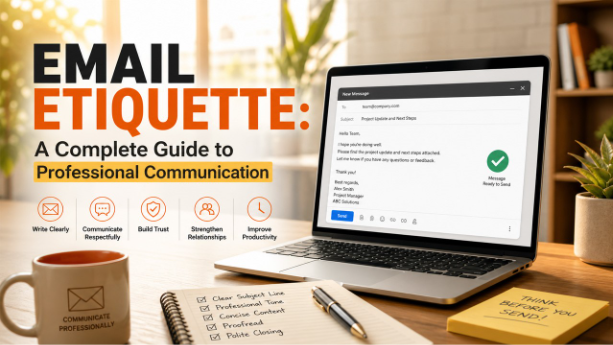
Understand what email etiquette is, and learn its key components, application, benefits, and limitations.
Email etiquette is a set of principles aimed at enhancing professionalism in a digital mode of communication. Email etiquette includes proper greetings, along with concise structure and appropriate tone. It also ensures that the messages sent by the sender are actionable and courteous. A proper email etiquette includes a few key components, like subject line, greetings, structured body, and professional tone.
The proper email etiquette helps build trust, along with avoiding miscommunication. It also ensures professionalism, especially when non-verbal cues are absent. Email etiquette is also essential in maintaining a positive working relationship with colleagues or clients.
What is Email Etiquette?
In simple words, email etiquette is a set of principles for clear, professional, and respectful communication, digitally. It includes proper greetings, along with concise structure and appropriate tone. Email etiquette also ensures that the emails are actionable and courteous.
A proper email etiquette helps the user build trust with the recipient, along with avoiding miscommunication and ensuring professionalism. It is also essential to maintain a positive relationship in the workplace, especially when non-verbal cues are absent
Benefits of Email Etiquette
A proper email etiquette helps strengthen the professional reputation of the sender, along with increasing communication clarity and improving efficiency. It also helps ensure that the messages are read and understood without creating any misunderstandings. It also helps in saving time and present themself as reliable and competent professionals.
Some of the major benefits of email etiquette include:
- Maintain Credibility: Email etiquette ensures a proper email tone, spelling, and grammar. This helps in building trust with clients and colleagues.
- Enhance Email Clarity: A concise and well-organized email helps ensure that the recipient understands the message quickly.
- Boosts Productive Time: A clear subject line, along with direct and well-structured content, helps the recipient prioritize messages. It also helps in accelerating the decision-making process, along with project workflows.
- Reduces Errors: A proper or business email etiquette includes double-checking the content, attachments, and recipient, which ensures minimizing the risk of accidental information sharing.
Limitations of Email Etiquette
While fostering professional communication, email etiquette also features key limitations, like the inability to convey tone, which often leads to misunderstanding.
Some of the major limitations of email etiquette include:
- Misinterpreted Tone: Professional emails, without verbal tones or body language, seem rude, abrupt, and cold.
- Perpetual Miscommunication: Emails can often lead to long confusion. These can also lead to damage to professional relationships with clients or colleagues.
- Cultural Disconnects: Often, cultural differences can also lead to a violation of email etiquette, which can cause offence, even when standard professional language is followed.
Why is Email Etiquette Essential?
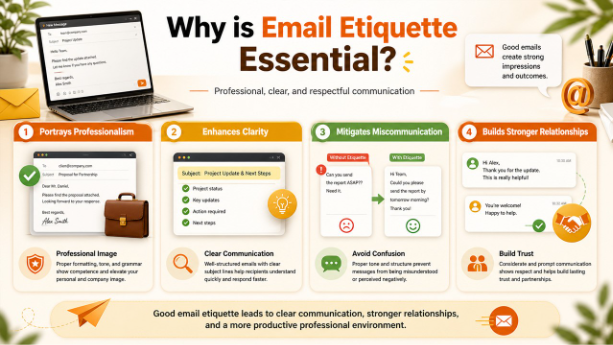
Email etiquette helps in fostering professionalism, along with ensuring clear communication between the sender and recipient. It also helps in building trust, along with enhancing productivity and reputation. It also helps in providing a proper tone and structure of the digital medium and ensures that the messages are polite and efficient.
Major factors why email etiquettes are essentials are as follows:
- Portrays Professionalism: Email etiquette includes proper formatting, along with spelling and tone, signaling competence. It helps boost the personal brand, along with enhancing the company’s image. Sender can use the business email format, which delivers a clear and effective message to the recipient.
- Enhances Clarity: A well-structured email consists of clear subject lines, which ensure that the recipient understands the purpose of the email immediately. It also allows the recipient to facilitate faster responses and reduce unnecessary follow-ups.
- Mitigates Miscommunication: Email etiquette acts as a guide to the recipient, in the absence of body language, which helps in preventing the message from appearing rude or ambiguous.
- Builds Stronger Relationships: Email etiquette offers considerate and prompt communication, which demonstrates respect for the recipient, helping in building stronger trust and partnership.
Key Aspects of Email Etiquette
Email etiquette depends on clear, professional, and respectful communication, which is used to ensure that the messages are read and acted upon by the recipient. The essential aspects of effective email etiquette include concise content, along with descriptive subject lines, and professional tones.
The key aspects of effective email etiquette include:
- Descriptive Subject Line: Create a clear subject line that outlines the purpose of the email.
- Professional Greetings and Closings: Use appropriate greetings and sign-offs.
- Concise and Scannable Content: Draft a concise email content, using short paragraphs, and use points.
- Proper Language and Tone: Maintain a polite and professional tone. Also, avoid using all capital letters and exclamation points.
- Response Time and Efficiency: Try to respond to an email within 24 hours and avoid unnecessary “Reply All”.
- Proofreading and Accuracy: Check for spelling, grammar, and punctuation errors to maintain professionalism.
- Professional Signature: Include a signature, which consists of the full name, title, and contact information of the sender. There are email signature examples that the sender may use to maintain email etiquette, like attaching an email signature with social icons or using an email signature with banners.
- Attachment and Privacy: Ensure to attach the correct attachments. Also, use BCC when emailing large groups.
There are other key email etiquette rules and aspects which are aimed at representing professionalism and boosting the sender’s reputation, like describing the email attachments and using standard fonts and formats.
Common Email Etiquette Mistakes
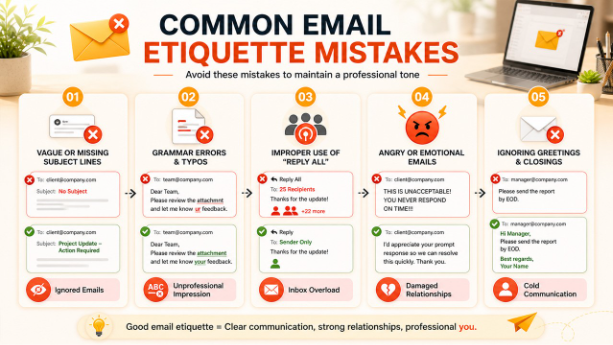
There are various key email etiquette mistakes that senders to definitely avoid, to maintain a professional tone. Some key email etiquette mistakes include:
- Vague or Missing Subject Lines: Emails with no or vague subject lines often get ignored by the recipient.
- Grammar Errors and Typos: Lack of proofreading the email content also hinders the professional appeal of the sender.
- Improper Use of “Reply All”: Using “Reply All” when the message is only relevant to the sender leads to inbox fatigue.
- Angry or Emotional Emails: The sender should avoid sending angry or emotional emails, as such messages can damage professional relationships.
- Ignoring Greetings and Closings: Skipping a polite salutation makes the message feel cold or impersonal.
Application of Email Etiquette
A proper email etiquette offers its applications across all forms of professional communication, which includes workplace communication, job applications, client communication, and follow-up emails, among others.
Some key applications of email etiquette in different scenarios include:
- Workplace Communication: In the workplace, email etiquette ensures that clear, professional, and respectful communication is maintained. It also helps in increasing productivity, along with strengthening professional relationships and preventing misunderstandings.
- Job Application: For a job application, proper email etiquette is essential, as it serves as the first impression of the applicant, reflecting their professionalism and attention to detail. Using proper email etiquette, like using a clear subject line, a professional email address, and error-free texts, significantly increases the chances of getting noticed by recruiters.
- For Students: A proper email etiquette for students helps build a better relationship with the faculty. It also increases the likelihood of getting a positive and timely response. An email etiquette for students helps project maturity, along with demonstrating respect for the recipient and building essential and transferable skills.
- Client Communication: For client communication, proper email communication helps build trust and professionalism. It also prevents misunderstandings and ensures that the messages are clear, concise, and respectful. For client communication, email etiquette helps improve efficiency, as it reduces unnecessary back-and-forth.
- For Army Personnel: In military environments, email etiquette becomes even more critical due to the need for clarity, discipline, and chain-of-command communication. Platforms like Army Outlook are often used for official correspondence, where maintaining a formal tone, using precise subject lines, and avoiding ambiguity is essential. Proper email etiquette for army personnel ensures that communication remains secure, efficient, and aligned with organizational protocols.
Conclusion
Email etiquette can simply be explained as a set of principles or guidelines that ensure that a clear, professional, and respectful communication is maintained between the sender and the recipient. Proper email etiquette helps in building trust between the sender and recipient. It also enhances the clarity of the mail, along with reducing errors and boosting productivity time.
The email etiquette helps in portraying professionalism and also maintains clarity. A proper email etiquette includes various key aspects, like a descriptive subject line, a professional greeting and closings, proper language, and a professional signature, among others. Email etiquette offers various key applications, especially workplace communication, job applications, for students, and client communications.
Frequently Asked Questions
Why is email etiquette important in professional communication?
Proper email etiquette is considered a crucial element in professional communication. It helps in maintaining a positive reputation, along with preventing misunderstandings and damage relationships.
What are the key components of proper email etiquette?
There are various key components of proper email etiquette. Some of the major components include a descriptive subject line, professional tone, proper greeting, and following up within 24 hours.
What is the ideal length of the proper email body?
In a professional email, the email body should be between 50 and 125 words. While emails with 200 words are also acceptable, it is recommended to create a concise and clear message for a higher response rate.
What is the role of a professional email signature?
In a professional email, the signature is among the most important components. A professional email signature acts as a digital business card, which establishes the credibility of the sender, along with providing instant access to the contact information and improving brand identity.
Can email etiquette help reduce miscommunication?
Yes, proper email etiquette is considered the best technique to reduce miscommunication. A proper email etiquette helps in enhancing clarity, along with reducing ambiguity and managing the tone of the message.