












 Continue with Google

 Share on media
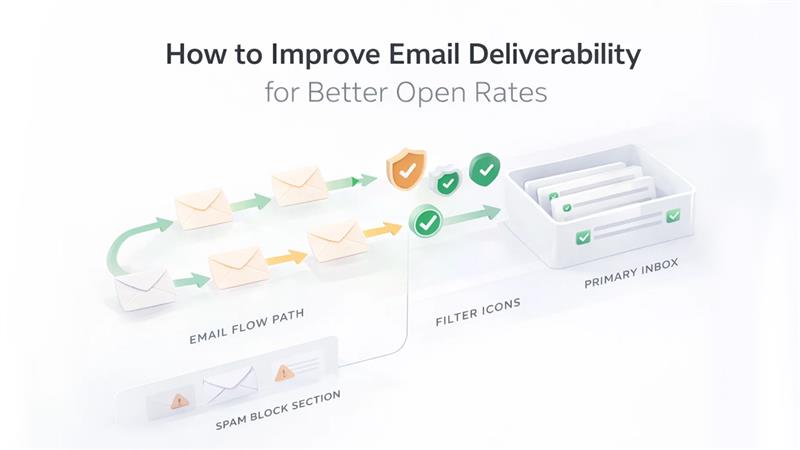
Want to boost your conversion, while reducing email spam complaints? Learn how to improve email deliverability in a few easy steps.
The blog offers you a deep dive into the workings, benefits, and key tips to improve email deliverability. An improved email deliverability helps in maximizing ROI, along with maintaining the sender’s reputation. There are three main methods to improve email deliverability, which include key steps like authenticating your domain, monitoring metrics, using double opt-ins, and avoiding excessive sending, among others.
What is Email Deliverability?
Email deliverability can simply be explained as the ability to successfully land emails in the primary inboxes of the recipient, rather than in the junk or spam folder. Email deliverability acts as a measure of email relevance and the sender’s reputation, ensuring that emails are wanted and safe. Through email deliverability, marketers gauge their email campaign to reach their subscribers’ inboxes.
Benefits of Improved Email Deliverability
Some of the key benefits of improved email deliverability are as follows:
- Increases Conversion and ROI: An improved email deliverability helps boost the return on investment and conversion rate, as higher placement of email in the inbox results in more email openings, clicks, and sales.
- Improved Sender’s Reputation: With the emails constantly reaching the inbox of the recipients, a positive reputation is built with the ISPs, ensuring future trust.
- Builds Trust: Emails reaching the primary inbox of the recipient strengthen the relationship between the sender and the subscribers.
Factors Affecting Email Deliverability
Email deliverability is primarily determined by the reputation of the sender, along with list quality and authentication. There are various key factors that affect email deliverability, which include lower engagement metrics, low quality of the list, and higher sending consistency, among others.
Some of the major factors affecting email deliverability are:
- Sender Reputation: Sender’s reputation is tracked by the ISP tracking of your email sending behavior and is among the major factors that affect the deliverability of an email.
- Low List Quality: Factors like high volume of invalid or inactive emails, along with inclusion of “spam trap” emails, also lead to lower email deliverability.
- Engagement Metrics: High spam complaints, low open rates, or higher unsubscribe rates also significantly affect email deliverability.
- Higher Sending Volume: Infrequent sending patterns, along with abrupt spikes in volume, also trigger the ISPs, affecting the deliverability of the email.
How to Improve Email Deliverability?
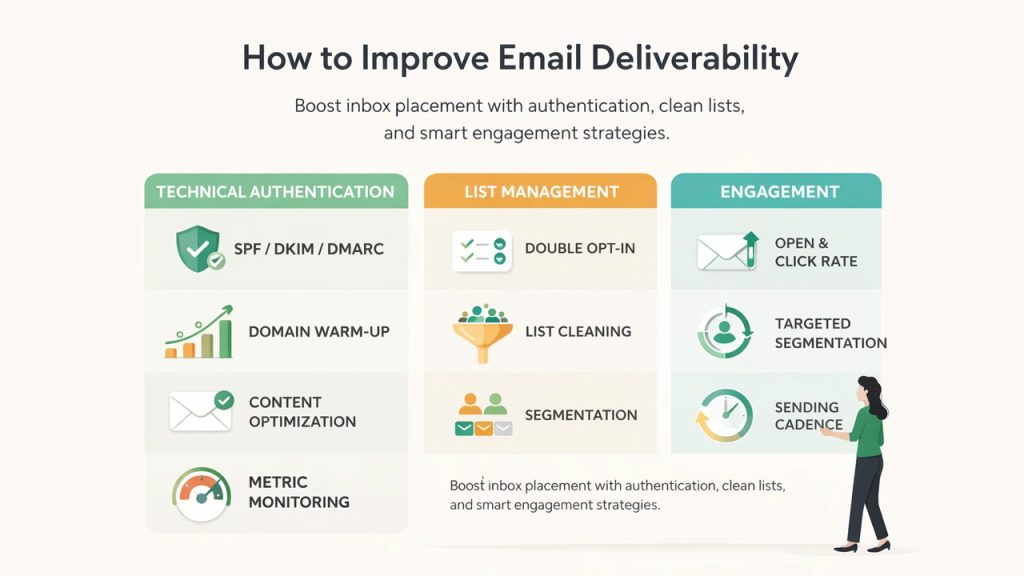
To improve the email deliverability, you need to follow a combination of technical authentication, quality management, and monitoring reputations. The process of improving email delivery key steps, like domain warm-up, optimizing email content, using double opt-in, and avoiding excessive sending, among others.
To understand the detailed process of how to improve email deliverability, you can follow the following process:
Technical and Content Authentication Method
The essential technical methods of improving email deliverability include key processes, like setting up technical authentication, i.e., SPF, DKIM, and DMARC, along with implementing domain warming and maintaining a clean reputation.
In the content authentication method, “Email Etiquette” also plays a key role in improving email deliverability. Email etiquette, merged with content authentication methods like SPF, DKIM, and DMARC, acts as a major “trust booster” to the ISPs.
Some of the major technical and content essentials for email deliverability include:
- Authenticating Your Domain: You can prove your legitimacy using the Sender Policy Framework (SPF), DomainKeys Identified Mail (DKIM), and Domain-based Message Authentication, Reporting, and Conformance (DMARC).
- Domain Warming: You also need to follow the crucial domain warm-up technique, in which the volume of the email is gradually increased to establish a positive reputation with the ISPs.
- Optimizing the Email Content: For improved email deliverability, you also need to optimize the content of the email, which includes avoiding spam-triggering words, excessive images, and URL shorteners, among others.
- Monitor Metrics: Constantly tracking and keeping the bounce rate below 2% with the help of Google Analytics and reducing spam complaints also helps in improving email deliverability.
List Management Method
The list management method to improve email deliverability focuses on the hygiene of the list. List hygiene is implemented by double opt-in, which verifies addresses and removes inactive subscribers. The list management method helps in reducing the bounce rates, along with minimizing spam and protecting the sender’s reputation. List management and segmentation are considered among the key email deliverability best practices.
Some of the key steps of list management methods include:
- Implementing Double Opt-in: The process uses a confirmed opt-in process for the new subscribers to verify their email validity and ensure that consent is attained.
- Regular List Cleaning: Under the process, you need to frequently remove the email addresses that are invalid, inactive, hard bounces, and spam traps, to prevent high complaint rates.
- Segmentation: Segmenting the list to send relevant and more relevant content boosts the engagement rate and also reduces the spam complaints.
Engagement Method
A key method of improving email deliverability is by increasing the engagement metrics, which boost the reputation of the sender. Increasing engagement metrics also ensure that the emails reach the inbox of the subscriber, rather than their spam or junk folder.
Some of the key processes to boost engagement include:
- Using Proper Segmentation: Using proper segmentation of the subscriber and tailoring messages to the specific audience helps in increasing the engagement metrics.
- Improving Engagement Rates: You need to focus on high open and click-through rates, which boost the engagement rates of the email and also indicate high-quality email content.
- Avoiding Excessive Sending: Excessive email sending leads to list fatigue, which can be avoided by optimizing your sending cadence.
Popular Tool to Improve Email Deliverability
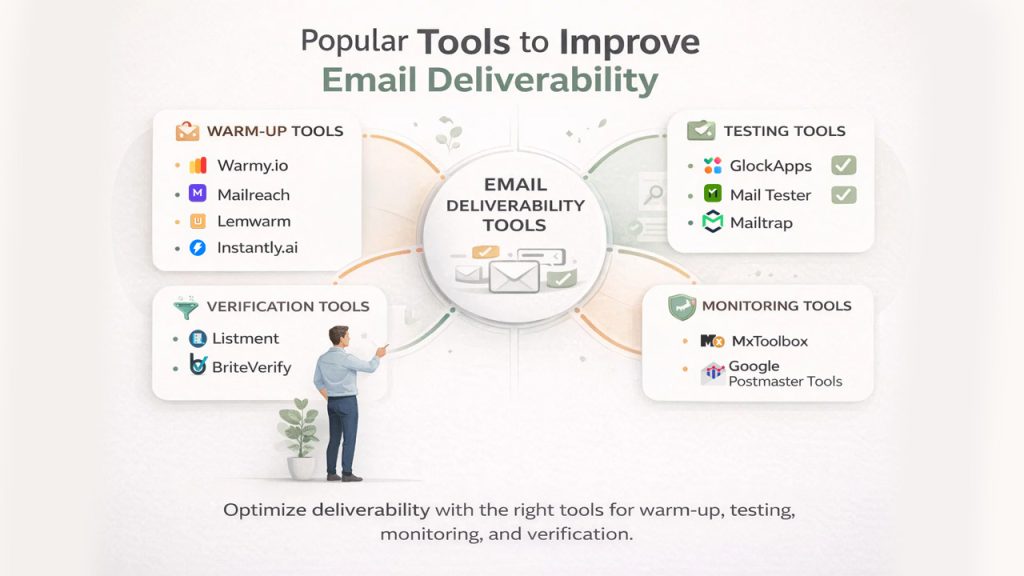
An email deliverability tool helps in ensuring that your mail reaches the inbox of the subscriber, rather than in their spam or junk folder. These tools offer various services, like placement testing, domain warmup, and reputation monitoring, which help in preventing spam folder placement. Some of the popular email durability tools are as follows:
Tools for Email Warm-Up:
Email warmup tools send automated emails between accounts, which helps in building a positive sender reputation. Some of the popular email warmup tools include:
- Warmy.io: Warmy.io is renowned for high-volume email warmup, along with offering AI-driven template control.
- Mailreach: The tool helps in setting up new or repairing damaged inboxes.
- Lemwarm & Instantly.ai: These are among the most popular email warmup tools for cold email outreach.
Tools for Deliverability & Inbox Texting:
The delivery and inbox testing tools help in checking if the emails land in the inbox, spam, or promotional tab.
- GlockApps: The tool offers inbox placement insight, along with spam testing and DMARC analysis.
- Mail Tester: A free-to-use tool that gives a quick score on the spamminess of your email.
- Mailtrap: Mailtrap offers a “sandbox” feature, where emails can be tested without impacting real recipients.
Tools for Domain and Infrastructure Monitoring:
The infrastructure and domain monitoring tools constantly track the technical components of the email, like SPF, DKIM, IP reputation, and blacklists, among others, to ensure the emails reach the inbox of the subscriber.
Popular domain and infrastructure monitoring are as follows:
- MxToolBox: The MxToolBox acts as the industry standard tool to check the DNS records, like SPF, DKIM, and DMARC, along with verifying if your IP is blacklisted.
- Google Postmaster Tools: A free tool that monitors domain reputation, specifically with Gmail.
Tools for Email Verification:
The email verification tools help in keeping your subscriber list clean. The tools help in removing invalid or risky emails, which reduces the bounce rates. Some popular email verification tools include:
- Listment: Listment is among the most effective tools for validating “catch-all” emails.
- BriteVerify: BriteVerify is renowned for its robust list cleaning.
Apart from the tools, there are various email deliverability consultants that help in ensuring the emails reach the inbox, instead of the spam folder, and maximize the campaign effectiveness.
Read More: Role of Email Deliverability Consulting
Conclusion
Email deliverability is the ability of an email sent by a sender to successfully land in the primary inbox of the recipient, rather than their spam or junk folder. With improved email deliverability, the reliability and reputation of the sender increase, resulting in higher revenue and return on investments. There are three main methods to improve email deliverability, which include: engagement, technical and content authentication, and list management methods. These methods offer key processes like domain warmup, list segmentation, double opt-in implementation, and engagement monitoring, providing a detailed answer to the question of how to improve email deliverability.
FAQs
How to prevent email from going to spam?
To prevent your email from going to the sender’s spam list, you need to authenticate your domain, along with avoiding trigger words like “act now” and “guarantee” in the subject line.
What are Domain Warm-ups?
A Domain warm-up is the process of increasing the email volume gradually, from a new domain, which establishes a positive reputation with ISPs (mailbox providers).
What are good email deliverability metrics?
Good email deliverability rates are as follows:
- Delivery Rate: >95% to 98%.
- Inbox Placement Rate: >80% to 90%.
- Spam Complaint Rate: <0.1%.
- Bounce Rate: <2%.
- Sender Score: 90+
Can content affect email deliverability?
Yes, the content of the email significantly affects its deliverability. Various mailbox providers analyze the content of an email to prevent phishing or spam, which can cause emails to be blocked or sent to the spam folder.
What are some popular tools to monitor email deliverability?
There are various popular email deliverability monitor tools, like Google Postmaster Tools, Microsoft SNDS, GlockApps, Folderly, InboxAlly, MxToolbox, and TrulyInbox, among others.