











 Continue with Google

 Share on media
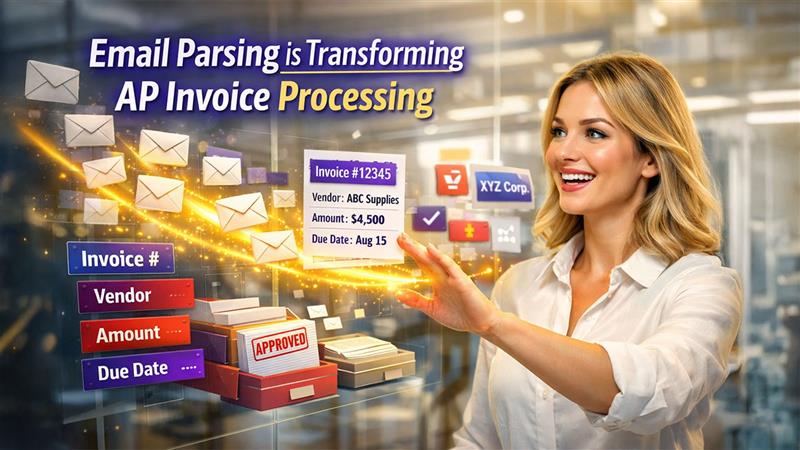
Accounts payable teams have to deal with an influx of vendor invoices being sent via email in all sorts of unstructured formats, from different senders, and at unpredictable frequencies. Manually processing each one of them is laborious and can be challenging to scale.
This is where email parsing for invoices comes into play. By extracting structured data from invoice emails, businesses can look to automate and speed up their accounts payable invoice processing.
This blog aims to provide an overview of what exactly is email parsing, how it works, and why it is important for accounts payable teams, along with some best practices.
What Is Email Parsing?
Email parsing is the process of automatically extracting specific information from incoming emails and converting the extracted information into a specific format, such as CSV or a database record. Specialized software reads the content of the email and uses pre-defined rules or algorithms to identify and extract specific information such as sender information, dates, subject lines, invoice numbers, and financial information.
In simple terms, instead of having someone read the email and manually enter the information into the system, email parsing does the work automatically.
How Does Email Parsing Work?
The email parsing process follows a clear, repeatable sequence:
- Step 1 – Receiving the Email: The business email inbox receives an email containing invoice information from a vendor, supplier, or billing system.
- Step 2 – Identifying Relevant Data: Using pre-defined parsing rules or algorithms, the system scans the received email and extracts relevant information such as invoice amounts, invoice numbers, due dates, and vendor names.
- Step 3 -Structuring the Data: The identified data is put into a structured format, which can be a CSV file, a spreadsheet row, or a database record.
- Step 4 -Integration: The structured data is automatically sent to connected business systems, which can be an ERP system, accounting system, or AP system. For businesses that need to connect financial data with customer and business operations, CRM and Finance Integration can help create a more connected workflow.
Practical Example: An e-commerce business can use email parsing to automatically extract customer order details from confirmation emails and update inventory levels in real time—the same principle is applicable to data extraction from invoices in an AP system.
Why Email Parsing Matters for AP Invoice Processing
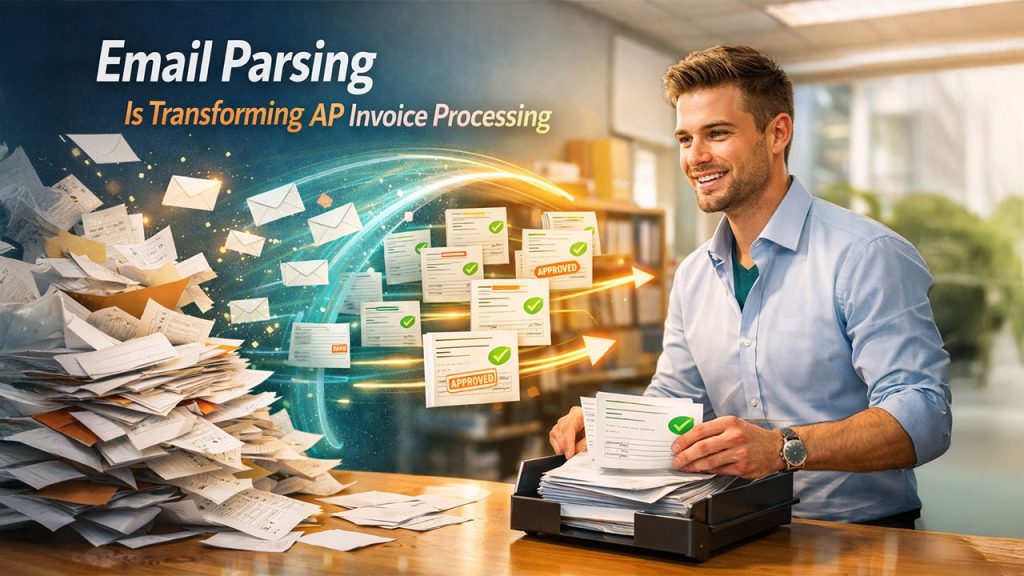
One of the most tedious and time-consuming processes for the finance department is the AP invoice processing. Email parsing helps remove these inefficiencies and automates the process of extracting data from the emails and attachments. This increases efficiency as employees do not have to input invoice data into accounting systems, freeing them up to concentrate on more important activities, such as exception handling and financial analysis.
Another important advantage of email parsing is that it increases data accuracy. It is often difficult to avoid human errors when entering data manually. Such errors may lead to payment duplication, incorrect payment amounts, or even missed payment deadlines. With email parsing, there is no chance of such errors occurring.
Email parsing also supports scalability. With a growing business, there is a corresponding increase in the number of invoices. An automated system is useful in this case since it can handle many invoices without the need to hire extra personnel.
Lastly, email parsing reduces costs of doing business. An automated system reduces labor costs and increases productivity.
Key Benefits of Email Parsing for Accounts Payable
The advantages of automated invoice processing through email parsing extend beyond efficiency:
- Time Savings: Automation of data extraction can help in saving considerable amounts of time as more and more invoices can be processed on a daily basis without any hold-up.
- Data Accuracy: The elimination of manual data entry can help in ensuring high accuracy of data extracted from invoices.
- Cost Effectiveness: Organizations can save on the cost of hiring more personnel to manage the data entry process, which would be the case if the organization were to use conventional means.
- Seamless Integration: Most email parsing tools integrate with the most commonly used business systems, such as the CRM, ERP, and accounting systems, to ensure the process flows smoothly. When invoice data also needs to connect with billing workflows, CRM and Billing Integration can help businesses synchronize customer, invoice, and payment-related information more efficiently.
How Email Parsing Fits into Email Extraction Workflows
Businesses generally receive a constant stream of emails, which may contain invoices, purchase orders, receipts, customer requests, and other important documents. Organizations need to extract meaningful information from these emails and feed it into business applications. This is where email extraction and email parsing work together.
Email extraction collects relevant email information, such as attachments or metadata. Once these data are collected, email parsing analyzes their content to identify and extract specific pieces of information, such as invoice numbers, vendor names, due dates, payment amounts, purchase order numbers, or customer details. This process is closely connected to ETL Process Optimization, where extracted data is transformed, validated, and prepared for efficient use across business systems.
Email Extraction Workflow includes the following steps:
- Step 1: Email Collection
Relevant emails are automatically retrieved from designated inboxes or folders.
- Step 2: Email Filtering
Emails are filtered based on various criteria, such as sender, subject line, keywords, labels, or attachments, to identify invoice-related messages.
- Step 3: Content and Attachment Extraction
The email body and any attachments are extracted for processing.
- Step 4: Email Parsing
The parser identifies predefined fields and extracts structured data.
- Step 5: Data Validation
Extracted information is validated against business rules, vendor databases, or purchase orders.
- Step 6: System Integration
The structured data is automatically sent to the predefined location, such as CRM software, ERP, or accounts payable.
Email Parsing vs Email Scraping vs Email Extraction
Email parsing, email scraping, and email extraction mainly refer to the distinct processes that serve different purposes.
Email parsing is the process of analyzing the content of an email and converting unstructured information into structured data. The parser identifies predefined fields within the email body and extracts valuable information.
Common Application:
- Invoice data extraction
- Order processing
- Lead capture
- Customer support automation
Email extraction is the process of retrieving emails, attachments, and metadata from one or more email accounts or mail servers. It mainly focuses on collecting email data from various platforms, such as Gmail, Outlook, Microsoft Exchange, IMAP, or PST/OST.
Common Application:
- Exporting emails from Outlook or Gmail
- Collecting invoice emails from vendor mailboxes
- Email backup and archiving
Email scraping refers to collecting email addresses from various sources, such as websites, online directories, documents, and other digital sources. Scraping does not retrieve emails from a mailbox. Unlike email extraction, it just gathers contact information for marketing, sales, recruitment, or research purposes.
Common Application:
- Lead generation
- Sales prospecting
- Market research
- Recruiting
A quick comparison between Email Parsing vs Email Scraping vs Email Extraction:
| Features | Email Extraction | Email Parsing | Email Scraping |
| Primary Purpose | Retrieve emails and attachments. | Extract structured data from email content. | Collect email addresses from public sources. |
| Output | Email, attachments, and metadata. | Structured fields like invoice numbers, vendors, or amounts. | Email addresses and contact information. |
| Works on Existing Mailboxes | Yes | Yes | No |
| Support Attachments | Yes | Yes | No |
Common Use Cases Beyond Invoice Management
Although AP invoice processing is arguably one of the most impactful email parsing business functions, email parsing itself performs various business tasks:
Invoice Management: Parsing tools help automate invoice data extraction such as invoice due amount, invoice number, invoice date, and vendor name for smoother accounts payable and accounts receivable processing.
Lead Capture and CRM Integration: The extracted data from the emails can be automatically fed into CRM systems, which can help in faster response times and more accurate tracking of leads.
Customer Support: Customer support teams can utilize email parsing to automatically route emails to the concerned teams based on the content of the emails.
E-commerce Order Processing: The data extracted from confirmation emails can be automatically fed into the inventory management system.
Top 4 Email Parsing Tools
There are several tools that can be used to automate invoice processing using email parsing. Here are some of the top tools for parsing emails:
- Mailparser.io is a versatile tool, and it can be used by any business, whether small, medium, or large-sized. This tool can parse emails, attachments, and much more. This tool offers the option of customizing emails using templates, and this makes it one of the best email parsing tools. A business can create a perfect invoice parser within minutes by following the setup process of Mailparser.io.
- Parseur is known for its strong Optical Character Recognition (OCR). Parseur is quite effective in dealing with complex documents and attachments. It is also suitable for companies dealing with invoices, receipts, and other types of documents.
- Email Parser by Zapier For teams that are already using Zapier for workflow automation, Email Parser by Zapier is a great option. This tool parses emails and automatically performs actions across multiple platforms, allowing for easy connection of AP data to other tools.
- Integromat (now Make) Make provides email parsing in conjunction with powerful workflow automation tools. It is recommended for use by businesses that aim to automate end-to-end workflows, such as receiving invoices and approving payments.
Each of these tools excels in its own right. The right tool for you depends on the size of your business and the intricacy of your invoices.
Email Parsing Best Practices for AP Teams
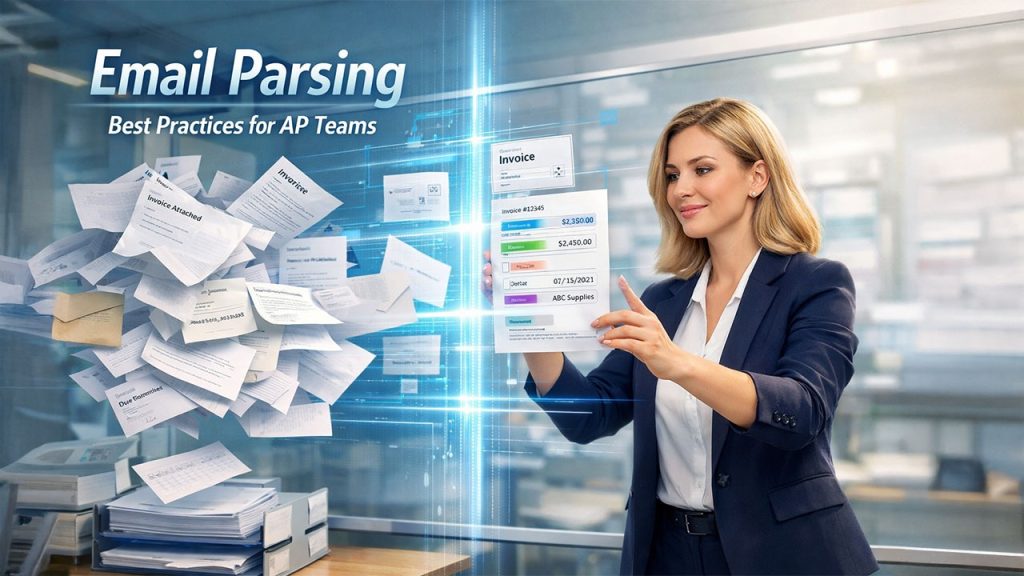
To ensure that the parsing process yields accurate and consistent results for AP invoices, the following best practices are applicable:
- Template Design: Designing email templates that clearly define the data to be extracted is important. A standardized format for vendor emails helps ensure accurate parsing results.
- Error Handling: Implement an error handling system to deal with situations when emails do not comply with a standard format or when essential data fields are not provided.
- Data Security: Since we are dealing with invoice parsing that includes sensitive financial data, it is essential to ensure that the software of your choice complies with data security standards such as data encryption and GDPR regulations.
- Ongoing Optimization: It is essential to continually optimize and improve parsing rules to cater to any changes made to vendor email formats or any other business needs.
Challenges in Email Parsing and How to Address Them
However, there are a few challenges which might arise during the implementation of email parsing for invoices, despite its advantages. For instance, one of the problems which might be encountered during the parsing process is the parsing of complex emails. Some emails might be in different formats or might be complex, which makes the parsing process difficult. Using sophisticated email parsing tools which utilize machine learning might be useful in such cases.
Another issue is data quality. At times, it is possible that the extracted data is incomplete or incorrect due to formatting issues. The implementation of validation rules and monitoring of parsing can help in correcting this.
Lastly, tool limitations may also impact performance. It is worth noting that not all email parsing tools are the same; therefore, businesses should select a tool that is suitable for their accounts payable process.
The Future of Email Parsing in Accounts Payable
The prospects for email parsing in AP automation are positive. Advances in artificial intelligence and machine learning are enabling accuracy and efficiency in parsing, even in complex scenarios such as context-based parsing.
With the growing demand for accounts payable automation, email parsing is being incorporated into comprehensive business automation solutions. This enables the automation of the entire accounts payable process without human intervention at any stage of the process.
By investing in email parsing infrastructure, companies can effectively handle the increasing volume of invoices while avoiding the need for proportional increases in human resource costs and processing times.
Conclusion
Email parsing is a viable and effective way to automate the processing of AP invoices, which helps to reduce manual processing efforts. This is because it aids in the automation of invoice processing in a much faster and more accurate way compared to when it is done manually.
By integrating email parsing with AP Invoice Processing, businesses can significantly reduce manual workload, improve data accuracy, and scale their finance operations efficiently. Whether a business is handling dozens or thousands of invoices every month, email parsing and overall accounts payable automation offer a clear path to a more efficient, more accurate, and more cost-effective AP function.
To get a sense of the broader context in which this kind of tech is utilized, check out this in-depth resource: What Is Email Scraping? – a must-read for anyone interested in learning more about this kind of data extraction from digital communications.
FAQs
What types of invoice data can email parsing extract?
Email parsing extracts fields like vendor name, invoice number, date, due date, totals, taxes, and payment terms based on configured parsing rules.
Is email parsing suitable for invoices in PDF attachments?
Yes. Tools with OCR can read PDF attachments and extract invoice data automatically, making them useful when vendors send invoices as files.
How does email parsing integrate with accounting or ERP systems?
Parsed invoice data is automatically sent to accounting or ERP systems using APIs, integrations, or automation tools, removing manual entry.
What happens if an invoice email does not match the expected format?
If the format differs, the system flags the email for manual review to prevent incorrect data processing and allows rule adjustments.
Is email parsing secure for handling financial data?
Most tools use encryption and follow standards like GDPR to protect financial data, but businesses should review security policies before use.