











 Continue with Google

 Share on media
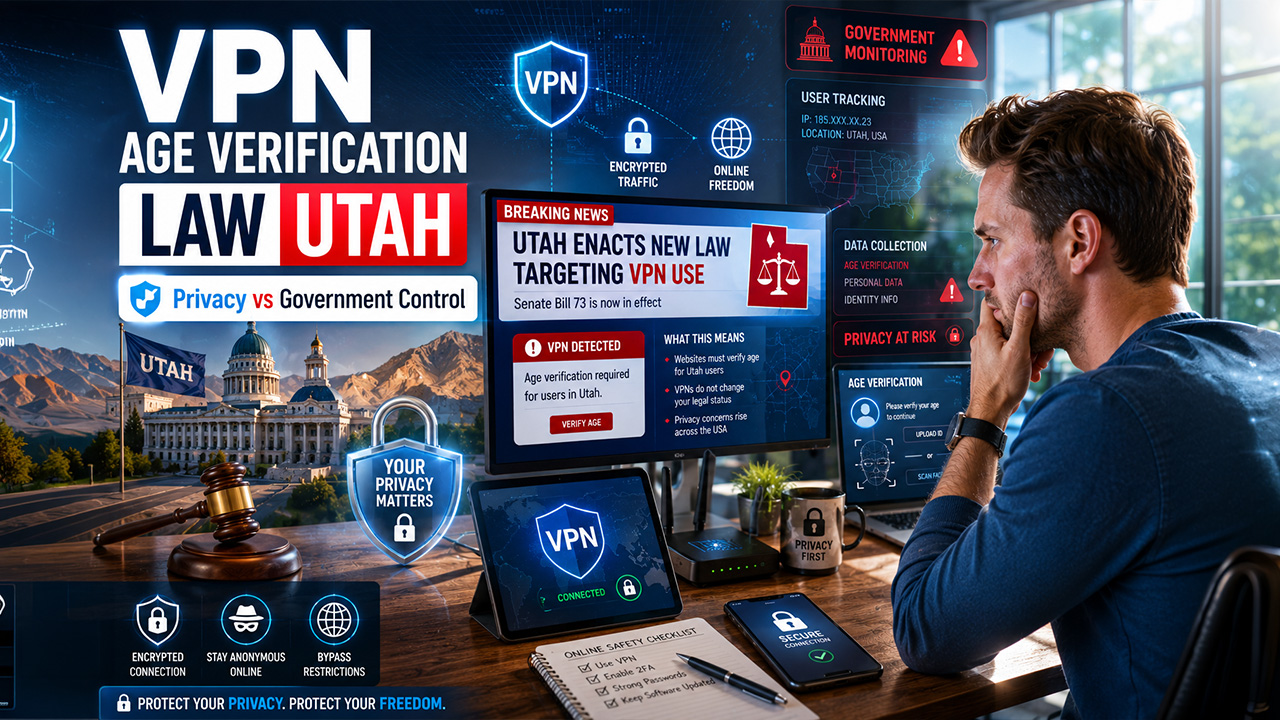
Recently, Utah became the first state in the country to go after VPN use itself, not just adult content. Senate Bill 73 took effect on May 6, 2026, and the VPN age verification law Utah introduced is already making privacy experts, VPN companies, and everyday internet users pretty anxious. Understanding this law matters because the VPN restrictions in Utah stretch far beyond adult websites.
Let’s discuss what the law actually says, what it does not say, and what it means for anyone who uses the internet today.
What Is Utah’s New Law and What Does It Actually Do?
Senate Bill 73 is the one to understand well. Officially named the “Online Age Verification Amendments,” it was signed by Governor Spencer Cox on March 19, 2026. This bill covers a few different things, and most of it is about a 2% tax on adult content revenues. That part gets less attention.
The part that draws attention in the privacy community is a single section targeting VPN use specifically. Under this section, if a person is physically sitting in Utah, the law treats them as a Utah user; that’s it. It does not matter if they are routing their traffic through a server in another country.
A VPN, a proxy, any tool that masks their location, none of it changes their legal status under this law. On top of that, websites hosting adult content are now prohibited from telling their own users how a VPN works or how to use one to get around age checks.
Why Did Utah Lawmakers Introduce This Law?
The reason behind introducing the VPN age verification law in Utah is child safety online. Lawmakers noticed that every time a state passed an age verification mandate, VPN usage spiked almost immediately. Earlier, people used VPNs to bypass age gates and access adult content without showing identification.
Instead of asking why so many people were avoiding age verification, Utah decided the VPN itself was the problem. Privacy advocates argue the real effect is a direct attack on a legal, widely used privacy tool that millions of people rely on for reasons that have nothing to do with adult content.
Does Utah Actually Ban VPNs?
No. The VPN restrictions in Utah do not mean a total ban on VPN use. The law takes a “don’t ask, don’t tell” approach. A website only has an obligation to check for age if it actually learns a user is in Utah and using a VPN.
Still, the law holds websites legally responsible for the age of anyone physically in Utah, VPN or not. That puts a big pressure on websites to either block all VPN traffic or require age verification from every visitor across the globe, including people who have nothing to do with Utah.
How VPN Restrictions in Utah Work in Practice?
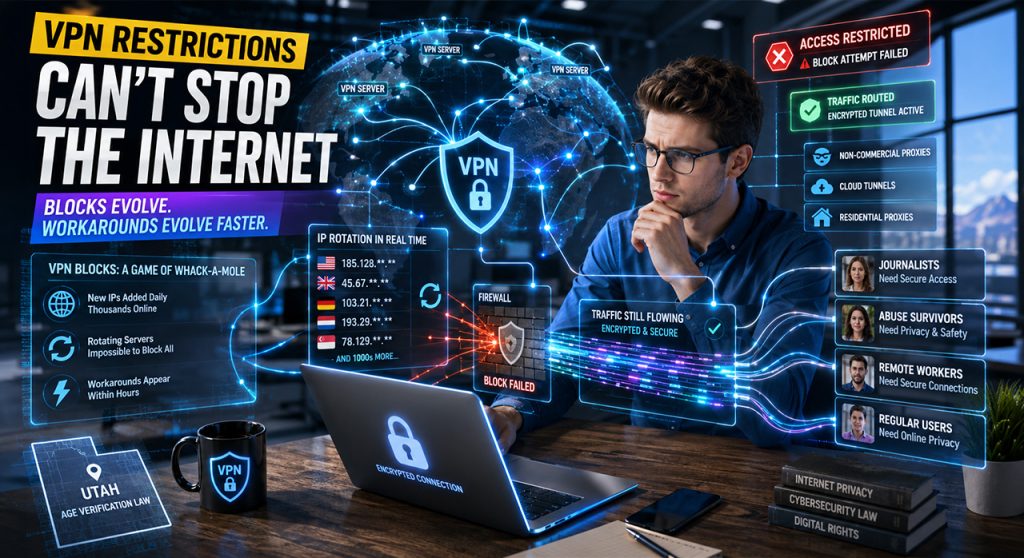
Here is the core technical problem with enforcing the VPN age verification law in Utah. VPN providers constantly rotate and add new IP addresses, and no complete blocklist exists. Trying to block all known VPN or proxy IPs is essentially a game of whack-a-mole that no website can genuinely win.
If commercial VPNs get blocked, users shift to non-commercial proxies, private cloud tunnels, or residential proxies that look similar to standard home traffic. Workarounds appear within hours.
Meanwhile, the people who suffer most are journalists, abuse survivors, remote workers, and regular users who rely on VPNs to stay secure, not to bypass content rules.
How Online Age Verification Systems Work?
Age verification online takes several forms, and understanding them helps explain why concerns around internet privacy laws in the USA are so serious nowadays.
Government ID upload requires users to submit a photo of a license or passport. Credit card checks assume cardholders are adults. AI face scans estimate age from facial features. Third-party database tools cross-reference identity records externally. Each method collects personal data that carries real risks.
A breach at an age verification company could expose sensitive identity information for millions of people, and that is not a hypothetical. It has already happened in other contexts.
User Verification in Email Systems vs. Website Age Verification
User verification in email systems works on a similar idea, but with a much lighter footprint. Signing up for an email platform requires a simple link click to confirm you own that address.
No government document. No face scan. Website age verification goes much further, demanding proof of identity that leaves a permanent data trail. The two systems share the goal of confirming who someone is, but the stakes are completely different.
User verification in email systems confirms an address. Age verification for restricted content demands sensitive personal information that can be stored, sold, or stolen.
Internet Privacy Laws USA and Where Utah Fits In
Utah is not operating alone. Internet privacy laws in the USA have been shifting fast at the state level. California, Virginia, Texas, Florida, and Colorado all have consumer privacy laws in place.
Several states have passed age verification mandates for adult websites. What makes Utah stand out is that it went a step further and targeted the tools people use to avoid those mandates. No other US state had done that before the VPN age verification law took effect in Utah on May 6, 2026.
How Utah Compares to Other States
| State | Age Verification Law | VPN Targeting |
| Utah | Yes, SB 73 active May 2026 | Yes, first in the US |
| Texas | Yes, HB 1181 | No |
| Florida | Yes, HB 3 | No |
| Wisconsin | Proposed, VPN provision removed | Removed after pushback |
| California | Proposed, under review | No |
The Electronic Frontier Foundation has called this a dangerous precedent, one that prioritizes government control over the basic infrastructure of a private and secure internet. The VPN age verification law in Utah shows a new phase in how states approach internet privacy laws in the USA.
Privacy Concerns Driving the Debate
Privacy advocates are not being quiet about this one. The problem they keep coming back to is pretty straightforward. Complying with the VPN restrictions in Utah means websites now have to collect and store deeply personal information from an enormous number of users, many of whom never consented to that kind of data collection and have no idea it is happening.
Next comes the question of what happens to that data. Who stores it, for how long, and under what security standards? The law also raises First Amendment concerns because it bans websites from even informing their own users that VPNs exist as a privacy tool.
Sharing information about a perfectly legal piece of software is now potentially illegal under Utah law for websites hosting adult content.
Could Other States Follow Utah’s Lead?
The short answer is yes. The UK’s Children’s Commissioner has publicly called VPNs a “loophole that needs closing.” France’s Minister for Digital Affairs has named VPN restrictions as the next item on his list. In the US, Wisconsin proposed a similar VPN ban before removing it under public pressure.
Utah moved forward anyway. If this law survives legal challenges, other states will use it as a template. The conversation around internet privacy laws in the USA is shifting fast, and the VPN age verification law Utah has put something new on the table that governments elsewhere are watching closely.
Know What Is Happening Before It Affects You
This law is live now. The VPN age verification law Utah established on May 6, 2026, is already being felt, and the debate is far from over. Privacy groups are pushing back. VPN companies are speaking out. Lawmakers in other states are paying close attention. The tension at the center of this debate is real and not going away.
It’s a fact that child safety online is a legitimate concern, and so is the right to use the internet without surrendering your identity. Utah has landed firmly on one side of that debate. Stay informed, ask hard questions, and understand what is being traded away in the name of protection.
Frequently Asked Questions
Is using a VPN illegal in Utah?
No. The law goes after websites, not users. Platforms are the ones held responsible for verifying ages, even when someone is masking their location. Using a VPN stays legal.
Can websites actually detect VPN users?
Sort of. They can block known VPN IP addresses, but providers add new ones constantly. Nobody has a complete list, and nobody ever will. That is exactly why enforcement is such a mess.
Does this law affect all websites?
No. It targets commercial platforms hosting content considered harmful to minors. News sites, social platforms, and services using standard user verification in email systems are not in scope.
Is online age verification actually safe?
That depends on who is holding your data and how well they protect it. Breaches at verification companies have already happened elsewhere. Plenty of internet privacy laws, USA advocates say, the data risk is not worth it.
Why are privacy groups so critical of this law?
Because it punishes a legal privacy tool instead of fixing the real problem. It forces mass data collection, stops websites from even mentioning VPNs, and hands governments a template they can use far beyond adult content.