









 Continue with Google

 Share on media
In today’s fast paced modern world, where online messages and social media influences the conversation, email is a flexible and essential technology that connects people all over the world. Email stands out as the foundation of the modern environment where users can communicate, share, and exchange messages in real time. It helps marketers to directly engage with target audiences , drive growth, generate return on investment (ROI), and provide valuable information. This article will uncover the key advantages of emails in effective communication, exploring the tips to maximise its advantages and how its effectiveness and strengths address common concerns.
Email serves as a powerful communication tool, equipped with modern AI technologies. Its ability to eliminate location restrictions, offers a reliable medium for information sharing, and guarantees prompt message delivery. Whether you’re managing a corporate project or working with colleagues, email provides a relief and flexibility that is difficult to compare. It’s understandable why email is still the most popular way to communicate in both personal and professional settings.
Key Advantages of Email Communication
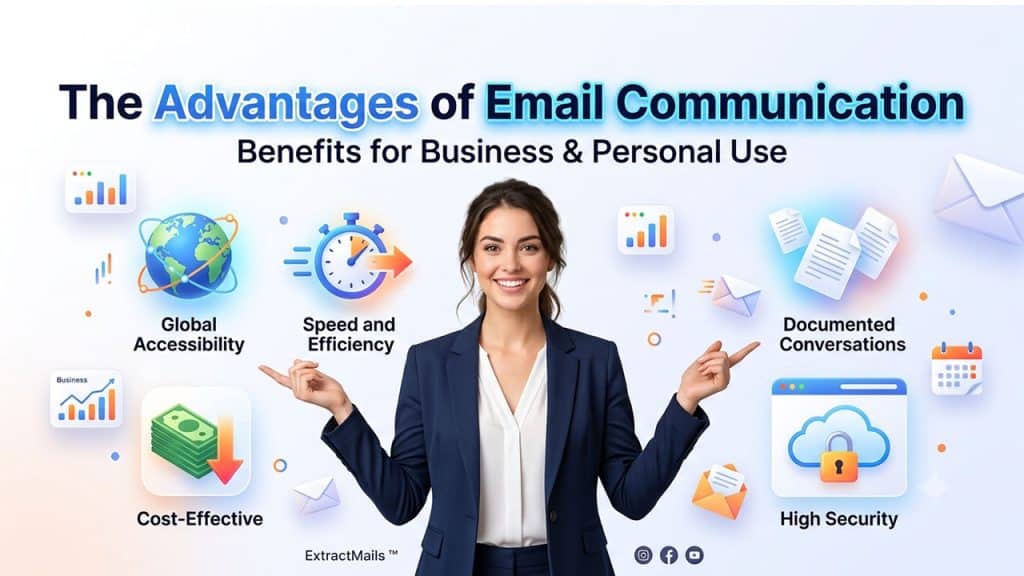
Email offers a fast, reliable, and cost-effective way to communicate. Below are the key advantages of email communication and why it remains an essential tool for personal and business use.
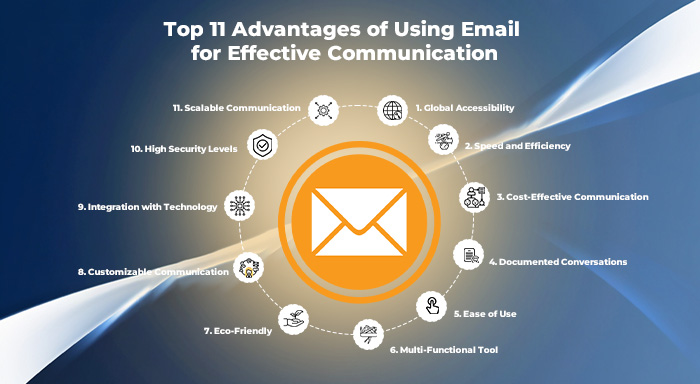
1. Global Accessibility
Emails are an effective tool, which communicate with people worldwide. With internet access, you can connect with anyone from anywhere which makes it a significant tool in the rapidly growing digital era. This benefit can help businesses operate across the borders and marketers or stakeholders to maintain long-distance relationships with their clients.
2. Speed and Efficiency
Email is renowned for its exceptional speed which takes a few seconds to reach its destination. Unlike traditional mail, which takes days to reach its destination.It allows users to communicate without delays and share urgent documents and updates which is essential in an advanced environment. The efficiency of emails is directly impacted by the time at which emails are delivered and opened, slow loading time leads to inefficiency and reduces the interest in the content.
3. Cost-Effective Communication
Businesses save an average of 50% of their communication cost by using emails over traditional methods. Phones and mails which can be expensive because it requires printing and shipping costs. The cost effective benefit makes it an ideal choice for individuals and businesses who are looking to optimise their budget or expenses.
4. Documented Conversations
Emails take permanent records of each communication within both the parties, which is invaluable for obligation and reference. It keeps written records, whether it’s meeting notes, personal correspondence, business agreement, or any file, which helps maintain clarity and resolve disputes. This is also used for monitoring project progress and keep everyone informed about the real time activity.
5. Ease of Use
One of the primary benefits of email is its ease of use. The majority of systems are made to be user-friendly, making it simple for people of any level of expertise to exchange, receive, and handle emails. Format your email so that it’s easy to read, use white spaces, paragraphs, and distinct blocks of text. Message tracking and discovery are made simple by features like search capabilities and structuring tools.
6. Multi-Functional Tool
Email is not only a tool for communication. It can be used for scheduling, sharing files, and even collaborating together. Apart from this sending and exchanging features, email has multi-functional capability. The ability to attach enormous documents and integrate with calendars make email a central location for work management and teamwork.
7. Eco-Friendly
By eliminating the requirement for paper-based communication, email is a more conscious environmental solution. Email promotes environment friendly behaviors by reducing the need for tangible goods like paper, envelopes, and delivery fuel.
8. Customizable Communication
Email provides more individualized communication. From formal business communication to informal updates for peers, emails can be customized to fit both the recipient and the goal. With the use of formatting tools, users may produce messages that are both effective and visually appealing.
9. Integration with Technology
Emails improve the functionality of many digital products through combining them seamlessly. Email may be integrated into almost any process, whether it’s integrating with cloud storage, task management apps, or customer relationship management (CRM) software.
10. High Security Levels
Email communication security is the highest priority. Features like spam filters, email filters, encryption, and two-factor authentication are available on modern platforms to guarantee that messages stay secure and confidential. They are essential safety measures for businesses that handle sensitive data.
11. Scalable Communication
Email is frequently used for both mass and individual communication because of its enormous scalability. Email gives you the ability to efficiently deliver a private note or publish an update to a big audience. Managing extensive communication is now easier than ever because of automation tools and mailing lists.
Common Challenges of Email Communication (And How to Overcome Them)
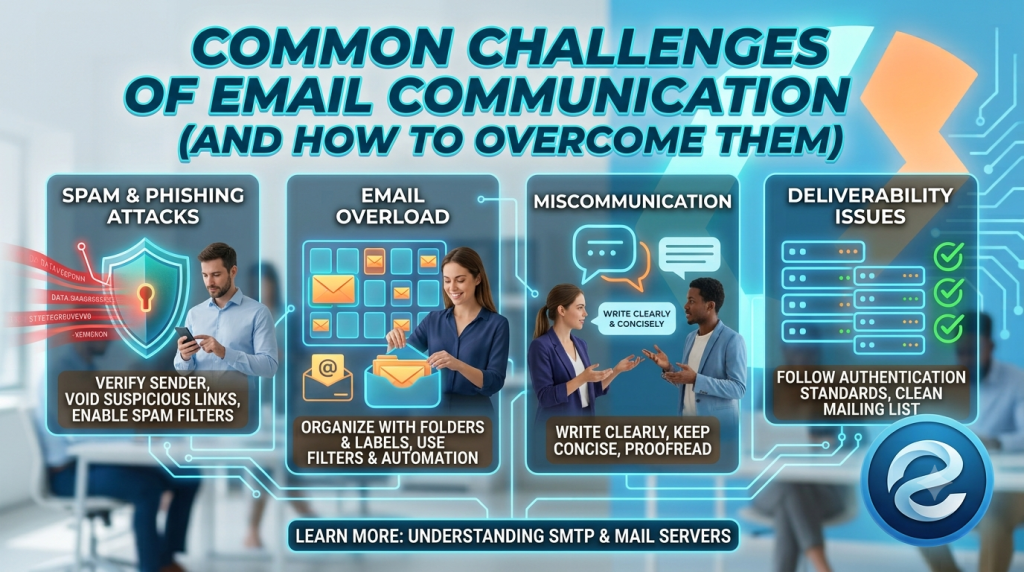
While email offers numerous advantages, it also comes with a few challenges. Understanding these limitations helps individuals and businesses use email more effectively.
Spam and Phishing Attacks
Spam emails and phishing attempts can waste time and put sensitive information at risk. Always verify the sender, avoid clicking suspicious links, and enable spam filters to reduce security threats.
Email Overload
Many professionals receive hundreds of emails every week, making it difficult to prioritize important conversations. Organizing emails with folders, labels, filters, and automation rules helps keep your inbox manageable.
Miscommunication
Since emails lack tone of voice and facial expressions, messages can sometimes be misunderstood. Writing clearly, keeping sentences concise, and proofreading before sending can prevent confusion.
Deliverability Issues
Even well-written emails may never reach the recipient if they land in the spam folder. Following email authentication standards and maintaining a clean mailing list improves deliverability and ensures important messages reach the inbox.
If you’re new to email technology, understanding What is SMTP and how mail servers deliver messages can help you better understand why some emails fail while others arrive successfully.
Tips for Making the Most of Email’s Benefits
Effective usage of email is crucial if you want to get the most out of it. Below are some useful points:
- Make Use of the Advanced Functions: To boost productivity, look into technologies like scheduling, automated responses, and email templates.
- Write Clear and Concise: Keep clear of unnecessary information and concentrate on the essential ideas. Readability can be improved by bullet points and brief paragraphs.
- Organize Your Inbox: Keep your emails organized and user-friendly by using filters, labels, and folders.
- Keep a Professional Tone: Respect and professionalism are crucial, particularly in business communication.
Why Email Remains Relevant in the Age of AI and Instant Messaging
Despite the popularity of messaging apps, collaboration platforms, and AI-powered communication tools, email continues to be the preferred communication channel for businesses worldwide.
Here are a few reasons why email remains indispensable:
- It provides a permanent written record of conversations.
- It is universally accepted across organizations and industries.
- It supports professional communication better than most messaging apps.
- It integrates seamlessly with business tools such as CRM platforms, project management software, and cloud storage.
- It enables personalized marketing campaigns with measurable performance metrics like open rates and click-through rates.
Whether you’re communicating with customers, colleagues, or partners, email continues to offer reliability, professionalism, and flexibility that few communication methods can match.
If you’re just getting started, learning What is Email can help you understand how email works, its components, and why it remains an essential communication tool in both personal and business environments.
Conclusion
Email is a vital component of modern communication due to its many benefits. Its reliability and flexibility are highlighted by its speed, affordability, and worldwide exposure. Email is convenient and efficient, but on the other hand, sometimes overwhelms users with spam or additional notifications. This can be mitigated with proper management. You may increase the effect of communications, streamline processes, and promote better cooperation by carefully using email’s features.
There is always scope to improve your use of this powerful tool, regardless of how familiar you are with email. Accept the possibilities and discover how email may improve both your business and personal communications.
Frequently Asked Questions (FAQs)
What are the biggest advantages of using email?
Email offers fast communication, global accessibility, cost savings, secure message sharing, easy file attachments, and permanent records of conversations. It is suitable for both personal and professional communication.
Why is email still important for businesses?
Email allows businesses to communicate professionally with clients, employees, and partners while supporting marketing campaigns, customer service, document sharing, and workflow automation.
Is email more secure than messaging apps?
Modern email providers offer security features such as encryption, spam filtering, malware detection, and two-factor authentication. While no platform is completely risk-free, following good security practices makes email highly secure.
What makes email better than traditional mail?
Email is significantly faster, more affordable, environmentally friendly, and allows users to send documents, images, and files instantly without printing or postage costs.
How can I use email more effectively?
You can improve your email communication by:
- Writing clear subject lines
- Keeping messages concise
- Organizing your inbox with folders and labels
- Using professional language
- Enabling security features like two-factor authentication
- Scheduling emails when appropriate