
 Continue with Google

 Share on media
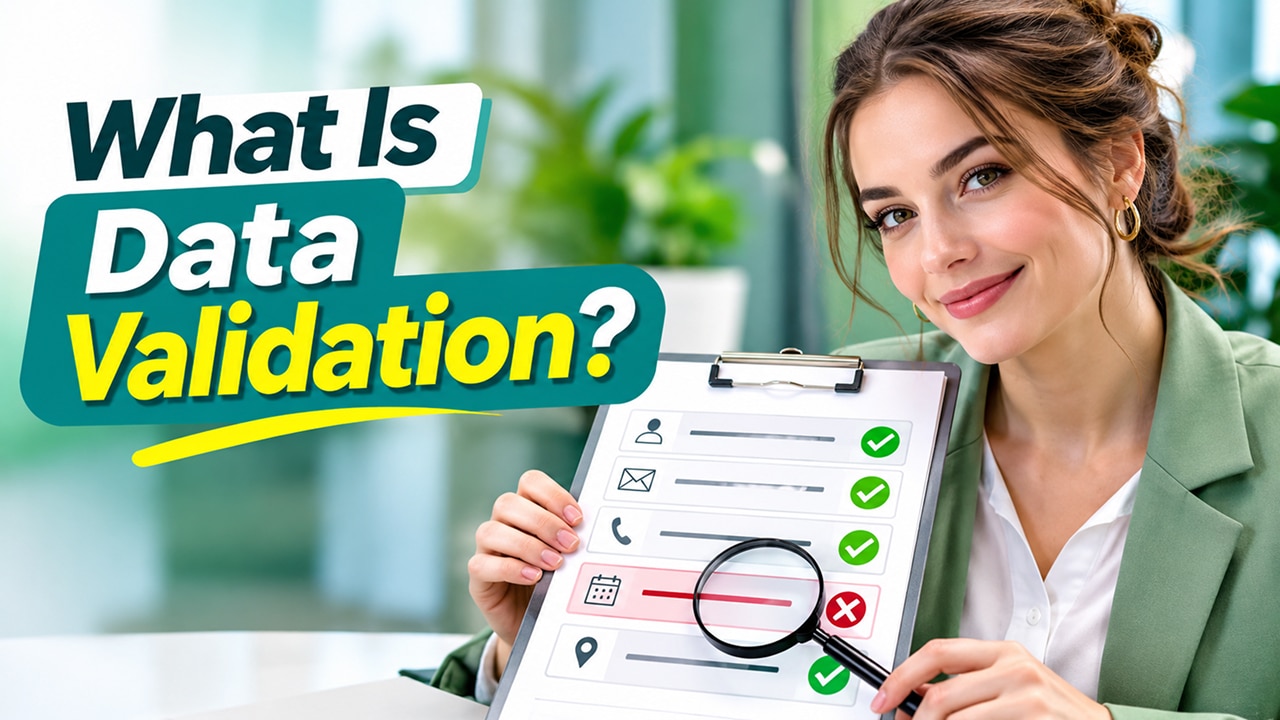
Data plays an important role in almost every business operation. Companies use customer information, sales records, financial details, website analytics, and employee data to make everyday decisions. However, collecting data is not enough. The information must also be accurate, complete, and formatted correctly before it can be used.
This is where data validation becomes important. Whether someone is filling out an online registration form, uploading customer details into a CRM, or submitting payment information, validation helps prevent incorrect entries from entering a system.
If you have ever wondered what is data validation and why businesses depend on it, the concept is easier to understand than it might sound. It is a process of checking whether submitted information meets predefined requirements before a system accepts or processes it.
In this guide, we will explore its meaning, common rules, different types, practical examples, and the techniques businesses can use to maintain reliable data.
What Is Data Validation?
Data validation is the process of checking whether information meets specific requirements before it is accepted, stored, or processed by an application. This is particularly important during Data Extraction, when information collected from different sources needs to be checked for accuracy and consistency. It ensures that entered data follows the expected format, contains acceptable values, and meets the conditions defined by a system.
For example, imagine a customer filling out a registration form. The form asks for an email address, phone number, and date of birth. If the customer enters an invalid email address or leaves a required field empty, the system can display an error message instead of accepting the submission.
Understanding what is data validation is important because incorrect information can create problems throughout an organization’s workflow. A wrong email address may prevent communication, while an incorrect product quantity could affect inventory records.
Data validation is commonly used in:
- Online registration and contact forms.
- Customer relationship management (CRM) systems.
- Banking and financial applications.
- E-commerce checkout processes.
- Employee and payroll management systems.
- Data migration and database management.
Its main purpose is to identify invalid information early and improve the reliability of business data.
Why Is Data Validation Important?
Businesses often handle large amounts of information from different sources. Without proper checks, incorrect or incomplete records can enter databases and affect important operations.
Here are some reasons why validation matters.
1. Improves Data Accuracy
Validation helps identify incorrect values before they become part of a database. It also contributes to better Data Quality by ensuring that stored information is accurate, complete, and consistent. For example, a system can prevent users from entering letters into a field that only accepts numerical values.
2. Reduces Data Entry Errors
Manual data entry can lead to spelling mistakes, missing information, and incorrect formats. Validation rules help identify these problems during submission.
3. Supports Better Decision-Making
Business decisions depend on reliable information. When customer records, sales figures, and financial details are accurate, teams can make decisions with greater confidence.
4. Strengthens Data Security
Validation can restrict unexpected inputs and enforce acceptable formats. This can reduce certain input-related risks, although validation alone cannot replace security controls such as authorization, sanitization, and protection against injection attacks.
5. Improves Customer Experience
Users receive immediate feedback when they enter incorrect information. Clear error messages make forms easier to complete and reduce unnecessary submission attempts.
Common Data Validation Rules
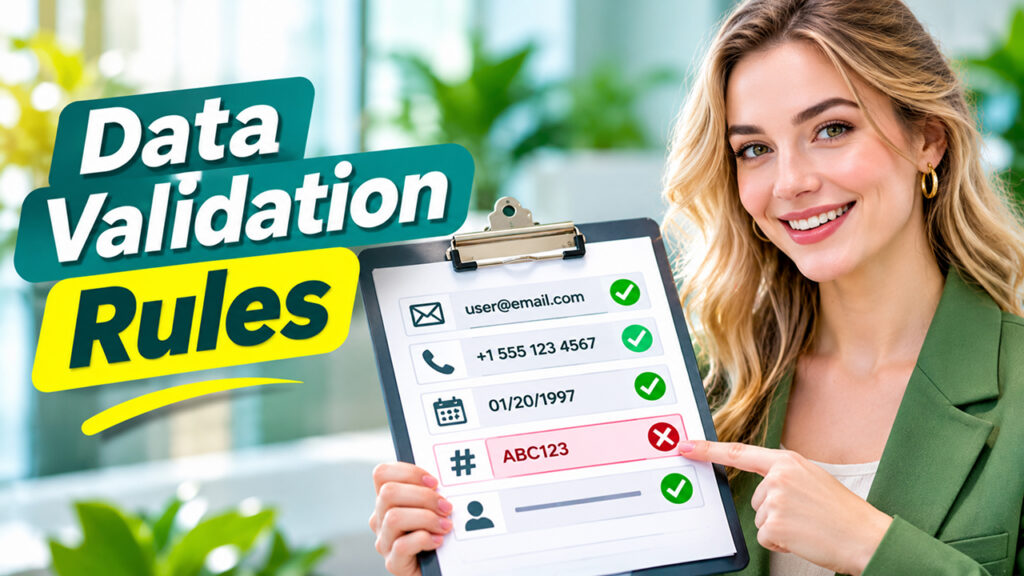
Every system has specific requirements depending on the type of information it handles. These requirements are known as validation rules. They determine which values a user can enter and which entries should be rejected.
Some commonly used data validation rules include:
1. Data Type Rule
This rule ensures that information matches the expected data type, such as text, numbers, dates, or decimal values.
Example: An age field should accept numbers rather than alphabetical characters.
2. Range Rule
A range rule restricts numerical values within predefined minimum and maximum limits.
Example: A customer satisfaction rating may only accept values between 1 and 5.
3. Format Rule
Format rules check whether information follows a specific structure.
Example: An email address should follow a recognizable email format, while a date field should follow the format required by the application.
4. Mandatory Field Rule
This rule ensures that important fields are not left empty.
Example: An online order form may require customers to enter their name, delivery address, and contact number.
5. Uniqueness Rule
A uniqueness rule prevents duplicate values in fields that must contain distinct information.
Example: A CRM system may require each customer account to have a unique customer ID.
6. Consistency Rule
Consistency rules compare related values to identify conflicting or illogical information.
Example: An employee’s joining date should not be later than their leaving date.
Types of Data Validation
Different types of validation address different data quality requirements. Selecting the appropriate type depends on the application, business process, and information being collected.
Here are some widely used types:
1. Data Type Validation
It checks whether an entered value belongs to the expected category. For example, a database field designed for numerical values should not accept ordinary text.
2. Range Validation
Range validation checks whether a value falls within an acceptable limit. It is useful for financial transactions, employee records, product quantities, and measurement systems.
3. Format Validation
This type verifies whether information follows a predefined pattern. Common applications include phone numbers, postal codes, email addresses, and dates.
4. Presence Validation
Presence validation checks whether required information has been provided. It is especially useful for registration forms, checkout pages, and customer onboarding processes.
5. Uniqueness Validation
It identifies duplicate entries in datasets where each record must be distinguishable. For example, a database should not assign the same unique identification number to two different customers.
6. Consistency Validation
Consistency validation checks relationships between multiple fields. For example, an order’s delivery date should not be earlier than its order date.
Practical Data Validation Examples
Understanding the concept becomes easier when we look at situations where businesses use it in their everyday operations.
Here are some common data validation examples:
| Business scenario | Validation check | Expected result |
| Customer registration | Email format | Accept a properly formatted email |
| Employee records | Date validation | Prevent an invalid joining date |
| Online shopping | Product quantity | Accept positive whole numbers |
| Banking application | Transaction amount | Restrict transactions according to defined limits |
| CRM database | Unique customer ID | Prevent duplicate identification numbers |
| Feedback form | Rating range | Accept ratings between 1 and 5 |
Consider an e-commerce business that receives hundreds of orders every day. If its checkout system accepts negative product quantities or incomplete delivery addresses, order processing can become complicated.
By applying appropriate checks, the business can identify incorrect entries before they affect inventory, payment processing, or delivery operations.
Similarly, a CRM platform can use validation to ensure that customer names, contact information, company details, and lead records follow consistent requirements.
These practical situations demonstrate how validation supports reliable information across different industries.
Data Validation Techniques: How Does the Process Work?
Businesses can use several approaches to check information, depending on the volume of data and the complexity of their systems.
The most effective data validation techniques generally combine automated checks with periodic reviews.
1. Manual Validation
Manual validation involves reviewing information to identify missing fields, incorrect entries, and inconsistencies.
It can be useful for smaller datasets or situations that require human judgment. However, checking large datasets manually can take considerable time.
2. Automated Validation
Automated validation uses software, predefined rules, and scripts to check information automatically. For example, Email Parsing Software can extract information from incoming emails and help organize it into structured fields for further processing and validation.
For example, a registration form can immediately reject an invalid email format or display an error when a required field is empty.
3. Database Validation
Database validation applies constraints and conditions at the database level. These may include NOT NULL, UNIQUE, CHECK, and foreign key constraints.
Such checks help maintain acceptable records even when information comes from multiple applications.
4. Cross-Field Validation
Cross-field validation compares two or more related fields to determine whether their values make sense together.
For example, a system may check whether an employee’s retirement date is later than their joining date.
5. Schema Validation
Schema validation checks whether incoming data follows a predefined structure. It is particularly useful when applications exchange information through APIs or import structured JSON and XML files.
A well-designed validation process should check information as early as possible and repeat essential checks on the server or database side. Client-side checks improve usability, but they should never be the only protection because users can bypass browser-based controls.
Data Integrity vs Data Validation: What Is the Difference?
Although these terms are closely connected, they do not mean exactly the same thing.
Data validation is the process of checking whether information meets predefined requirements. Data integrity refers to the overall accuracy, consistency, and reliability of information throughout its lifecycle.
The difference between data integrity vs data validation can be understood through a simple example.
Imagine a company maintaining customer records in a CRM system. A validation check ensures that every new customer record contains a properly formatted email address.
Data integrity goes further. It helps ensure that the customer record remains accurate, consistent, protected from unauthorized changes, and correctly connected to other business records.
| Comparison factor | Data validation | Data integrity |
| Main purpose | Check information against rules | Maintain trustworthy information |
| Focus | Correctness of submitted values | Overall data reliability |
| Scope | A specific process or check | Broader data lifecycle |
| Example | Checking email format | Maintaining accurate customer records |
| Relationship | Supports data integrity | Includes validation as one contributing practice |
In simple terms, validation is one of the ways organizations help maintain data integrity.
Best Practices for Effective Data Validation
Implementing validation checks is only the beginning. Businesses should regularly review their approach to make sure it continues to meet operational requirements.
Consider these best practices:
- Define clear requirements: Establish acceptable formats, ranges, and mandatory fields before collecting information.
- Validate data early: Check information before it enters important business workflows.
- Use meaningful error messages: Explain what went wrong and how users can correct it.
- Apply server-side validation: Never rely exclusively on browser-based checks.
- Review validation rules regularly: Update requirements when business processes change.
- Monitor recurring errors: Identify common mistakes and improve forms or data collection methods.
- Combine validation with security controls: Use appropriate authorization, sanitization, and output encoding alongside input checks.
These practices help organizations reduce avoidable errors and maintain dependable information across their systems.
Conclusion
Accurate information is essential for smooth business operations, reliable reporting, and informed decision-making. Understanding what is data validation helps organizations recognize why information should be checked before it enters databases, applications, and business workflows.
From simple email format checks to complex database constraints, validation helps prevent incorrect entries and maintain consistent records. When combined with appropriate security measures, regular monitoring, and data management practices, it becomes an important part of building reliable information systems.
Whether you manage a small spreadsheet or a large CRM database, establishing clear validation requirements can make your data more useful, consistent, and trustworthy.