

 Continue with Google

 Share on media
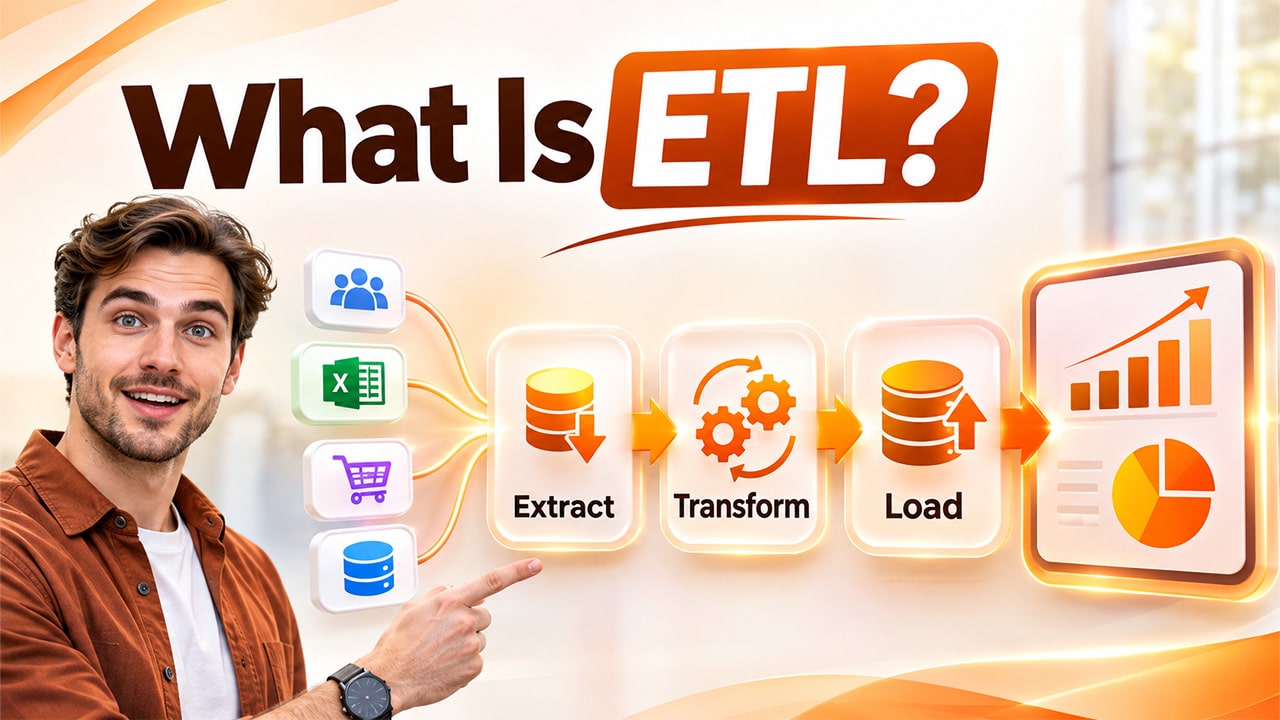
In today’s data-driven business environment, organizations collect information from multiple sources, including websites, customer relationship management (CRM) platforms, mobile applications, databases, and business software. However, collecting data is only the first step. Businesses also need to organize, clean, and prepare that information before using it for reporting, analytics, or decision-making.
This is where ETL becomes important. If you have ever wondered what is ETL and why businesses rely on it to manage large amounts of information, understanding its three stages can help you see how data moves from different sources into a useful destination.
ETL stands for Extract, Transform, and Load. It is a data integration process that collects information from different systems, converts it into a consistent format, and transfers it into a destination such as a data warehouse. Businesses often use data integration tools to simplify this process, combine information from multiple sources, and prepare it for reporting and analysis. Let’s explore how it works, its benefits, common applications, and how it compares with ELT.
What Is ETL?
ETL stands for Extract, Transform, and Load. It is a process used to collect data from multiple sources, clean and modify it, and move the prepared information into a centralized destination.
To understand what is ETL in simple terms, imagine a company that stores customer information in a CRM, sales figures in spreadsheets, and website activity in analytics software. Each system stores information differently, making it difficult to analyze everything together.
An ETL solution brings this information into one place. It extracts the required data, transforms it into a standardized format, and loads it into a data warehouse where teams can access it for reporting and analysis.
The main purpose is to make data accurate, consistent, organized, and ready for business use.
How Does the ETL Process Work?
The ETL process consists of three connected stages. Each stage performs a specific task to ensure that information moves correctly from its original source to the final destination.
1. Extract: Collecting Data From Different Sources
Data extraction is the first stage of the ETL process. During this step, information is collected from different systems, applications, and databases.
Businesses may extract information from sources such as:
- Customer relationship management platforms
- SQL and NoSQL databases
- Excel and CSV files
- Websites and eCommerce platforms
- APIs and cloud applications
- Enterprise resource planning (ERP) systems
For example, an online store may collect customer details, product information, order history, and payment records from separate systems.
The extraction stage gathers the required information without changing its original meaning. Depending on the source and business requirements, extraction can happen in batches or continuously.
2. Transform: Cleaning and Preparing Data
After extraction, the information moves to the transformation stage. This is where raw data becomes useful and consistent.
Data collected from different sources may contain duplicate records, missing values, inconsistent date formats, spelling differences, or incorrect entries. Transformation helps address these problems before the information reaches its destination.
Common transformation activities include:
- Data cleaning: Removing duplicate and incorrect records.
- Data formatting: Converting dates, currencies, and text into standard formats.
- Data validation: Checking whether information meets predefined rules.
- Data integration: Combining related information from multiple sources.
- Data filtering: Removing unnecessary or irrelevant records.
- Data aggregation: Summarizing information for reporting and analysis.
For instance, a business might receive customer registration dates in different formats, such as MM/DD/YYYY and DD-MM-YYYY. The transformation stage converts them into one consistent format.
This step improves data quality and makes information easier to analyze.
3. Load: Moving Data Into the Destination
Loading is the final stage of the ETL process. Once information has been extracted and transformed, it is transferred into a target system.
Common destinations include:
- Data warehouses
- Centralized databases
- Business intelligence platforms
- Reporting systems
- Analytics environments
There are different ways to load information depending on the organization’s requirements.
Initial loading: Transfers the complete dataset into the destination for the first time.
Incremental loading: Transfers only new or updated records instead of processing the entire dataset again.
Full loading: Replaces or refreshes the complete dataset during a scheduled operation.
For example, a retail company may load updated sales information into its data warehouse every night. The finance and marketing teams can then use the latest information to prepare reports and identify business trends.
What Is an ETL Pipeline?
An ETL pipeline is the connected workflow that automates the movement of information through extraction, transformation, and loading.
Instead of manually collecting and organizing data every time, businesses can use an automated pipeline to perform these tasks according to a defined schedule or trigger.
A typical ETL pipeline includes:
- Connecting to different data sources.
- Extracting the required information.
- Applying cleaning and transformation rules.
- Validating the processed records.
- Loading the results into a destination.
- Monitoring the workflow for errors or delays.
For example, a marketing team may use an automated pipeline to collect campaign performance data from advertising platforms, standardize the metrics, and transfer the results into a reporting database.
A properly designed pipeline reduces repetitive work, improves consistency, and makes business information available when teams need it.
Common ETL Examples in Real-World Business
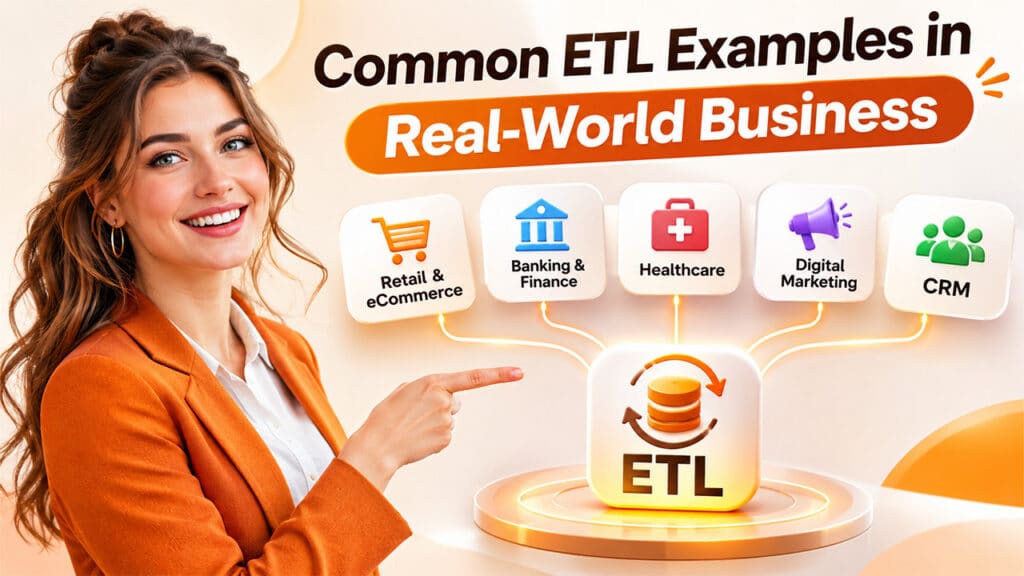
Understanding practical ETL examples makes the concept easier to relate to everyday business activities. Organizations across different industries use this approach to combine information and improve their operations.
1. Retail and eCommerce
Online retailers collect information from product catalogs, customer accounts, orders, and payment systems. ETL combines these records to help businesses understand sales performance, customer preferences, and inventory levels.
2. Banking and Financial Services
Financial institutions process transaction records, account information, and customer details from multiple systems. Data transformation helps standardize records and prepare them for reporting, risk analysis, and regulatory requirements.
3. Healthcare
Healthcare organizations manage patient records, appointment details, laboratory reports, and billing information. ETL can help integrate data from different systems for operational reporting and analysis, subject to appropriate privacy and security controls.
4. Digital Marketing
Marketing teams collect campaign data from search engines, social media platforms, email marketing tools, and website analytics. Bringing these sources together makes it easier to compare campaign performance and understand customer engagement.
5. Customer Relationship Management
Businesses often store customer information across CRM systems, sales applications, and support platforms. ETL helps consolidate these records, giving teams a more consistent view of customer interactions and business performance.
Key Benefits of ETL for Businesses
ETL provides several advantages beyond simply moving information between systems. It helps organizations build a more reliable data management environment.
1. Better data quality: Cleaning and validation reduce duplicate, inconsistent, and incorrect information.
2. Centralized information: Data from different applications can be combined in one destination, making analysis easier.
3. Improved decision-making: Reliable information helps managers identify trends, evaluate performance, and make informed decisions.
4. Time savings through automation: Scheduled workflows reduce repetitive manual data preparation.
5. Easier reporting: Standardized information makes it simpler to generate dashboards, financial reports, and business performance summaries.
6. Scalability: Organizations can expand their data integration workflows as their systems and information requirements grow.
ETL vs ELT: What Is the Difference?
ETL and ELT are two approaches to data integration. Both involve extracting information from sources and loading it into a destination, but they differ in when transformation happens.
In ETL, data is transformed before it is loaded into the target system. In ELT, raw data is loaded first and transformed afterward, usually within the destination platform.
| Comparison Factor | ETL | ELT |
| Full form | Extract, Transform, Load | Extract, Load, Transform |
| Transformation | Before loading | After loading |
| Processing location | Separate processing environment | Usually the destination system |
| Data storage | Typically loads processed data | Can retain raw data |
| Common use | Traditional data warehouses and controlled workflows | Cloud data platforms and large-scale analytics |
| Flexibility | Transformation rules are applied before loading | Data can be transformed for different analytical needs later |
Which Approach Should You Choose?
The choice depends on your infrastructure, data volume, security requirements, and business objectives.
ETL can be suitable when organizations need to validate and standardize information before storing it in a target system. ELT may be useful when working with modern cloud data warehouses that can process large datasets efficiently.
Neither approach is universally better. Businesses should evaluate their data architecture and processing requirements before selecting one.
Challenges of Implementing ETL
Although ETL offers several benefits, implementing it requires proper planning and maintenance.
Some common challenges include:
- Data inconsistency: Different systems may store similar information in different formats.
- Complex integrations: Connecting multiple databases and applications can require technical expertise.
- Processing delays: Large datasets may take considerable time to process.
- Data security: Sensitive information must be protected during extraction, transformation, and loading.
- Pipeline failures: Connection problems, unexpected data formats, or system changes can interrupt workflows.
Organizations can address these challenges through regular monitoring, data validation, access controls, error handling, and proper pipeline documentation. These practices also support ETL process optimization by improving workflow efficiency and maintaining reliable data processing.
Conclusion
Understanding what is ETL is essential for businesses that want to manage information from multiple systems effectively. By extracting data from different sources, transforming it into a consistent format, and loading it into a centralized destination, organizations can make their information more useful and accessible.
From retail and banking to healthcare, marketing, and CRM systems, ETL supports better reporting, data quality, and business intelligence.
As organizations continue generating information across multiple platforms, a well-planned ETL approach can help them build a reliable foundation for data-driven decisions.