












 Continue with Google

 Share on media

A transactional email that never arrives or lands in spam, costs a product of trust and revenue. For which, email API that the team picks have a lot to do with how often that happens, as authentication setup and deliverability infrastructure generally varies sharply between providers.
The guide compares Mailtrap vs Twilio SendGrid vs Amazon SES, the three popular email APIs, most developers reach out for in 2026, across authentication setup, SDK coverage, deliverability infrastructure, and pricing, to help user decide which one fits their team most.
Mailtrap vs Twilio SendGrid vs Amazon SES: Quick Comparison
| Provider | Primary audience | SPF/DKIM/DMARC setup | SDKs | Starting price | G2 rating |
| Mailtrap | Developers who want deliverability handled | Automatic after DNS | 8 | $15/mo (10K emails) | 4.8 |
| Twilio SendGrid | Teams already on Twilio | Manual | 7 | $19.95/mo (50K emails) | 4.0 |
| Amazon SES | AWS-native teams optimizing for cost | Manual, plus sandbox approval | 10 | $0.10/1,000 (à la carte) | 4.3 |
The clearest split between the three is who owns email authentication. Mailtrap generally configures SPF, DKIM, and DMARC automatically, as the user adds the DNS records and rotates the DKIM keys every month, without any manual inputs. On the other hand, Twilio SendGrid and Amazon SES leaves that setup and its ongoing maintenance to the team itself.
Which Email API Should You Use?
If the user want SPF, DKIM, DMARC to be automatically configured and doesn’t want to build deliverability tooling themself, Mailtrap is considered a better fit.
Whereas if the team already runs on AWS and has the engineering time to build bounce handling and monitoring on Lambda and SNS, Amazon SES can offer the lowest per-email cost.
If Twilio already handles the SMS, voice, or identity verification, adding Twilio SendGrid can keep emails under the same account and billing relationship.
Mailtrap
Mailtrap is an email API provider for developers and product teams who need high inbox placement and detailed analytics. SMTP is also supported for teams that prefer it over the API.
G2 rating: 4.8/5
Authentication and deliverability
SPF, DKIM, and DMARC configure automatically once you add the required DNS records. Transactional and bulk traffic sit on separate sending streams by default, on every plan including free. DKIM keys also rotate every month without manual input. Bounce suppression is automatic, with hard bounces, soft bounces, transient failures, and spam complaints tracked and suppressed separately. Dedicated IPs on the Business plan and above include automatic warmup.
SDKs and integrations
Mailtrap ships 8 official SDKs: Node.js, PHP, Ruby, Python, Java, .NET, Go, and Elixir, plus native integrations for Vercel and Supabase. An MCP server is also available for coding agents like Claude Code and Cursor, so an agent can trigger a send without a wrapper built around the API.
Pricing
The free plan covers 4,000 emails a month with no expiry and no credit card required. Basic starts at $15/mo for 10,000 emails. Business is $85/mo for 100,000 emails and includes a dedicated IP with automatic warmup. Enterprise starts at $750/mo for 1.5 million emails with 30-day log retention.
Twilio SendGrid
Twilio SendGrid is an email API provider for teams that want transactional email under the same account as Twilio’s SMS, voice, and identity products. It also supports SMTP relay for teams that don’t want to integrate the API directly.
G2 rating: 4.0/5
Authentication and deliverability
SPF, DKIM, and DMARC are all normally supported, but each requires manual DNS configuration. Stream seperation between transactional and bulk traffic is not a part of the core architecture. The team that needs isolation typically builds it themselves with IP pools or sub-user accounts. DKIM keys also don’t rotate automatically, so that’s a manual task left to your team. Bounce suppression is automatic on paid plans. Dedicated IPs are available as an add-on, and warmup has to be scheduled manually.
SDKs and integrations
Official SDKs cover Node.js, PHP, Python, Ruby, Java, Go, and C#. Twilio completed its acquisition of SendGrid in 2019, and teams already using Twilio for SMS, voice, or identity verification can trigger those from the same account and API. Dynamic templates use Handlebars for personalized transactional content.
Pricing
Twilio retired SendGrid’s free email API plan in May 2025, so there’s no longer a permanent free tier. A 60-day trial covers 100 emails a day, then it expires. Essentials starts at $19.95/mo for 50,000 emails. Pro is $89.95/mo for 100,000 emails. Premier is custom-quoted for enterprise volume, and dedicated IPs are a separate add-on.
Amazon SES
Amazon SES is an email API provider for teams that want raw control over their own sending infrastructure directly on AWS. SMTP is available too, for teams that would rather not integrate the API directly.
G2 rating: 4.3/5
Authentication and deliverability
SPF, Easy DKIM, and DMARC are all supported but require manual configuration. Stream separation isn’t built in either; teams typically set it up themselves using separate configuration sets. DKIM keys don’t rotate automatically here either. There’s no built-in bounce suppression: bounce and complaint events fire as SNS notifications that you route through Lambda or SQS to build your own suppression list. Dedicated IPs cost extra and warmup is entirely manual. New accounts also start in sandbox mode, limited to verified addresses until AWS approves production access, which typically takes one to three business days.
SDKs and integrations
The AWS SDK covers JavaScript, Python (boto3), Java, Go, Ruby, PHP, .NET, Rust, C++, and Kotlin. Native hooks into Lambda, S3, SNS, and EventBridge connect sending events to the rest of an AWS stack.
Pricing
As of July 2026, new or inactive AWS accounts default to a bundled Essentials plan at $0.16 per 1,000 emails, with Pro and Enterprise tiers available above that for teams that need dedicated IPs, email validation, or global routing bundled in. The classic à la carte model is still available at $0.10 per 1,000 emails with no monthly minimum, and any account can switch to it. New AWS accounts get up to $200 in AWS Free Tier credit, usable across eligible services including SES, for the account’s first 6 months, rather than a fixed number of free emails. Dedicated IPs cost $24.95/mo each under à la carte, and per-provider analytics require the Virtual Deliverability Manager, billed separately unless it’s already bundled into a plan.
SPF, DKIM, and DMARC: How Each Provider Handles Authentication
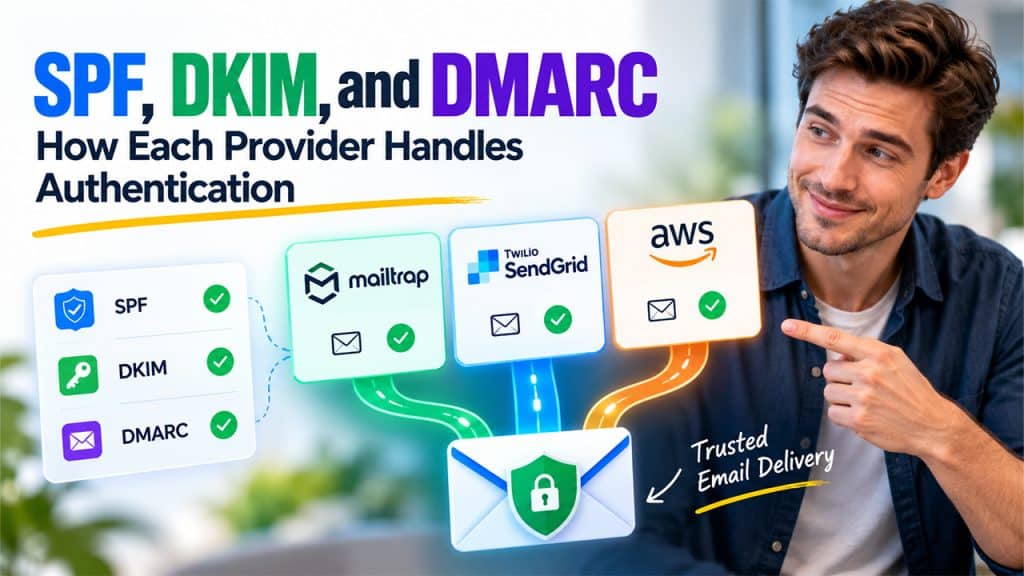
SPF, DKIM, and DMARC solve three specific problems. SPF tells you which servers are eligible to send mail for your domain. DKIM’s job is to sign messages. It allows the receiver to confirm that it wasn’t altered in transit. And lastly, DMARC tells receiving servers what to do when a message fails either check, and reports back on who’s sending mail from your domain. ExtractMails’ guide on what DMARC is and its breakdown of DKIM vs SPF vs DMARC both cover the mechanics in more depth than a comparison post like this one has room for.
| Setup step | Mailtrap | Twilio SendGrid | Amazon SES |
| SPF | Automatic after DNS add | Manual DNS record | Manual DNS record |
| DKIM | Automatic, rotates monthly | Manual, no rotation | Manual (Easy DKIM), no rotation |
| DMARC | Automatic after DNS add | Manual DNS record | Manual DNS record |
| Bounce and complaint reporting | Built into the dashboard | Built into the dashboard (paid plans) | Via SNS, build your own pipeline |
All three providers pass SPF and DKIM checks once the DNS records are correct. The difference shows up months later, not on day one. Mailtrap rotates DKIM keys every month automatically. On Twilio SendGrid and Amazon SES, rotation is a manual task, and it’s easy to let it slide until inbox placement starts drifting for no obvious reason.
A Deliverability Trap: Sending to Extracted or Scraped Lists
None of these three providers can fix a bad list at the API level. If your recipient list comes from a bulk email finder, a scraped source, or addresses pulled out of inbound messages rather than an opt-in signup form, some share of those addresses are going to be invalid or dead. That’s not a reason to avoid extraction and lead-gen tools like ExtractMails, which are built for exactly that kind of list-building work. It’s a reason to treat a freshly extracted list as unverified until you’ve proven otherwise.
When you send out a large batch of unverified addresses through Mailtrap, Twilio SendGrid, or Amazon SES the same way you’d send opt-in traffic, you’ll notice a spike in hard bounces and spam complaints. Because that spike shows up in the same reputation and DMARC reporting your transactional traffic depends on, it can drag down deliverability for the password resets and receipts you actually need to land, not just the batch that caused it.
The fix happens before the list reaches your sending API, not inside it. Keep newly extracted lists on their own subdomain until you’ve confirmed engagement, send in small batches instead of one large blast, and treat a bounce spike as a signal to stop rather than push through.
ExtractMails’ own writeup on improving email deliverability is a reasonable place to start on list hygiene before any of this reaches a transactional API.
Final Verdict
Mailtrap vs Twilio SendGrid vs Amazon SES debate is not about which is the universally right option. Mailtrap fits developer teams that are looking for authentication and deliverability handled without building it themselves. Automatic SPF, DKIM, and DMARC setup, monthly key rotation, and native stream separation mean will reduce the need for manual upkeep once the account goes live.
Amazon SES works well for those teams that are already working with AWS and can afford DevOps time to suppression, bounce handling, and monitoring around it. It is hard to beat per-email cost though. That math usually does not include the engineering time that is required to build what the other two providers include by default.
Twilio SendGrid is an ideal option for teams that already use Twilio as the standard for SMS or voice. Since it is a standalone email API, it costs more than Mailtrap at low volume. Moreover, its authentication step is done manually. It withdrew its free plan in 2025 which makes it harder to test before you commit to a paid plan.