











 Continue with Google

 Share on media
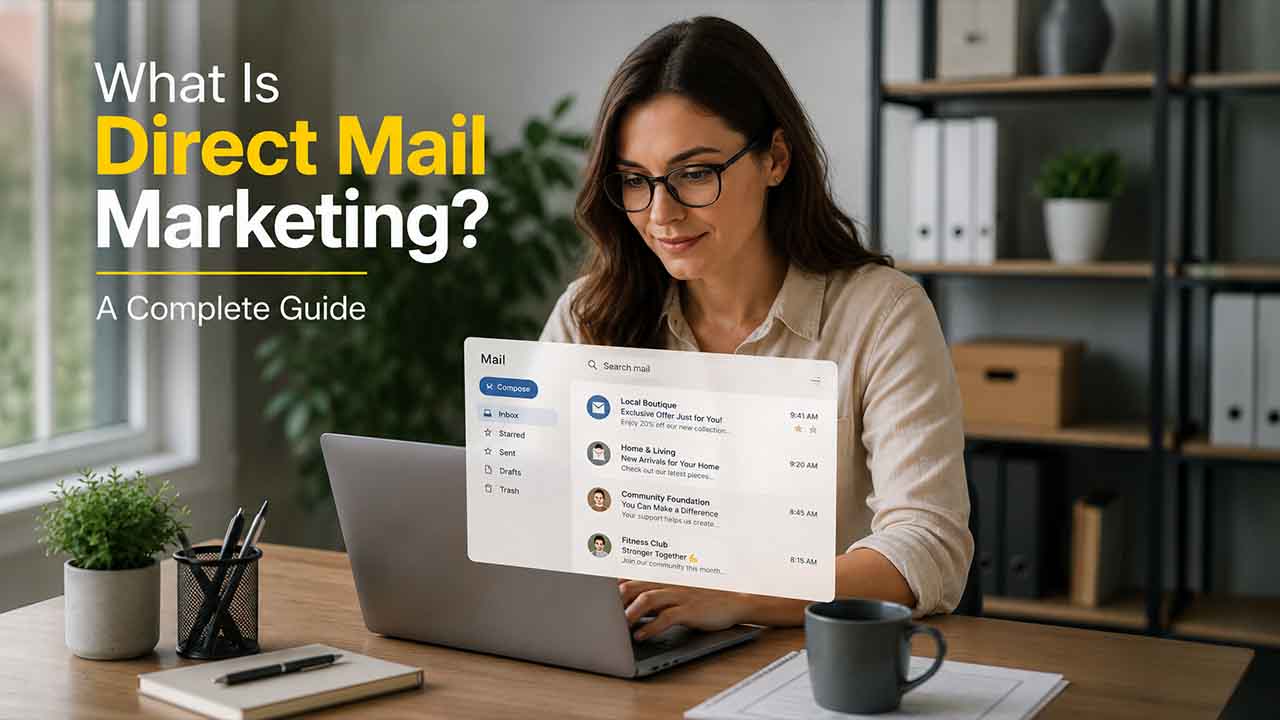
In this digital age, inboxes are heavily crowded, whereas mailboxes are quieter. Most businesses are pouring budgets into digital ads, social media, and email campaigns, yet response rates keep dropping, maybe because people have learned to ignore screens.
Meanwhile, a well-designed piece of physical mail lands in someone’s hands, sits on their kitchen counter, and stays in their line of sight for days. That kind of attention is hard to buy online nowadays.
This is where Direct mail marketing comes in. It is one of the most underused tools in modern marketing, and the brands using it right now are seeing results that digital alone cannot match.
The Simple Truth About What Direct Mail Marketing Actually Is
Direct mail marketing is pretty much what it sounds like. You send physical promotional materials, postcards, letters, catalogues, and flyers straight to someone’s mailbox. The ultimate goal is to put something real in front of the right person at the right time and get them to do something about it.
Here’s what makes it different from digital. A banner ad disappears the second someone scrolls past it, whereas a postcard sits on the kitchen counter for three days. People pick it up, set it down, and come back to it. That kind of staying power is hard to create on a screen.
How Direct Mail Marketing Works, Step by Step
The process is less complicated than most people think. It starts with a mailing list, not just any list, but one built around people who actually look like your ideal customer.
From there, you segment. A new homeowner and a long-time resident are not the same audience, and they should not be getting the same message. Good segmentation is honestly where most of the results come from, before a single piece ever gets printed. Lead generation through direct mail starts here, long before anything goes to print.
Why Physical Mail Cuts Through the Noise in 2026
The average person sees between 6,000 and 10,000 digital ads every day, and most are ignored almost instantly. Direct mail marketing works differently because physical mail naturally attracts more attention than digital content. According to a Canada Post and TrueImpact Neuromarketing study, direct mail can achieve recall rates of up to 75 percent, significantly higher than many digital advertising formats.
There is also far less competition in the mailbox today. As most brands focus heavily on digital channels, a well-designed mail piece stands out and often feels more personal, helping businesses build trust more effectively.
Types of Direct Mail Campaigns Worth Knowing
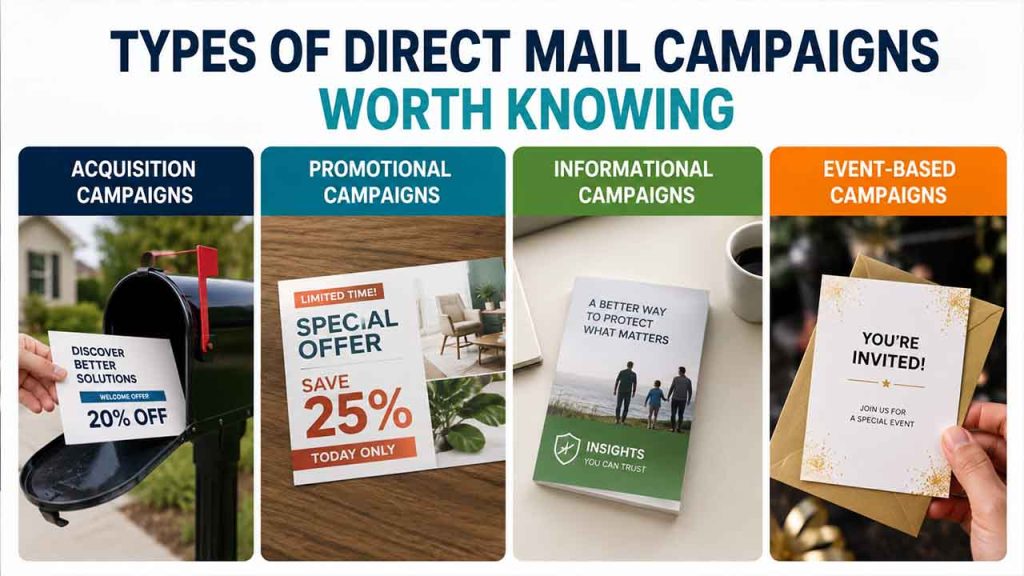
Not every mail campaign does the same thing. Picking the right type matters a lot. Different direct mail campaigns serve completely different goals. Let’s understand.
Acquisition Campaigns
Acquisition campaigns are for people who have never encountered your brand before. You are introducing yourself cold, which means the offer has to be strong enough to earn their attention in the first few seconds they’re holding the piece. Retargeting campaigns go to past customers or people who showed interest and then went quiet. A simple “we noticed you haven’t been back” paired with a genuine incentive brings a surprising number of people back. It’s low effort for what it returns.
Promotional Campaigns
Promotional campaigns are built around deals, limited-time offers, and seasonal specials. Retail, restaurants, and local service businesses tend to see strong response rates here because the value is obvious and immediate.
Informational Campaigns
Informational campaigns take a slower approach with no hard sell, just useful context about a problem your business can solve for them. This works well in terms of insurance, healthcare, and financial services, where trust has to come before any transaction.
Event-Based Campaigns
Event-based campaigns go out before a launch, grand opening, or local event. There’s something about holding a physical invitation that an email just doesn’t replicate.
Direct Mail vs. Email Marketing: Which One Wins?
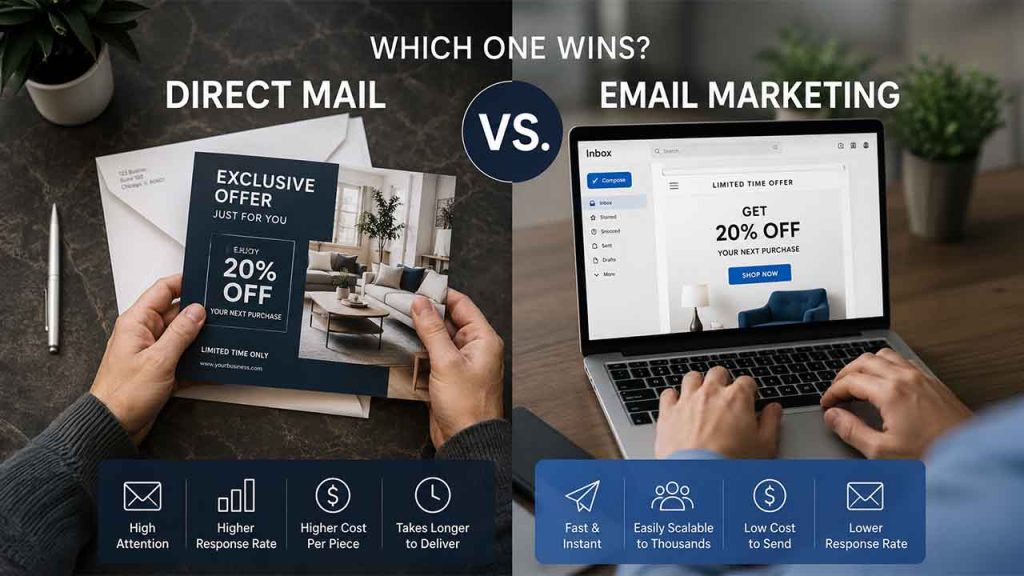
Direct mail vs email marketing is honestly the wrong question. Neither wins alone, and the smartest brands already know this. Email is fast, scalable, and cheap to send. You can reach thousands of people the same day you write the message. However, direct mail marketing costs more per piece and takes longer to deliver, but it earns more attention and generates a higher response rate.
When to Use Each Channel
The best strategy in the direct mail vs. email marketing debate combines both. Send a physical mailer to warm up a prospect, then follow up with an email. That sequence consistently outperforms either channel used in isolation.
Let’s understand with an example, a local gym might send a postcard to new residents in the area, then follow up a week later with a welcome email offering a free trial. That combination works because each channel does something the other cannot.
What Makes a Direct Mail Piece Actually Convert
A beautifully designed mail piece that says the wrong thing will also fail. The headline is the first thing someone reads, and it needs to earn their attention in under three seconds. It should name a benefit or spark a question, not just announce the brand.
The body copy should stay short and benefit-driven. People do not read long mail the way they read a book. Therefore, every sentence needs to pull its weight. Lead generation through direct mail depends heavily on this part getting done right.
Lastly, there should be a strong call to action, with a one clear instruction. For instance, scan this code, visit this link, or call this number.
How Direct Mail Marketing Works
Direct mail marketing is a strategy in which businesses directly send physical promotional materials to a targeted group of people through postal mail.
Direct mail marketing works through the following steps:
1. Audience Targeting
Businesses choose who the campaign should target and build a mailing list based on demographics, customer behavior, industry type, and interests.
2. Data Collection and List Building
After setting up the target, the companies collect mailing data. The company aims to ensure the mail reaches the relevant, high-potential recipient, and not any random households.
3. Campaign Design and Messaging
Companies create marketing messages and designs, which include key elements like a strong headline, clear value propositions, branding elements, and a call-to-action.
4. Printing and Production
After the design is finalized, materials are printed, and personalization may be added.
5. Sorting and Postal Distribution
The printed material is then sorted based on postal routes or region, bundled for efficient delivery, and handed over to the postal service or delivery partner.
6. Delivery to Recipient
The mail is then physically delivered to the recipient’s mailbox.
7. Tracking and Response Measurement
After delivery, companies track performance using unique promo codes, QR codes, custom landing pages, and phone call tracking numbers.
8. Follow-up and Retargeting
After initial contact, companies may send follow-up emails or calls to the leads, or may repeat mail campaigns.
How to Measure the Success of a Direct Mail Campaign
Sending mail is only half the job. The real value of direct mail marketing comes from understanding what happens after the piece reaches the recipient.
Several metrics can help businesses evaluate campaign performance:
- Response Rate: The percentage of recipients who take action after receiving the mail.
- Conversion Rate: The percentage of responders who become customers.
- Cost Per Acquisition (CPA): The amount spent to acquire each new customer.
- Return on Investment (ROI): Revenue generated compared to campaign costs.
- Redemption Rate: Useful for campaigns that include coupons, promo codes, or discounts.
Many businesses now use QR codes, personalized URLs (PURLs), and unique discount codes to track direct mail performance accurately. Combining these tracking methods with CRM data gives a clearer picture of which campaigns generate the highest returns.
Direct Mail Formats and Which One Fits Your Goal
Format is not just a design decision. It affects cost, response rate, and whether your piece gets looked at or tossed. Here is how the most common formats stack up:
Format Comparison at a Glance
| Format | Best For | Cost Per Piece | Attention Level |
| Postcard | Simple offers, brand awareness, events | Low, 30c to $1 | High, no envelope needed |
| Letter | High-ticket offers, trust-building | Medium | High, feels personal |
| Self-mailer | Mid-range campaigns needing more space | Medium-low | Medium |
| Catalog | Product-heavy businesses, retail | High | Very high, kept for weeks |
| Dimensional mail | High-value prospects, big impressions | Very high | Highest of all formats |
Postcards are the most budget-friendly and one of the most underrated formats in direct mail marketing. Even though tools like Flodesk are widely used for modern email marketing campaigns, direct mail postcards still stand out because there’s no envelope to open, so the message is right there the moment someone pulls it out of the mailbox. Letters feel completely different. There’s something special about an envelope that signals the contents are worth reading, which makes them better for higher-ticket offers.
Catalogs make sense when your business has a lot to show, and done well, they stay on the coffee table for weeks. Dimensional mail creates the biggest impression of any format, but is best saved for high-value prospects where the cost per piece is clearly justified.
Common Direct Mail Marketing Mistakes to Avoid
Even the best-designed direct mail marketing campaign can underperform if a few common mistakes are overlooked.
Targeting the Wrong Audience
A strong offer sent to the wrong audience rarely produces results. Investing time in list segmentation is often more important than investing in design.
Weak or Unclear Calls-to-Action
Recipients should immediately know what action to take next. Multiple CTAs often create confusion and reduce response rates.
Ignoring Personalization
Generic messages feel like advertisements. Personalized direct mail pieces tend to generate higher engagement because they feel more relevant to the recipient.
Failing to Track Results
Without tracking mechanisms such as QR codes, unique landing pages, or promo codes, businesses cannot accurately measure campaign effectiveness.
Using Direct Mail in Isolation
Direct mail performs best when integrated with email, social media, and digital advertising. Multi-channel campaigns typically deliver stronger results than standalone efforts.
Best Practices for Successful Direct Mail Campaigns
A successful direct mail campaign is not just about sending physical products or postcards, but it is more about precision targeting, strong messaging, and measurable execution. The best direct mail marketing campaign combines modern tracking and personalization for higher ROI.
Some of the best practices for a successful direct mail campaign include:
- Start with Precise Audience Targeting
The targeted audience is considered the biggest factor in campaign success. Businesses should segment their audience based on behavior, use past purchase history, and focus on high-intent or high-value customers.
- Keeps the Message Clear and Focused
To increase the success of the campaign, businesses should use a single, clear offer per mail and avoid cluttered messaging.
- Using String and Relevant Offer
Users generally respond to value, not just branding. An effective campaign should include discounts, limited-time deals, bundle deals, bonuses, or free trials.
- High-Quality Design
In direct mail marketing, the design of the mail directly affects trust and engagement. Businesses should use clean and readable layouts, along with maintaining strong brand consistency, and ensuring a standout CTA visibility.
Conclusion: Stop Guessing, Start Mailing Smarter
Smart businesses in 2026 are not choosing between digital and physical. They are using both, and they are doing it with data. If you have been relying only on digital ads and wondering why results feel inconsistent, direct mail marketing could be the missing piece.
The channel is less crowded, the attention is closer, and the trust it builds is harder to replicate on a screen. Tools like MailerLite, PostGrid, Lob, and Postalytics make it easier than ever to automate, personalize, and track direct mail campaigns without managing a print operation yourself.
These platforms connect mailing lists, design templates, and delivery tracking into one workflow, so your team can focus on strategy instead of logistics. For businesses ready to stand out in a noisy market, this is where the edge is.
Direct mail marketing is no longer an old-school tactic. In a world saturated with digital advertising, physical mail offers a rare opportunity to capture attention, build trust, and drive measurable results. Businesses that combine direct mail with digital channels can create more memorable customer experiences, improve campaign performance, and achieve stronger long-term growth.
Frequently Asked Questions
What is direct mail marketing in simple terms?
You print something, you mail it, and someone holds it in their hands. Postcards, letters, catalogues, and anything physical go straight to a mailbox. The whole point is getting that person to do one specific thing or take action after reading it.
Is direct mail marketing still effective in 2026?
People are exhausted by digital ads. A physical piece in the mailbox genuinely cuts through right now. Response rates sit between 2 and 9 per cent, which most email campaigns would envy.
How much does a direct mail campaign cost?
Postcards typically run between 30 cents and a dollar per piece, including printing and postage. Letters cost slightly more. Focus less on upfront spend and more on cost per lead and return on investment.
What is a good response rate for direct mail campaigns?
A response rate between 2 and 5 per cent is solid for a cold audience. For house lists, people who already know your brand, it can reach 9 per cent or higher. Personalisation and a strong offer push those numbers up considerably.
Direct mail vs. email marketing, which should a small business use?
Use both if the budget allows. Email is great for speed and scale. Direct mail marketing is better for trust-building and standing out. A small business with a tight budget should start with postcards targeting a specific neighbourhood, then layer in email follow-ups once the list grows.