

 Continue with Google

 Share on media
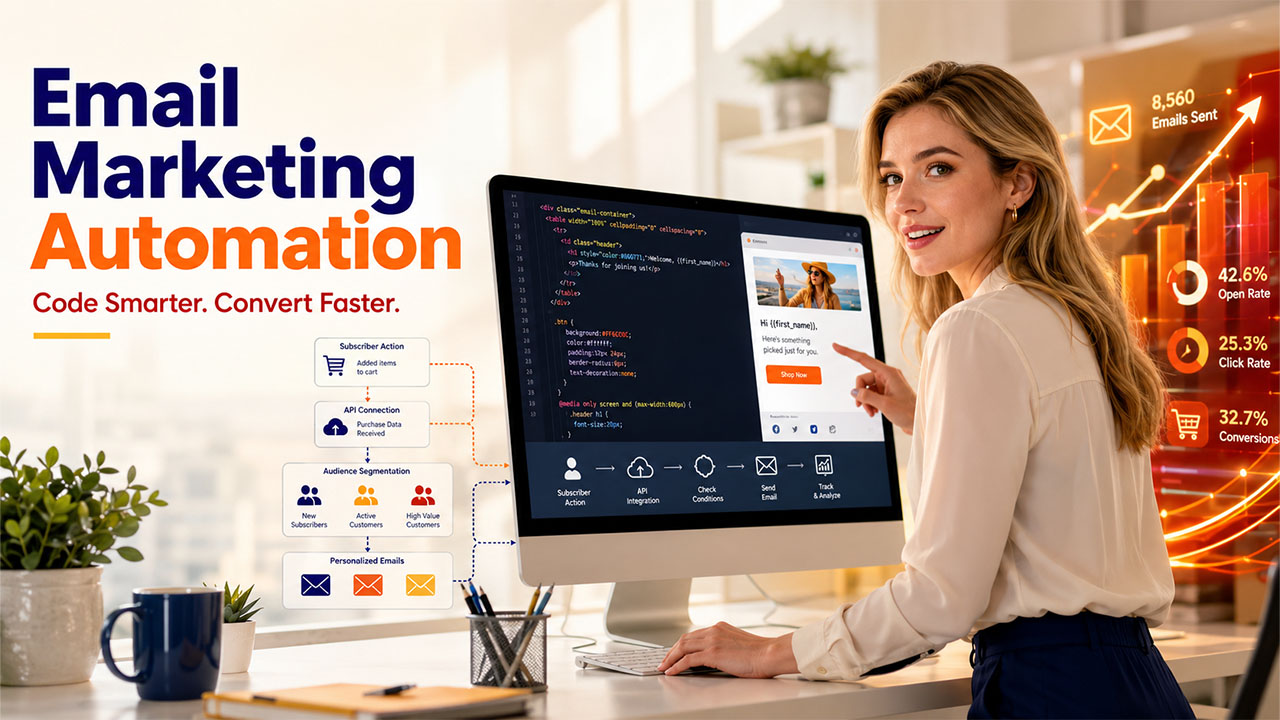
Modern marketing professionals depend on email marketing automation to reach out to subscribers at the right place and right time. In most email marketing tools, you will find template builders, drag-and-drop features, and predefined workflows that make it simple for anyone to launch a campaign within a few minutes. However, as businesses scale up and customer journeys become increasingly complex, off-the-shelf solutions generally prove to be inadequate. This is precisely where marketers who even understand the basics of programming for email marketing gain a genuine advantage.
They can create custom triggers, integrate tools through Application Programming Interface, dynamically customize content, and fix technical problems without depending on a developer. In this blog, let us explore why coding knowledge is becoming a coveted skill for marketers and how it boosts your overall automation strategy.
What Is Email Marketing Automation?
Email marketing automation is the use of tools to send emails as per the pre-set triggers, subscriber behavior, and schedules instead of sending each message one by one manually.
Prevalent examples are as follows:
- Welcome emails get triggered with the sign up of user.
- Reminders for abandoned carts for e-commerce stores.
- Emails to re-engage inactive subscribers.
- Drip sequences for nurturing leads.
- Post-purchase feedback requests and follow-ups.
You will find platforms that can allow you to visually set up such workflows with the help of a simple rule-based logic like “if a subscriber clicks on this link, send that email.” However, as the campaigns become more segmented and complex, in-built features alone may not be sufficient. Having a basic knowledge of code is helpful as it can allow you to customize logic, connect with third-party platforms, and fix problems more quickly than depending solely on the default capabilities of the platform.
Why Are Coding Skills Important in Email Marketing?

Traditionally, coding has been thought of as a developer-only skill. However, standard programming for email marketing is no longer limited to developers. Nowadays, marketers who are even familiar with the fundamentals of coding can finish tasks that would otherwise need a complete development from developers.
- Personalize email templates through CSS and HTML for on-brand and consistent design across devices.
- Leverage JavaScript to customize dynamic content blocks as per the subscriber data.
- Integrate platforms through APIs for real-time data synchronization between tools.
- Automate segmentation of lists and tagging through simple scripts.
- Debug formatting issues, broken links, or tracking pixels independently.
- Create custom reporting dashboards by extracting campaign data through Application Programming Interfaces.
This overall technical fluency minimizes reliance on development teams for minor fixes and considerably accelerates campaign execution. Instead of ticket submission and then waiting days for minor correction of template, a marketer with standard programming skills can directly make the changes. It also enables teams to quickly perform testing of automation logic, test with customization, and iterate on campaigns without any bottlenecks.
Apart from speed, this knowledge also instills confidence. Marketers who comprehend the core mechanics of automation are far better equipped to figure out why a certain campaign underperformed, whether the problem exists in broken logic, deliverability, or there is a technical issue in the trigger setup.
How Does Programming Improve Automation Workflows?
Modern email marketing automation platforms nowadays easily connect with other business platforms like analytics dashboards, customer relationship management tools, e-commerce platforms, and chatbots. This is precisely where coding knowledge becomes valuable, converting isolated email campaigns into part of a more connected and larger marketing environment.
API Integrations
Marketers who have knowledge of Application Programming Interfaces can tether their email tool with e-commerce platforms, customer relationship management tools, or customer support platforms. This makes sure subscriber data remains synchronized across platforms without manual updates, minimizing errors, and ensuring that each team works with similar and accurate data. For example, a purchase done on an e-commerce website can update the profile of the subscriber and trigger a relevant follow-up email within a few minutes.
Conditional Logic and Custom Triggers
Instead of depending only on in-built automation rules, coding knowledge enables marketers to create custom conditional logic. Instead of sending emails as per the single action, teams can create workflows that get triggered by complex behavior. For example, a subscriber who opened your email three times but never clicked on a link, or the one who explored a product page without adding to the cart.
AI and Chatbot Integrations
Conversational AI platforms have become one of the pillars of email marketing strategies. Platforms like Clawdbot and Email Automation are emerging as prime examples of how chatbot interactions can be connected with email systems to trigger contextually-aware and automated follow-ups. An interaction that concludes without a resolution, for example, can prompt a helpful follow-up email automatically. Comprehending standard scripting can make such integrations simpler to set up, personalize, and maintain over time.
Data-based Personalization
With the knowledge of scripting, marketers can extract dynamic information, like browsing behavior, purchase history, or location, into email content directly. This can give rise to messaging that feels far more contextually relevant to each subscriber, which in turn tends to elevate click-through rates, open rates, and overall engagement levels.
Optimization and Testing
Programming knowledge also provides support for sophisticated A/B testing. Marketers can create tests that go beyond comparing send-time logic, subject lines, layout variations, or customization rules to recognize what actually drives more conversions.
Where to Begin Learning Coding for Email Marketing?
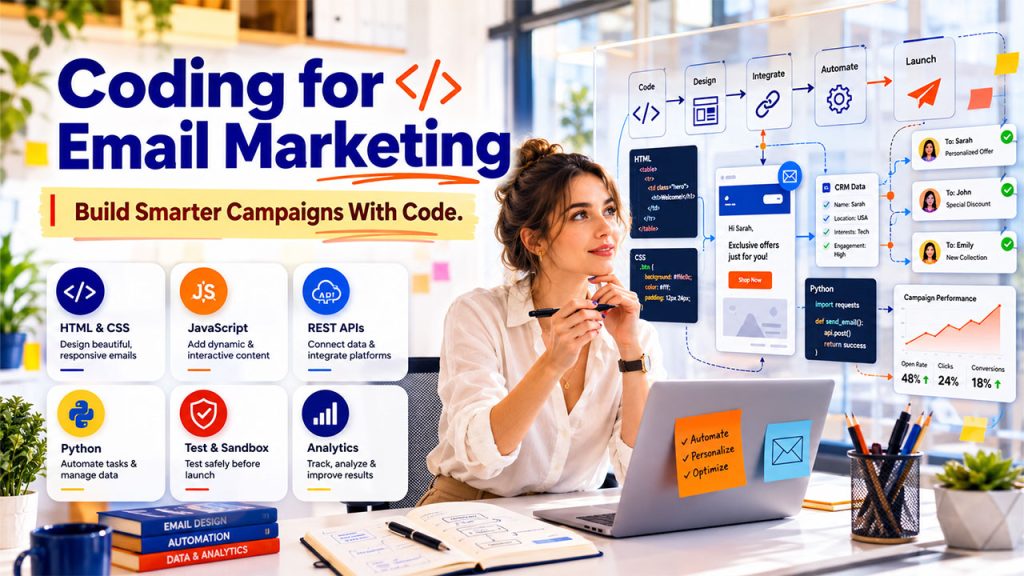
Marketers do not have to become full-stack developers to benefit from programming knowledge. A practical and focused learning path is an effective option that can be slowly built along with routine campaign work.
- Begin with CSS and HTML for layout control and email template personalization.
- Learn standard JavaScript for dynamic and interactive content blocks.
- Comprehend REST APIs for synchronizing data and connecting platforms.
- Explore JavaScript or Python for data management, automation scripts, or reporting.
- Ensure that you have practiced with a sandbox environment before making changes to live campaigns.
For organized learning, multiple top programming tutorials are available on the internet through paid and free coding courses specifically personalized to marketers, not just programmers. Such resources generally focus on practical use-cases relevant to campaigns instead of theoretical computer science concepts, making them simpler to instantly apply.
If handling such workflows independently feels outside the current skill set of the team or time-consuming, professional platforms providing Email Marketing Automation Service can execute custom automation logic on your behalf. This approach integrates technical expertise with marketing strategy, enabling businesses to benefit from sophisticated automation without investing months into learning a skill that is slightly outside your domain.
Conclusion
As email marketing automation continues to evolve, understanding programming for email marketing gives marketers a genuine competitive edge. From custom API integrations and conditional logic to AI-powered tools like Clawdbot and Email Automation, technical fluency enables smarter, faster, and more personalized campaigns. It also reduces reliance on external development support, allowing marketing teams to move quickly and test new ideas with confidence. Whether you choose to build these skills in-house or rely on a professional Email Marketing Automation Service, combining marketing strategy with technical know-how is quickly becoming essential for staying ahead in a competitive digital landscape.
Frequently Asked Questions
Do I need to learn coding to leverage email marketing automation platforms?
No. Most tools offer drag-and-drop builders, but programming knowledge helps with advanced customization, integrations, and troubleshooting when campaigns grow more complex.
Which programming language is most valuable for email marketing?
Python and JavaScript are one of the most commonly used languages for customization, scripting, and API integrations in email marketing workflows.
Can non-technical marketers still benefit from gaining coding skills?
Yes. Even standard knowledge of CSS, HTML, or JavaScript greatly enhances marketers’ ability of the marketers to personalize content, tailor templates, or resolve minor problems independently.
How does coding help with customization of email?
Programming enables marketers to extract dynamic subscribers’ data, like behavior or purchase history, and display tailored content blocks, enhancing engagement and relevance.
What is better: personally learning programming or hiring a professional service?
It depends on available resources and business needs. Smaller teams can benefit from learning the fundamentals themselves, while bigger campaigns generally benefit from a dedicated Email Marketing Automation Service for consistency and scalability.
How long does it take to learn enough programming for email marketing?
Most marketers can learn practical basics within a few weeks by focusing on HTML, CSS, and simple scripting, especially when learning through top programming tutorials designed for marketing use cases.