


 Continue with Google

 Share on media
In this Mailtrap Vs Mailgun Vs Amazon SES comparison, we evaluate deliverability, pricing, features, and ease of integration to help you choose the right SMTP server in 2026.
Mailtrap, Mailgun, and Amazon SES are three of the most common SMTP servers teams use to send transactional email in 2026. Each takes a different approach: Mailtrap ships deliverability infrastructure and analytics by default, Mailgun builds its whole pitch around flexible inbound routing, and Amazon SES hands you raw AWS building blocks at the lowest per-email price on the market. We compared all three on authentication setup, inbound handling, and real-volume pricing, pulling from each provider’s current docs and pricing pages as of September 2026.
Mailtrap Vs Mailgun Vs Amazon SES: Quick Comparison
This Mailtrap Vs Mailgun Vs Amazon SES comparison summarizes the key differences in pricing, sending capabilities, deliverability tools, and support to help you identify the best fit for your email infrastructure.
| Mailtrap | Mailgun | Amazon SES | |
| Best For | High inbox placement and detailed analytics | Regex-based inbound routing | Cost efficiency on AWS |
| Stream Separation | Native, every plan | Manual (subdomains/IP pools) | Manual (IP pools) |
| Free Tier | 4,000 emails/month | 100 emails/day | None (new accounts get $200 in general AWS credit, 6 months) |
| Starting Paid Plan | $15/month for 10K emails | $15/month for 10K emails | $0.16/1,000 (default Essentials plan); $0.10/1,000 on opt-in à la carte pricing |
| Dedicated IP | Included on Business plan, auto warmup | $59/month add-on | $24.95/month add-on |
| G2 Rating | 4.8/5 | 4.2/5 | 4.3/5 |
How To Choose An SMTP Server
Pick Mailtrap if you want an SMTP server with stream separation, automatic authentication upkeep, and analytics included by default, without stitching it together yourself. Pick Mailgun if your application needs conditional inbound routing, forwarding email to different endpoints based on regex rules rather than a simple parse-and-store flow. Pick Amazon SES if your stack already runs on AWS, per-email cost is the deciding factor, and your team has the engineering time to build bounce handling and monitoring on Lambda and SNS.
Each provider takes a different approach to email infrastructure, and comparing Mailtrap vs SendGrid vs Amazon SES can help teams understand the differences in deliverability, integration, analytics, and ongoing maintenance. Understanding these differences is essential when comparing Mailtrap Vs Mailgun Vs Amazon SES, particularly in terms of deliverability, inbound routing, analytics, and ongoing maintenance.
Mailtrap: Best For High Inbox Placement And Analytics
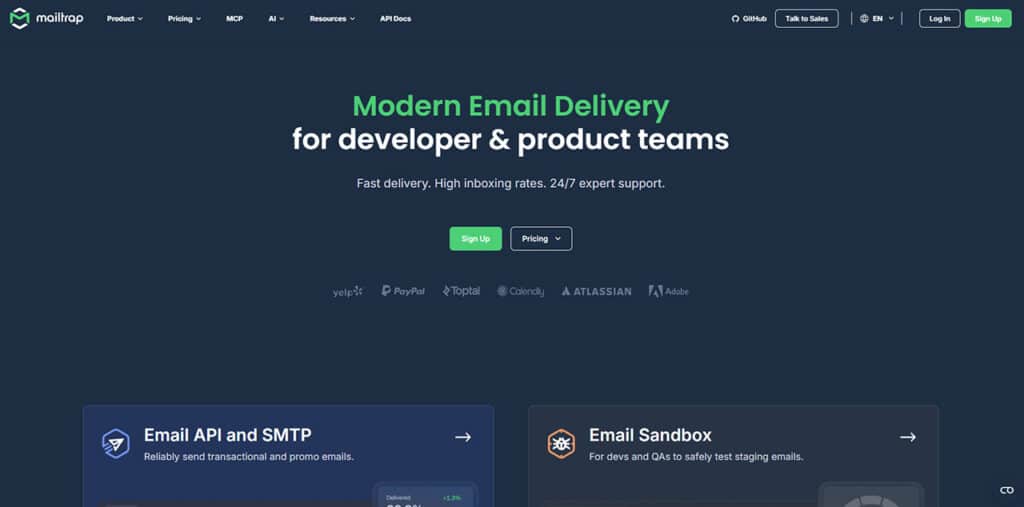
G2: 4.8
Mailtrap is an SMTP server built for developers and product teams that need high inbox placement and detailed analytics. Transactional and bulk traffic run on isolated sending streams by default, on every plan including the free one, so a marketing blast that trips a spam filter never touches the same reputation as your password reset emails.
SPF, DKIM, and DMARC configure automatically once the DNS records are in place, and DKIM keys rotate every month without anyone having to remember to do it. Sending works over both SMTP relay and a REST API, with dashboards that show delivery, opens, clicks, bounces, and spam complaints broken down by mailbox provider and sending stream.
Mailtrap holds ISO 27001, SOC 2 Type II, and GDPR certifications, runs on a 99.99% uptime SLA, and offers 24/7 live support on the Business plan and above.
Pricing: Free tier covers 4,000 emails/month (150/day cap). Paid plans start at $15/month for 10,000 emails, $85/month for 100,000 emails on the Business plan (includes a dedicated IP with automatic warmup), and $750/month for 1.5 million emails on Enterprise.
Where It Falls Short: Email only, no SMS or push. 24/7 live support and dedicated IPs are both gated to Business and above, so smaller teams on Basic get standard support hours and no owned IP reputation.
Mailgun: Best For Regex-Based Inbound Routing
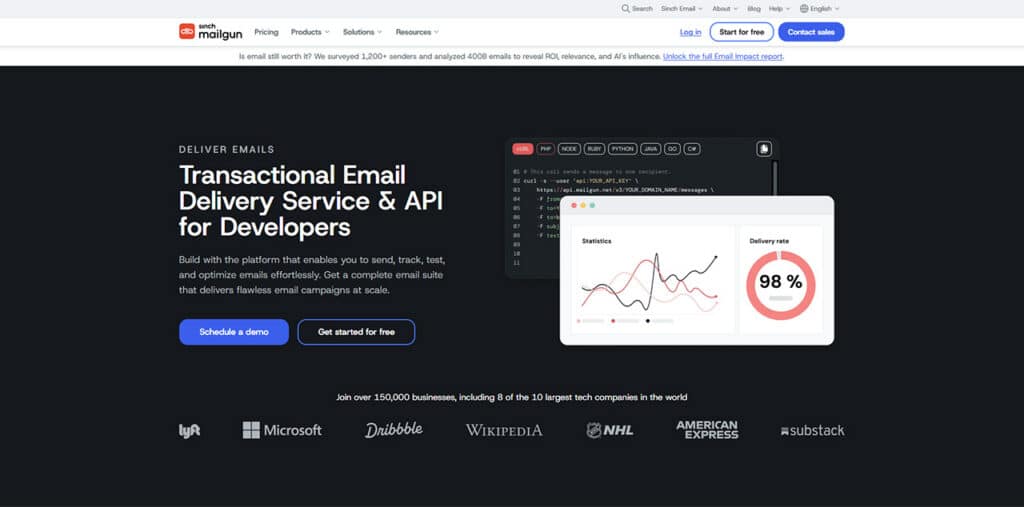
G2: 4.2
Mailgun is an SMTP server from Sinch built for teams that need flexible, regex-based inbound routing on top of standard transactional sending. Incoming email can be forwarded, filtered, or routed to different webhook endpoints based on regex patterns, which is the feature Mailgun leans on hardest.
SPF, DKIM, and DMARC need manual configuration, and stream separation between transactional and bulk mail runs through subdomains or IP pools you set up yourself. Sending works over both SMTP relay and a REST API, with a dashboard that shows aggregate delivery stats rather than a per-mailbox-provider breakdown.
Mailgun holds SOC 2 Type I and II, ISO 27001, HIPAA, and GDPR certifications, and support runs on tickets by default, with chat and phone support added on the Scale plan.
Pricing: Free tier covers 100 emails/day. Basic starts at $15/month for 10,000 emails, Foundation is $35/month for 50,000 emails, and Scale is $90/month for 100,000 emails with 5,000 email validations included (Basic and Foundation only get validations as a paid add-on). A dedicated IP runs $59/month.
Where It Falls Short: No permanent free tier beyond the 100/day cap, one-day log retention on the entry paid plan, and no stored inbox for teams that need to search past messages later.
Amazon SES: Best For Cost Efficiency On AWS
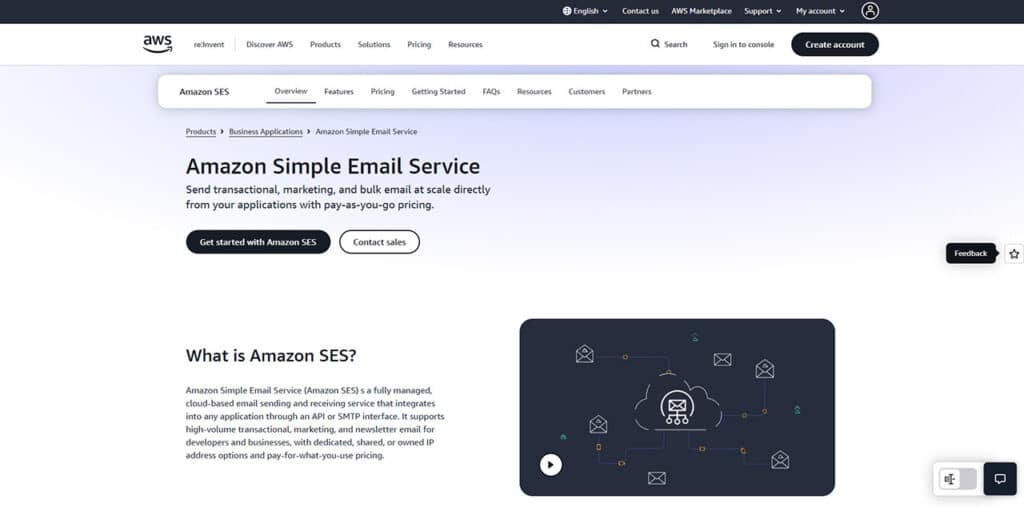
G2: 4.3
Amazon SES is an SMTP server built for AWS-native engineering teams that need the lowest per-email cost on the market. It ships as raw sending infrastructure rather than a managed platform, so bounce handling and suppression lists are pieces you largely assemble yourself using Lambda, SNS, and CloudWatch.
SPF, Easy DKIM, and DMARC are supported but need manual setup, and stream separation works the same way, through IP pools you configure on your own. Sending works over both SMTP relay and a REST API, and delivery, bounce, and complaint events arrive as SNS notifications rather than native webhooks.
Amazon SES holds SOC 2, ISO 27001, FedRAMP, and HIPAA-eligible certifications, which can carry weight in enterprise procurement, and support comes through separate AWS support plans rather than anything bundled in.
Pricing: As of July 2026, new accounts default to the bundled Essentials plan: $0.16 per 1,000 emails with no monthly fee, which now includes basic Virtual Deliverability Manager reporting. The classic pay-per-email model is still available as opt-in “à la carte” pricing at $0.10 per 1,000 emails, with dedicated IPs ($24.95/month), validation, and deeper VDM billed separately. There’s no email-specific free tier anymore; new AWS accounts instead get up to $200 in general AWS Free Tier credit, valid for six months across eligible services.
Where It Falls Short: No native bounce suppression and no native webhooks (bounce and complaint events route through SNS instead). Deeper deliverability reporting beyond the basic VDM bundled into Essentials still runs through paid VDM tiers, and building the missing suppression and webhook logic takes real engineering time.
Mailtrap Vs Mailgun Vs Amazon SES: Feature-By-Feature Comparison
| Feature | Mailtrap | Mailgun | Amazon SES |
| DKIM rotation | Automatic, monthly | Manual | Manual |
| Log retention | 3 to 30 days by plan | 1 to 30 days by plan | Basic CloudWatch metrics only |
| Analytics depth | Per-mailbox-provider drill-down | Aggregate stats | CloudWatch; basic VDM bundled on Essentials+, deeper VDM tiers still cost extra |
| Bounce/complaint delivery | Native webhooks, 40 retries | Native webhooks, 8-hour retry window | SNS notifications, no native webhook |
| Inbound email | Hosted inbox, no DNS setup | Regex-based routing to endpoints | Manual setup via SNS/Lambda |
| 10,000 emails/month | $15 | $15 | ~$1 (à la carte) / ~$1.60 (default Essentials plan) |
| 100,000 emails/month | $85 | $90 | ~$10 + add-ons (à la carte) / ~$16 (default Essentials plan) |
| Uptime SLA | 99.99% | 99.99% | 99.9% (AWS User Engagement SLA, covers SES) |
| Certifications | ISO 27001, SOC 2 Type II, GDPR | SOC 2 Type II, ISO 27001, HIPAA, GDPR | SOC 2, ISO 27001, FedRAMP, HIPAA-eligible |
| Support | Standard hours (Free/Basic), 24/7 (Business+) | Ticket-based, chat and phone on Scale | Separate AWS support plans |
Line up all three side by side and the pattern holds: Mailtrap bundles the most infrastructure by default, Mailgun trades some of that for routing flexibility, and Amazon SES gives up the most included infrastructure in exchange for the lowest possible per-email cost, provided you opt into its à la carte pricing rather than the newer bundled plans. Which trade-off makes sense depends on how much of that missing infrastructure your team is prepared to build.
Final Verdict: Which SMTP Server Should You Choose?
Choosing between Mailtrap Vs Mailgun Vs Amazon SES ultimately depends on your email volume, deliverability requirements, budget, and engineering resources. Mailtrap is a strong choice for teams seeking built-in deliverability tools and analytics, Mailgun suits applications that need flexible inbound routing, and Amazon SES works well for AWS-native teams prioritizing low sending costs.
For most teams weighing SMTP servers in 2026, the real question is how much infrastructure you’re willing to build yourself.
Mailtrap is the strongest all-around pick for teams that want native stream separation, automatic DKIM rotation, and included analytics without assembling any of it from scratch. Mailgun earns its spot when regex-based inbound routing is a hard requirement, and Amazon SES is the right call for AWS-native teams with the DevOps capacity to build what it leaves out.