












 Continue with Google

 Share on media
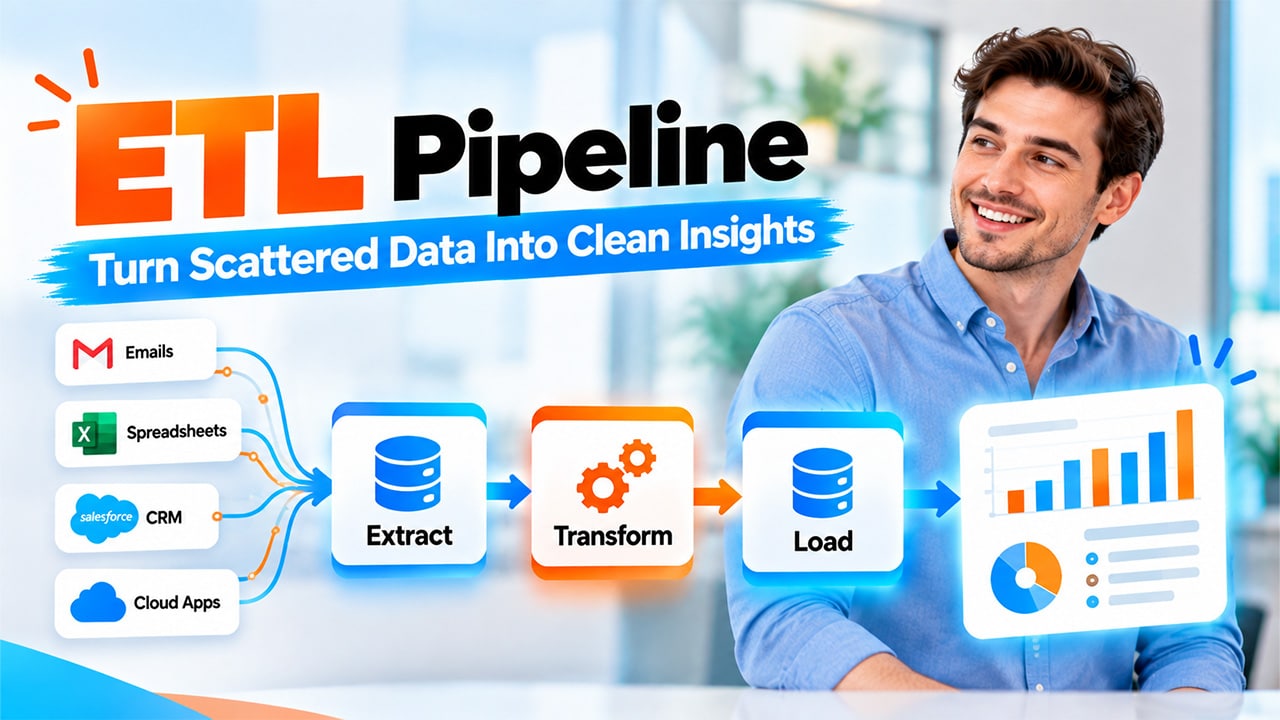
Every business nowadays works on data extracted from different systems such as marketing tools, CRMs, customer inboxes, and spreadsheets. However, the raw data existing in distinct formats across diverse platforms is only seldom useful on its own. This is exactly where an ETP Pipeline becomes vital. It is referred to as an organized process that collects scattered and messy data and converts it into something dependable to power analytics, reporting, and daily business decisions.
In this complete guide, let us understand what the role of an ETL pipeline is, how it works in a step-by-step way, and where it fits into daily business processes.
What Is an ETL Pipeline?
The ETL pipeline meaning directly comes from its acronym, which is: Extract, Transform, Load. An ETL pipeline can be defined as a set of automated processes that pulls data from one or more source platforms, converts it into a more usable and consistent format and loads it into a specific destination like data warehouse, database, or CRM platform.
Contrary to a one-time transfer of data, an ETL pipeline is established to run repeatedly, i.e., daily, weekly, or on scheduled batch. Thus, the destination system always showcases fresh and accurate data. This makes it a core building block for any business that relies on different data sources to make decisions.
How Does an ETL Pipeline Operates?
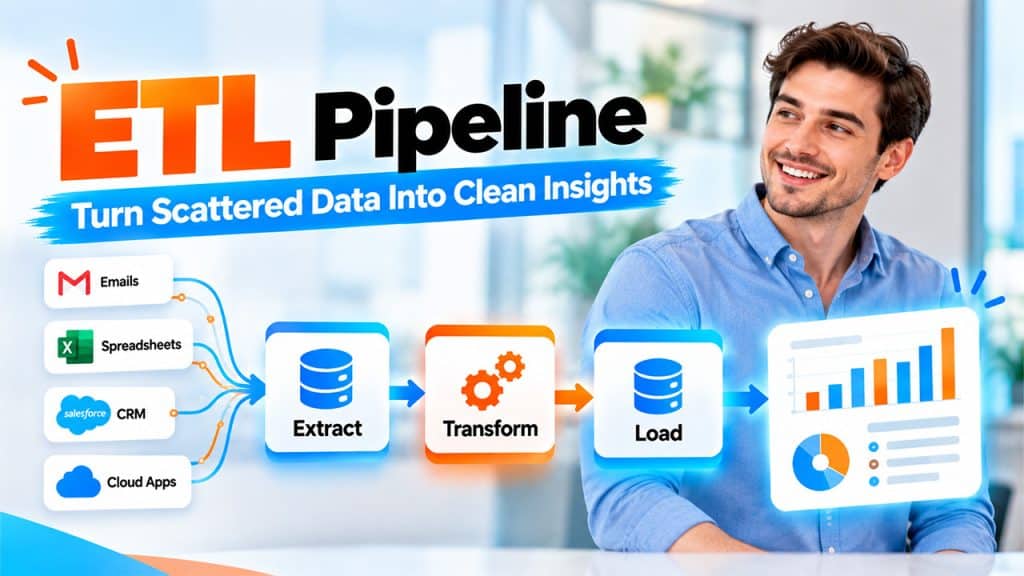
An ETL pipeline passes data through different stages. Every stage plays a particular role in ensuring that the final set of data is reliable:
- Extract: Data is collated from source platforms like NoSQL or SQL databases, CRM platforms, cloud applications, or email inboxes. Validate rules typically apply here to reject corrupted or incomplete records before they go forward.
- Transform: The extracted data is standardized, cleaned, and reshaped to align with the structure needed by the target system. This step may involve filtration, format conversion, deduplication, and applying business rules.
- Load: The converted data is provided into its final destination, i.e., data lake, data warehouse, or operational database, where it can be used for analysis and reporting.
Since the above three steps run in sequence and are often typically automated, an ETL pipeline eliminates the need for manual handling of data, which minimizes errors and saves great time for the data teams.
ETL Pipeline vs Data Pipeline: What Is the Main Difference?
The terms: data pipeline and ETL pipeline are typically utilized interchangeably. However, they are not the same. A data pipeline is a wider term for any process that goes from one system to another. An ETL pipeline is one particular type of data pipeline that always involves a transformation step before loading is done.
There are a few major differences that you need to know:
- Data pipelines do not transform data always; some just move it as-is or get converted after loading (a pattern also known as ELT).
- ETL pipeline processes often end once you have loaded the data into the target system, while data pipelines continue by causing downstream workflows or real-time alerts.
- ETL typically runs in scheduled batches, while wider data pipelines can provide support to real-time and continuous streaming.
Being aware of this difference is important when you are planning ETL process optimization, since the right approach depends on whether your business needs scheduled batch accuracy or real-time data movement.
ETL Pipeline Example and Common Use Cases
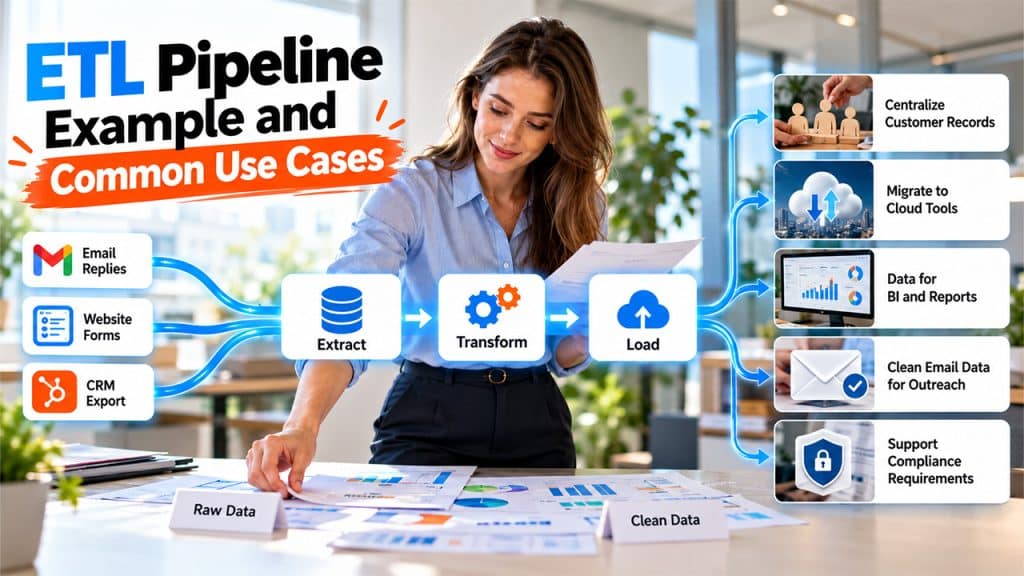
A straightforward ETL pipeline example aids in making the concept concrete. Consider a marketing team that collects leads via email replies, website forms, and a CRM export. An ETL process can fetch contact details from all three sources, standardize fields such as job title and email format, remove duplicate entries, and load the clean list into the CRM platform for the sales team to use.
You can apply the same pattern across different business functions:
- Centralize customer records from different support or sales tools into a single CRM system.
- Migrating information from a legacy platform to modern cloud tools.
- Once you prepare organized datasets for business intelligent tools and dashboards.
- Cleaning as well as standardizing bulk contact or email data before the outreach campaigns.
- Provide support to compliance requirements by eliminating sensitive fields before you have loaded the data.
Businesses that extensively depend on routine data-management tasks typically combine ETL with wider Business Process Automation Software, since both focus on minimizing manual work and enhancing consistency across repetitive workflows.
Why Is ETL Pipelines Significant for Evolving Businesses?
As companies evolve, the overall number of data sources they depend on often grows fast. Without an organized ETL pipeline, teams end up copying data manually between systems and spreadsheets, which enhances the risks of delays and errors. A pipeline, which is effectively built can solve this by:
- Building a reliable and single source of truth from different data sources.
- Minimize manual entry of data and the errors associated with it.
- Making huge volumes of data becomes usable for near-real-time or real-time analysis.
- Providing support to data-quality and regulatory needs through in-built validation steps.
Numerous businesses also tether their ETL workflows with Robotic Process Automation Software to automate data-entry tasks and repetitive extraction that would need manual effort otherwise, further minimizing the operational load on marketing and data teams.
Conclusion
An ETL pipeline is one of the most beneficial tools a business can utilize to convert inconsistent and scattered data into something valuable. By fetching the data from different sources, converting it into a standardized and clean format, and loading it into a central repository, businesses get a reliable foundation for reporting, analytics, and daily decision-making. Irrespective of whether you are centralizing customer data, creating data, generating reports, or automating routine workflows, a clean ETL pipeline ensures that your data remains updated, accurate, and ready-to-use.