


 Continue with Google

 Share on media

Introduction
In the digital landscape where efficiency is the key to gaining a competitive edge, businesses understand that manual or repetitive tasks are the actual cause of operational downgrades. That’s where task automation shines. Robotic Process Automation, or RPA, is a revolutionizing technology that redefines how businesses function, simplifies tasks, and eliminates manual work. Over time, RPA moves beyond simple task automation and integrates workflow management with AI to make intelligent automation (IA).
Technology has been continuously transformed through many phases, including cognitive automation, intelligent automation processing, and hyperautomation. And now we’re in the agentic process automation phase, where agents not only simply task but also analyze and collaborate across the systems. While the AI agents become the crucial aspect of business automation, most organizations often rely on RPA for their routine, rule-based work.
This comprehensive guide will explain to you what exactly robotic process automation software is, why it matters, how it works, and how to implement it into the workflow. Regardless of whether you’re a business owner exploring automation solutions or seeking to improve operational efficiency, you will get to know how RPA transforms your business process and provides you with a streamlined, automated workflow.
What is Robotic Process Automation (RPA) Software?
Robotic process automation, a software robot, is a technology that leverages artificial intelligence to automate repetitive, rule-driven tasks, like processing data, transferring files, and filling in digital forms. The technology helps businesses streamline complex operations, minimize errors, and remove manual work, enabling teams to focus on more valuable tasks. By mimicking human actions in digital systems, it ensures AI agents perform tasks quickly, reliably, and accurately with human-like speed and decisions.
However, many large-scale businesses have already leveraged RPA for over a decade, and it has evolved significantly. These technologies and tools are rapidly being used across a wide range of industries, use cases, and applications, delivering optimal results, cutting down costs, boosting productivity, and fostering digital transformation.
With the increasing adoption of artificial intelligence, RPA has gone beyond being a simple task automation tool and become an essential component of agentic automation. This means it is still an important phase of automation that uses intelligent automation (IA) to plan, scale, and make decisions independently. When comparing traditional automation that requires extensive coding and integration expertise, RPA offers user-friendliness and ease of use.
The Evolution of RPA: From Basic Automation to Agentic Automation
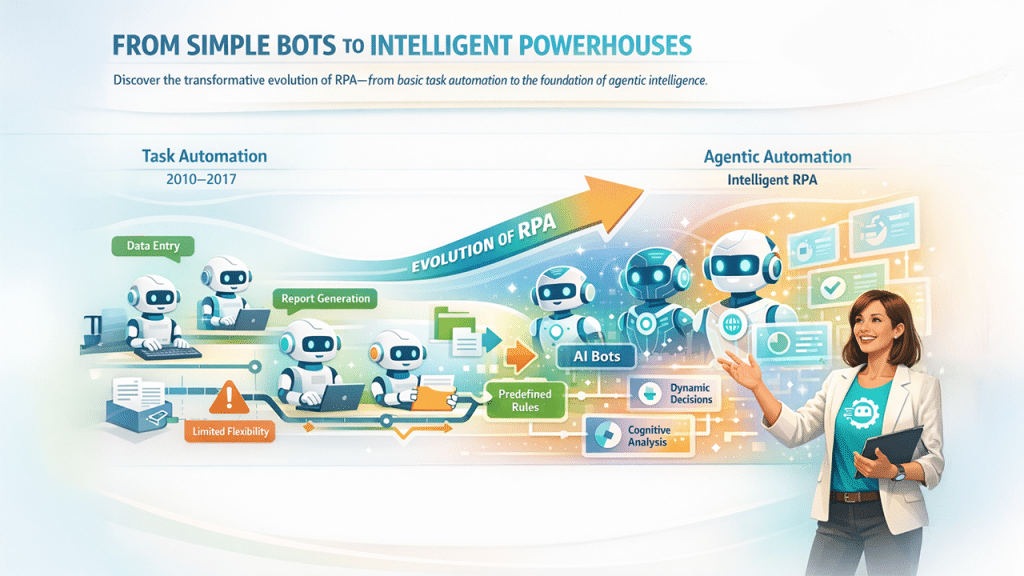
Understanding the evolution cycle of robotic process automation helps you contextualize its origin and evolutionary phases. The technology is not static; it has evolved through several different phases, each designed to improve the sophisticated automation capabilities.
Phase 1: Task Automation (2010-2017)
Robotic process automation is the first generation of this evolution cycle, which focuses on automating individual repetitive tasks. These software bots have simplified basic desktop actions, like data entry, file transfers, data copying, report generation, and clicking buttons in a predefined format. This phase represents RPA as a go-to alternative to conventional IT automation. Early adopters saw a rapid acceleration in task completion, from months of manual work to a few weeks, without massive IT overhauls and manual intervention.
Over time, they gained rapid traction across industries, especially in telecommunication and financial services, where high volumes of transactional data processing foster clear ROI. Despite its unprecedented role in business process automation, RPA lacks significant functionality, like bots being inefficient at managing errors, structured data, or vast adjustments in process flow.
Phase 2: AI Automation (2018-2022)
Later, RPA was integrated with artificial intelligence, machine learning, natural processing, and more sophisticated generative AI to make the next phase of automation: Intelligent Automation (IA). This robotic process automation software and machine learning integration helps analyze semi-structured data gathered from emails, images, and documents. NLP allows systems to extract text and interpretation from conversations, while computer vision lets bots see and analyze visuals on the screen, and predictive analytics forecast process efficiency.
This technological advancement enables businesses to streamline tasks that traditionally require human judgment, like invoice processing, document scanning, and email segmentation. This era also introduced more advanced RPA solutions like cognitive document automation (CDA), process mining, and hyperautomation.
Phase 3: Agentic Automation (2023-Present)
With the continuation of evolution, currently, automation reaches its third phase: agentic automation with the integration of agentic AI. This transformation shows a fundamental shift from traditional, rule-based bots to autonomous agents proficient in planning, reasoning, and smart decision-making. Agentic automation merges RPA with LLM (large language models), cutting-edge AI, and knowledge graphs to build systems that can interpret context, perform multi-step actions, and refine strategies based on results. This sophisticated collaboration of AI agents, RPA, and end-users enables precise execution of business processes across enterprise systems.
How Robotic Process Automation Works
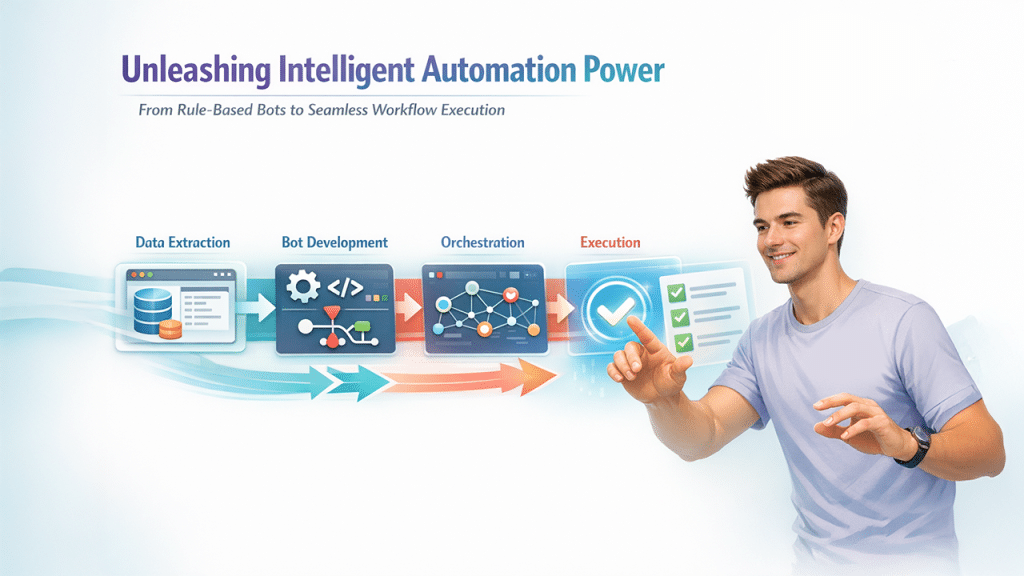
To leverage the full potential of RPA, it’s essential to first understand how these systems actually operate. Since the technology has advanced drastically, RPA remains accessible for various rule-based tasks. With RPA, businesses don’t need to re-execute legacy code and replace existing systems—they seamlessly execute tasks based on predefined rules, values, and capabilities. These automation technologies extract information through legacy systems, pass it across integrated applications, and execute insights that help businesses make informed decisions. This level of automation enables systems to automate repetitive tasks, transfer data across systems through copy-pasting, and click on buttons in predetermined sequences.
Modern RPA tools typically go through three main layers: Bot Development Layer, Orchestration Layer, and Execution Layer.
1. The Bot Development Layer
This is the first layer of robotic process automation functioning, where automation actually comes in. In this stage, RPA defines what the bots do, how they behave, and how they should tackle real-world challenges. With thorough analysis, management, and designing of action, decisions, and errors, so that the system should behave like a well-skilled human operator. Here, businesses and developers fragment complex processes into logical, actionable steps and convert them into data-driven insights that help bots make human-intelligent decisions.
Data Processing:
Data processing is the core element of determining the behavior of an effective RPA bot. They operate on structured and semi-structured data across diverse sources such as databases, emails, spreadsheets, CRM systems, or digital forms.
This phase involves:
- Data collection across multiple source systems
- Confirm the accuracy, relevancy and completeness of data
- Turn it into structured formats that the bot can understand and use
Ensuring efficient data management is crucial for bots to make informed decisions, prevent duplicacy, and maintain data credibility throughout the process.
Integrate with Existing Processes
The process mapping layer creates a perfect sequence of actions that the bot should perform from start to finish. This includes finding the trigger points that begin the automation, mapping out detailed task execution sequences, and determining rules for bot behavior in different scenarios. Additionally, robotic process automation (RPA) ensures efficient management of exceptions and various error conditions, whether standard cases or unexpected inputs.
Designing the Bot
As soon as the workflow is outlined, RPA tools move to the development phase, where the bot is designed with predefined rules, workflow, and conditions. The bots are designed to streamline complex, repetitive tasks, such as scanning and extracting data, clicking buttons, and navigating interfaces. Before launching the bot, the tools tested it thoroughly to detect potential errors and ensure accuracy, reliability, and compliance to meet the business needs.
2. Orchestration Layer
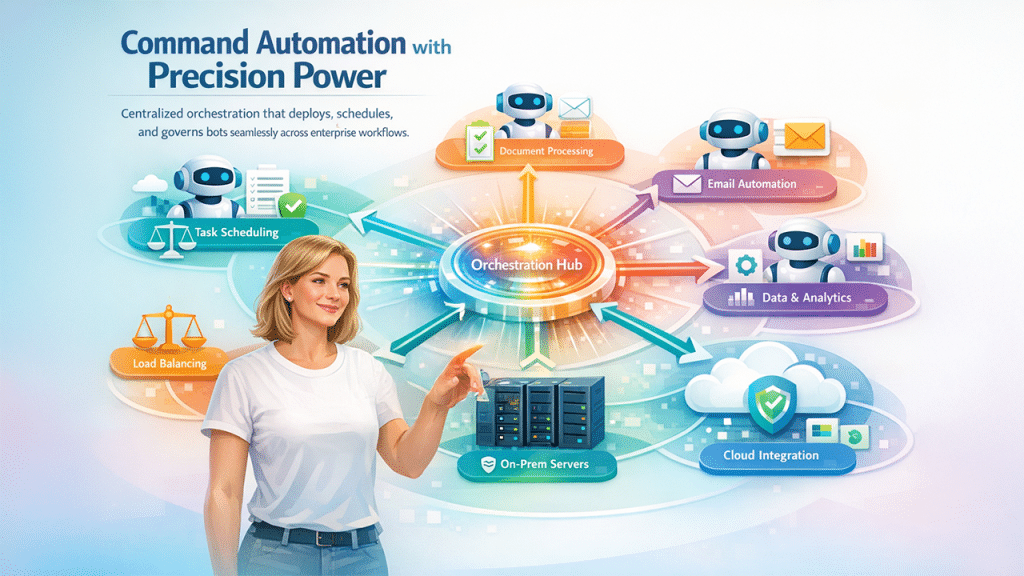
The orchestration layer is performed as a centralized hub for RPA infrastructure. This layer takes care of the deployment, scheduling, and coordination of bots across different processes and workflows. The orchestration layer is responsible for assigning tasks to the right bots, distributing workloads, managing accessibility, and enabling unified control and governance. This ensures bots execute the right tasks at the right time, in the right ecosystems without disruption, especially for large-scale enterprise automation.
3. Execution and Monitoring Layer
This is the last stage of RPA tools, where bots perform action in real time, and performance is monitored continuously. This layer provides complete visibility into deployment status, success and failure rates, error logs and exception handling, and process completion timeline. Meanwhile, tracking tools let teams identify challenges promptly, refine performance, and consistently deliver optimal business outcomes. Whereas instant notification and live dashboard view help maintain operational stability without compromising the flow of automated processes.
Types of Robotic Process Automation
Robotic process automation (RPA) software consists of mainly three kinds of automation categories: Attended, Unattended, and Hybrid Automation.
1. Attended Automation
Attended Automation triggers when humans enter an input or a command to help individuals streamline their tasks. This automation assists human personnel in operating their business processes, such as data processing, customer services, and IT operations, in real time. In simple terms, this is only performed on operations where human oversight is often required across devices and systems.
2. Unattended Automation
Unattended Automation triggers automatically through programming and data inputs from multiple sources, with no manual intervention. This type of automation in robotic process automation is performed to streamline operations where human oversight is not required, like back-office operations, data entry, and IT operations.
3. Hybrid Automation
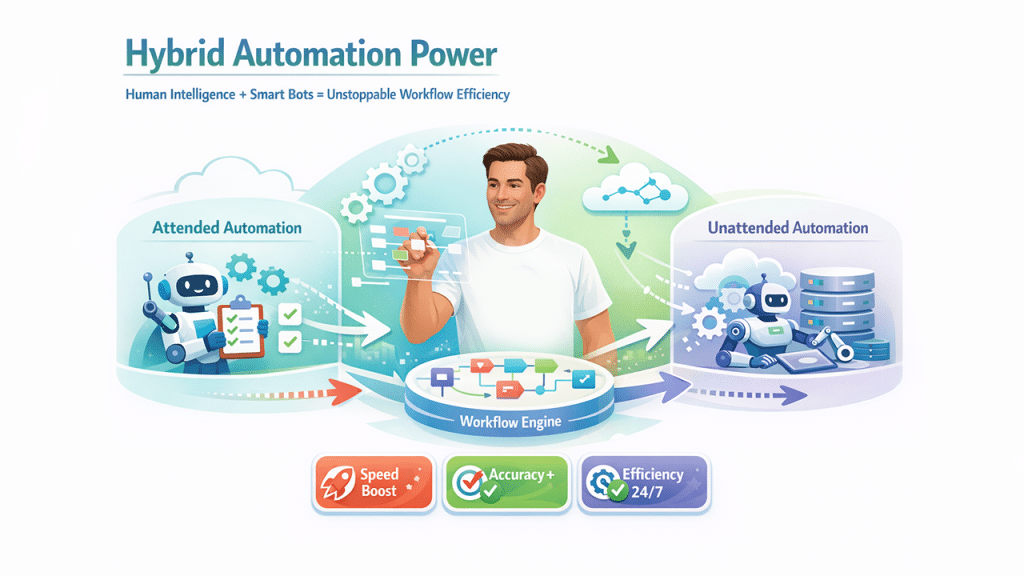
This is the combination of attended and unattended RPA automation, where human workers leverage automation to perform a task and operation. This automation is widely adopted by businesses to simplify even complex workflows with enhanced speed, accuracy, and efficiency.
How RPA Benefits Businesses
Improved Efficiency: By automating the tasks and processes, the risk of human error also decreases dramatically. It offers consistent execution of a high volume of operations, enabling businesses to optimize their workflow efficiency, boost productivity, and deliver greater ROI.
Refine Accuracy: This reduction of human intervention also reduces the inefficiency rate. AI bots rely on predefined rules and processes to perform a chore, which ensures greater precision in the executed work.
Better Customer Experience: Shifting from a manual, time-consuming workflow to a smart, automated ecosystem leads to saved time, improved customer satisfaction, and increased retention.
Greater ROI: Consequently, a greater customer experience drives optimal business growth and success. This automation of tasks minimizes labor costs and frees up teams to focus on more productive and high-value tasks.
Conclusion
Robotic Process Automation software has transformed dramatically from simple task automation tool to a vital component of advanced intelligence and agentic automation strategies. As AI has rapidly evolved, RPA remains the foundation of rule-driven, high-volume task deployment across businesses. Consequently, businesses can efficiently simplify tasks, eliminate costs, improve accuracy, and boost overall operational efficiency without compromising performance.
Every robotic process automation example represents its capabilities to eliminate human intervention while improving speed, accuracy, and consistency. However, RPA is not only about streamlining repetitive tasks but also about creating scalable, futuristic operations that foster teams to focus on refining strategies and offering enhanced customer experiences.
Read also: What Is Sapphire Bot? Features, Uses, and Everything You Need to Know
Frequently Asked Questions About RPA
What is Robotic Process Automation?
In simple terms, robotic process automation is a kind of technology that leverages virtual bots to perform tasks based on pre-defined rules, often utilized to automate repetitive tasks, like file exchange, data entry, and filling in forms.
What are the different types of robotic process automation?
Primarily, RPA comes with three main types, attended, unattended, and hybrid. While all these RPAs are designed to streamline rule-based repetitive tasks, they differ by their dependency on human and AI automation.
How does RPA differ from artificial intelligence?
RPA technology differentiates itself from artificial intelligence with its rule-based task automation approach, while AI mimics human intelligence to analyze, manage, and perform specific tasks.