
 Continue with Google

 Share on media
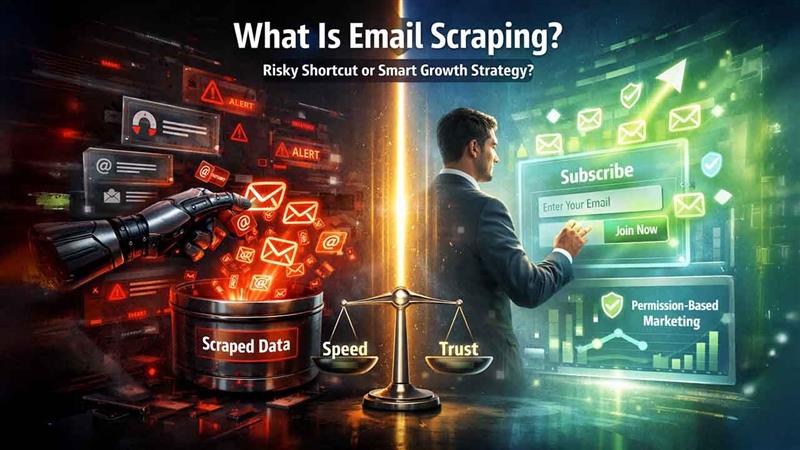
Everybody wants to grow their business in this competitive internet-first world. Imagine a startup founder looking at an empty CRM dashboard. He is not getting any leads or subscribers. Then someone whispers a shortcut of scraping emails from the web. It enables faster growth and instant outreach without any delay. However, this shortcut raises a deeper question — what is email scraping and whether it’s a smart growth strategy or a risky gamble in this growing privacy-first world?
Email scraping sits at the intersection of ambition and ethics. It promises to scale growth, but it comes with consequences. To fully understand whether it is safe to use in a modern growth strategy, let’s unpack what it really is, why businesses use it, its benefits, associated risks, and how it compares to legitimate email marketing.
What Is Email Scraping? How It Really Works
Email scraping refers to the automated process of extracting email addresses from multiple sources such as websites, online directories, social media platforms, forums, and public databases. This process is closely related to how web scraping works, where tools systematically scan and extract specific data from web pages. Email Parsing, on the other hand, focuses on analyzing the content of emails and extracting specific information from messages into structured data. Instead of using standard methods of collecting emails through opt-in forms or sign-ups, email scraping tools scan web pages to detect email addresses that can be used for various marketing purposes.
Here’s how email scraping typically works:
- A scraping tool or bot scans web pages.
- It identifies patterns that match email formats (like name@domain.com).
- It extracts those email addresses.
- The data is compiled into a list for outreach or marketing use.
- The list is often exported into a CRM or email platform.
The technology behind scraping can range from simple browser extensions to sophisticated AI-powered software automation. Some tools gather email addresses by scraping company websites while others scan LinkedIn profiles, online listings, or directories. In terms of technicality, it’s not complex. However, strategically and legally, it lies in the grey area.
Why Businesses Use Email Scraping
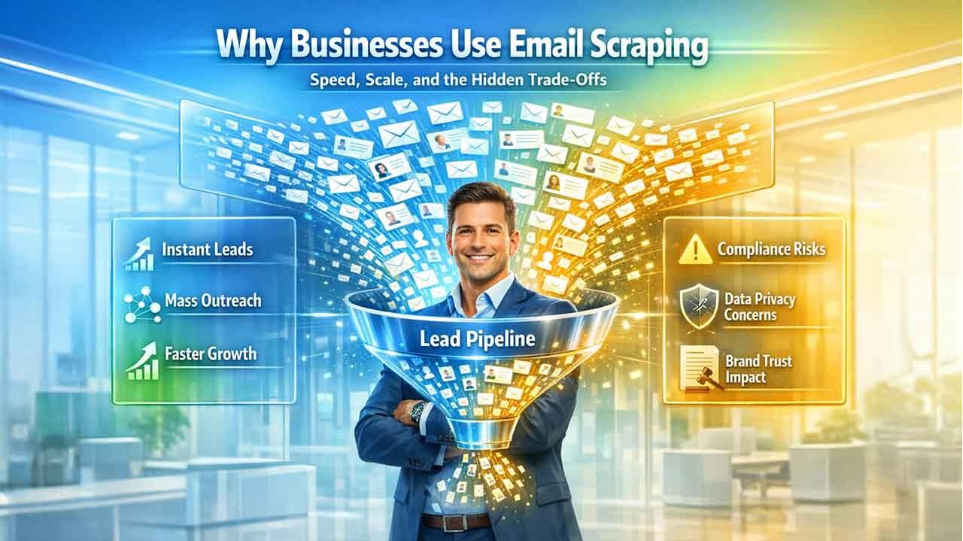
In this competitive market, businesses are constantly trying to find faster ways to score leads and expand their reach. Email scraping offers that speed. It provides:
- Immediate access to contact data
- Large-scale capabilities for outreach
- Reduced dependency on paid advertising
- Faster pipeline building
Sales-driven organizations or startups fall for this temptation. They do not wish to wait months to build an audience organically when scraping tools offer a shortcut to thousands of potential contacts. But shortcuts often come with trade-offs.
Key Benefits of Email Scraping
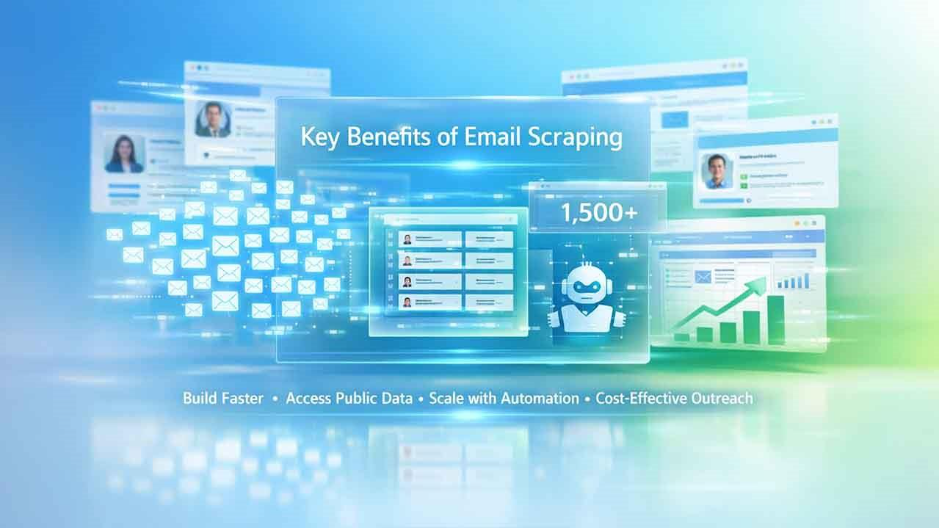
It is essential to acknowledge why scraping continues to attract business to fully understand what email scraping is. The below discussed are benefits of email scraping:
Rapid Email List Building
With scraping emails, businesses can build large contact lists in a short duration. They don’t have to spend months nurturing organic methods of sign-ups or form submission. Scraping tools can generate hundreds or even thousands of email addresses within a few days. This speed attracts new businesses who want instant outreach capacity.
Access to Publicly Available Contact Data
Email scraping allows businesses to quickly gather contact details that are publicly listed on websites and directories. This creates the perception of faster market reach without investing time in building opt-in funnels. For teams focused on rapid growth, this broader visibility can seem like an easy expansion opportunity though it comes with important considerations.
Scalability Through Automation
There are several modern scraping tools available in the market that can operate at scale. Automated bots are designed to scan multiple websites simultaneously. They also extract data and organize it into structured databases. This automation significantly saves time by reducing manual effort and allowing organizations to expand their outreach operations quickly.
Cost Efficient for Startups
Email scraping appears to be cost effective when compared to paid advertising campaigns. Businesses prefer to use software tools to directly gather contacts instead of investing in content marketing, ads, or lead magnets. This can be advantageous for small and budget-conscious teams.
Scraping can feel like a growth accelerator for aggressive outbound sales teams. However, on-surface benefits do not always give sustainable results.
Risks of Email Scraping You Should Know
On-surface level, the above discussed benefits of scraping may seem efficient, but it introduces serious technical, legal, and reputational risks. Here are the key challenges that email scraping poses:
Legal Risks and Compliance Issues
Email scraping can expose businesses to legal risks, especially in those regions where data protection regulations are strict. Companies may face fines or legal disputes if they use scraped emails for unsolicited marketing purposes without acquiring proper consent.
Spam Complaints and Blacklisting
When recipients receive unexpected bulk emails, they are more likely to mark or report them as spam. Sender’s reputation can take a hit due to high spam complaint rates. This may become a slippery slope over time and affect email deliverability as even legitimate campaigns may fail to reach inboxes. Additionally, this can also result in domain or IP address blacklisting. Once blacklisted, emails may be automatically blocked by major email providers. Recovering from blacklisting can pose challenges and is a time-consuming process.
Poor Data Accuracy
Scraped email lists often contain addresses that are outdated, incorrect, or inactive. Sending emails to invalid contacts contributes to increased bounce rates and it can further harms sender credibility. Additionally, inaccurate data also reduces the effectiveness of campaigns and waste resources.
Brand Reputation Damage
Brand reputation damage is one of the major risks of email scraping. Unsolicited and frequent outreach can negatively impact brand perception. In this rapidly evolving digital world, consumers increasingly value privacy and transparency. When they find business or marketing emails intrusive, they perceive them as dangerous and a violation of privacy.
Privacy Concerns
Modern users are more aware of how their data is collected and used. Scraping email addresses without explicit consent may conflict with evolving privacy expectations. As data protection awareness grows among digital users, their tolerance for unsolicited communication continues to decline. What begins as a growth shortcut can quickly become a deliverability nightmare.
Is Email Scraping Legal in 2026?
This is one of the most searched questions surrounding the topic: is email scraping legal? The answer depends on context, location, and usage. There are many regulations that govern digital communication and data privacy like GDPR (General Data Protection Regulation) in the European Union, CAN-SPAM Act in the United States, and CCPA (California Consumer Privacy Act). These laws prioritize consent, transparency, and responsible data handling.
Public Data vs Consent
There is a common misconception that if an email address is publicly visible then it can be used for marketing without asking for consent. However, this visibility doesn’t necessarily imply this. There are several data protection laws that focus not only on how data is collected but also on how it is being processed and used.
Legal Gray Areas
Although some non-commercial research involving scraping may fall into less restrictive categories; the risk of legal trouble increases when scraped data is used directly for marketing without consent. So, companies must carefully evaluate how they plan to use scraped email addresses before proceeding.
Enforcement and Risk
Regulatory enforcements are getting better at stepping in. Now they are looking into how data is misused and the practice of unsolicited communication. Businesses that rely on scraped email campaigns may face financial penalties along with reputational consequences.
Key Differences: Email Scraping vs Email Marketing
To truly understand the strategic implications, we must compare email scraping vs email marketing. Though they both involve email outreach, they operate on fundamentally different principles. Here’s the difference:
| Email Scraping | Email Marketing |
| Extracts emails without explicit permissions | Builds lists through consent-based opt-ins |
| Focuses on speed and scale | Prioritizes relationship building |
| Often results in cold outreach | Emphasizes value-driven communication |
| Higher risk of spam complaints | Higher deliverability rates |
| Lower trust and engagement risks | Stronger long-term brand trust |
Email marketing is sustainable. It nurtures those subscribers who want to hear from you. Scraping, by contrast, often disrupts relationships rather than building them. The difference is not just technical; it’s philosophical.
The Ethical and Strategic Question
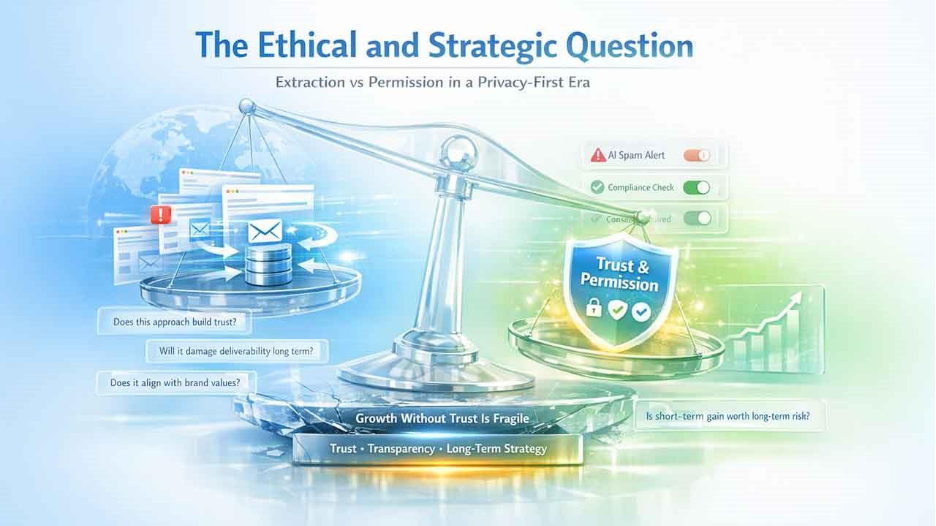
Beyond legality lies a deeper question: should businesses rely on extraction rather than permission? The internet is evolving towards greater transparency and user control. Modern consumers expect privacy and transparency from brands. Data protection regulations are expanding globally while AI-driven systems detect spam more effectively than ever.
Scraping may appear outdated in this digital landscape. Yes, AI can now automate scraping at scale. But AI also powers spam filters, compliance checks, and privacy enforcement. The same technology that makes scraping easier also makes misuse easier to detect. Growth without trust is fragile. That’s why business must strategically ask:
- Does this approach build trust?
- Will it damage deliverability in the long term?
- Does it align with brand values?
- Is short-term gain worth long-term risk?
Final Thoughts: Should You Use Email Scraping?
Understanding email scraping requires more than a technical explanation; it demands a strategic and ethical perspective. While scraping offers speed, scale, and automation, it also introduces significant legal, reputational, and operational risks. The comparison between email scraping vs email marketing highlights a fundamental difference: extraction versus permission. In today’s privacy-conscious digital environment, sustainable growth depends on trust, transparency, and consent. Businesses that prioritize responsible data practices are more likely to build long-term relationships, protect their brand reputation, and thrive in an increasingly regulated online landscape.
Frequently Asked Questions
What is email scraping in simple terms?
Email scraping is the automated process of collecting email addresses from websites and online platforms without users directly providing consent through sign-up forms.
Is email scraping legal?
The legality depends on how the data is used and local regulations. In many regions, using scraped emails for unsolicited marketing can violate privacy and anti-spam laws.
Is email scraping ethical?
Ethically, scraping raises concerns because recipients often have not granted permission for their data to be used for outreach. Permission-based communication is generally considered more ethical.
Email scraping vs email marketing: what’s the difference?
Email scraping collects emails without consent for outreach. Email marketing builds lists through voluntary subscriptions and focuses on long-term engagement and trust.
Can email scraping hurt my business?
Yes. It can lead to spam complaints, blacklisting, legal risks, and brand reputation damage if not handled carefully or used improperly.